
Equal parental responsibility is failing children, inquiry hears

family-courtAustralia’s family law system is failing to protect children by misleading separated parents into believing their children have to spend time with their ex-partner, even if they are dangerous, one of the nation’s largest children’s charities has warned.
Save the Children Australia chief executive Paul Ronalds said in his organisation’s submission to the parliamentary inquiry into family law that “Australia’s family law system is still not dealing with child protection issues adequately or appropriately”.

Separated parents are entitled to a presumption of “equal shared parental responsibility” under Australian law, which means courts start from a presumption that each parent gets an equal say in major decisions about their children, not equal time with them.

But the Australian Law Reform Commission, which delivered a major report on the family law system last year, found the provision was being misinterpreted to mean both parents should see the child for the same amount of time.

“The widespread nature of that misunderstanding has a number of effects, including leading unrepresented parties to believe they have no choice but to agree to equal time and to enter into informal agreements based on a misapprehension of the law,” the ALRC said in its final report.

Mr Ronalds said: “The presumption is harming children by leading to them being placed in contact with parents where such contact is unsafe.”

The presumption does not arise in cases of abuse or violence, but Mr Ronalds said the family law system was also bad at evaluating those claims.

“Our concern is that the system is still failing to listen to the very people it is entrusted to represent and protect – children,” Mr Ronalds said.

The family law inquiry, one of several recent examinations of the contentious area of law that governs topics including what happens to children when a couple gets divorced, was established by the government in September after pressure from One Nation leader Pauline Hanson.

Professor Patrick Parkinson, a family law expert and dean of the University of Queensland law school, said for the inquiry to be effective, it had to build on dozens of other family law reviews that had been left to gather dust.

“A vast number of reports have been written about the family law system over the last 20 years,” Professor Parkinson said in a submission to the inquiry. “Some reports get no governmental response at all. Others are cherry-picked.

“There is no reason to believe that the report of this committee will suffer any different fate from the previous ones unless it offers a thorough review of the many wise recommendations that have been previously made, and thereafter not implemented.”

The ALRC’s report from last year cites 22 state and federal government-sponsored reports on different aspects of family law in the past decade.

The inquiry is due to report in October 2020.

‘Do not resuscitate’ tattoo creates medical dilemma: What would Australian doctors do?

do-not-resuscitate-tattooThe man arrived at the hospital unconscious, without identification, with a high blood alcohol level.

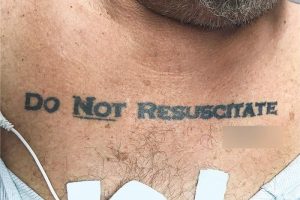
He was 70, had a history of lung disease, heart problems and diabetes, and three words tattooed in big, black letters across his chest: “Do not resuscitate”.

Doctors at the Jackson Memorial Hospital in Miami, Florida weren’t sure how to proceed.

The message on his chest was clear, and has his (presumed) signature underneath, but they had no way of knowing if the tattoo was sincere, or done impulsively.

Efforts to contact the man’s next of kin were unsuccessful. Doctors administered some treatment to increase his level of consciousness, but he never become responsive enough to speak and discuss his end-of-life wishes.

“We initially decided not to honour the tattoo, invoking the principle of not choosing an irreversible path when faced with uncertainty,” they wrote in a letter published in the New England Journal of Medicine on Thursday.

“This decision left us conflicted, owing to the patient’s extraordinary effort to make his presumed advance directive known; therefore, an ethics consultation was requested.”

After reviewing the case, the ethics consultants advised the doctors to honour the man’s “do not resuscitate” tattoo.

“They suggested that it was most reasonable to infer that the tattoo expressed an authentic preference … and that the law is sometimes not nimble enough to support patient-centred care and respect for patients’ best interests,” they wrote.

The man’s health deteriorated, and he later died, without being resuscitated.

Before he died, medical staff discovered he had in fact filled out a form in advance expressing his end-of-life wishes, which were consistent with his tattoo.

What would happen in Australia?

Different state and territories have different laws when it comes to advance care planning and legal directives.

There are, however, common principles, including respecting the right of an adult who has the mental capacity to plan in advance for their health care.

“The community ethic is that the autonomous decision of the patient should be heeded by a medical team,” said Ian Olver, oncologist and bioethicist at the University of South Australia.

“But you’ve got to be able to actually ascertain what that decision is.”

To do this, under common law, doctors must be satisfied of three things: that a person was competent when they made the directive; that it was an informed choice; and that it applies to the situation they’re currently in.

“The doctor has to try and determine what the patient’s wishes are … so in this case, looking for relatives, looking for their GP, looking for documentation to try and reinforce the directive was a very sensible thing to do,” Professor Olver said.

While doctors as Jackson Memorial Hospital sought advice from a medical ethics team, Professor Olver said that was unlikely to happen in Australia.

“A lot of the hospitals have treatment ethics committees where they set ethical policy. But it is uncommon for there to be an ethicist on call for a situation like this.”

Professor Olver said it was more likely doctors would have to make a decision, especially in emergency situations.

“You’ve got to make a call, and if there’s sufficient uncertainty, I think the call might be to do what you need to do medically, and you sort it out later.

“But in other cases where, perhaps the chance of ‘[successful] resuscitation is very small and the patient’s wishes seem to be clear, the ethos of the community is to heed the patient’s wishes,” he said.

Making end-of-life wishes clear

While uncommon, Professor Olver said the US case was worth examining to see what improvements could be made to advance care planning processes.

“It highlights where we perhaps need to do better, to make sure patient’s wishes are known and communicated,” he said.

Making an advanced care plan is a good place to start, and it’s important to be specific, and to disseminate it widely, he said.

“It’s worth your GP knowing if there is a copy, and certainly relatives ought to have a copy.”

10 Ways an Ex Can Hide Money From You

Financial abuse is a common issue for many ex-couples after separation and through the family court.

In the midst of separation or divorce, some male and female ex-partners go to extreme lengths to hide money in order to reduce their future liabilities to the other parent/ex-partner or children of the relationship.

Below are 10 common ways an Ex can hide money from the other party

  1. Depositing money in trusts or in children’s accounts that the other parent has no control over
  2. Manipulating joint Self-Managed Retirement Funds
  3. Drawing money on a redraw mortgage
  4. Declaring bankruptcy to avoid payment
  5. Minimising income by deferring salary or bonuses until after settlement
  6. Minimising bank account balance by ‘lending’ money to friends, overpaying creditors (credit cards, tax, etc.) or buying expensive items that can be sold later
  7. Stockpiling cash
  8. Hiding personal assets via a complex web of companies
  9. Using trust structures
  10. Hiding funds in offshore foreign bank accounts

Special Note about non-disclosure in Family Court

The Family Law Act requires full and frank disclosure of the financial affairs of both partners who have to swear an oath and set out a complete statement of income, expenses, assets, financial resources and liabilities.  The duty of disclosure is ongoing, so if there are changes in parties situations or facts come to light that were hidden even years after orders were made, then it can be a basis for asking the Court to change orders. The court in recent years has been very harsh on people who have not fully and frankly disclosed their proper financial position.

Special Note on Hidden Asset Search

A hidden asset search involves the use of a forensic accountant or private investigator who can undertake certain searches to help uncover the true status of your spouse’s assets. There are three main assets searches that can be performed: a Brokerage Account Search; a Bank Account Search, and a Public Assistance Search. The Brokerage Account Search is used to locate any stocks, bonds or securities that may be owned; a Bank Account Search can locate all bank accounts the person may have in their name and which bank they are with, and a Public Assistance Search can identify any payments or benefits the person may be receiving from government departments such as Centrelink or Family Assist.

Finding where the money has gone

If you have grounds to suspect your ex-partner has hidden a lot of money and other assets, you could use a forensic accountant to assist you to find it. This service can be expensive, but the accountant should be able to advise whether it is worth pursuing. You can also enquire about a ‘no win, no fee’ arrangement. Forensic accountants work alongside your lawyer. Find a forensic accountant through your lawyer, or search the Certified Practicing Accountant Australia website.

Australian man faces jail in Japan while searching for his abducted children

Freelance-journalist-Scott-McIntyre-with-his-two-children-in-Japan

Freelance journalist Scott McIntyre with his two children in Japan.

An Australian man faces the prospect of three years in jail in Japan after a desperate bid to track down his two young children, who were taken by their mother in May without his consent.

Scott McIntyre, an Australian freelance journalist based in Tokyo, has been charged with illegal entry, which under Japanese law carries a maximum penalty of three years in jail, or 100,000 yen ($1327).

“I’m desperately worried for Scott’s future,” said Mr McIntyre’s mother Lynne. “He’s been through so much already. If he gets three years it will completely destroy him.”

Mr McIntyre, 45, has been living in Tokyo with his wife since 2015. After the breakdown of their marriage, the children went to stay with their grandparents for a night and never returned.

Friends say he has not heard from his wife or children since and does not know their whereabouts. Mr McIntryre’s wife did not respond to requests for comment.

In late November, Mr McIntyre allegedly gained access to the apartment block where his parents-in-law live. It’s thought he then knocked on their door, requesting information about his children.

The police were called and he was arrested. Since then, Mr McIntyre has been held in Takaido detention centre, in west Tokyo, where he is allowed one shower every five days. His cell is lit for 24 hours a day and he cannot wash his clothes.

“He gets one 20 minute visit a day,” said friend Catherine Henderson, who visits him regularly.

“We take stuff for him like clothes and books, but they are often refused. There is no privacy, even for the toilet.”

Mr McIntyre was sacked as a sports reporter by SBS in 2015 after he published tweets about Anzac Day which were deemed “inappropriate” and “disrespectful” by then SBS boss Michael Ebeid and then communications minister Malcolm Turnbull.

He commenced unfair dismissal proceedings against SBS and the parties settled in 2016.

Japan is one of the few developed nations in the world that does not recognise joint custody upon separation. Even if a court order does provide for shared custody, visitation rights are routinely ignored.

Scott McIntyre says he has not seen his children since his wife took them to stay with their grandparents in Japan.

Scott McIntyre says he has not seen his children since his wife took them to stay with their grandparents in Japan.

There are no official figures, but it’s thought up to 20 children every year are snatched from Australia and taken to Japan without the consent of one parent.

“Worldwide, the figure is closer to 1150,” said child recovery expert Colin Chapman.

“Japanese law makes it very hard to get those children back, which is why Japan has become known as a black hole for child abduction.”

Japan is a signatory to the Hague Convention on the Civil Aspects of International Child Abduction, which provides a legal process through which a parent can seek to have their child returned to their home country.
But Japan has been widely criticised for non-compliance. In any case, the convention only applies to international abductions. It is of no help to Mr McIntyre, whose children were abducted within Japan.

Embassy officials have visited Mr McIntyre in detention. It’s expected he will face court in January. Prime Minister Scott Morrison will also be in Japan in January, to discuss a defence cooperation agreement.

“While he’s there we’d like the Prime Minister to raise this issue of child abduction with the Japanese government,” Mr McIntyre’s father Laurie said.

“Scott’s not the only person this has happened to. Other Australian kids have gone missing in Japan. Someone has to do something about this.”

Psychologist’s misconduct raises questions about family court expert witnesses

Perth-based psychologist Darryl Menaglio accepted a professional misconduct finding over a report he prepared for a custody case at the Western Australia Family Court.

Perth-based psychologist Darryl Menaglio accepted a professional misconduct finding over a report he prepared for a custody case at the Western Australia Family Court. Picture: Colin Murty

It was a Family Court psychologist’s report that came with a heavy cost. Not only in monetary terms — although at $25,000 the psychologist’s fees were high. But also in its human toll, which continues more than seven years after it was handed to the Family Court of Western Australia.

In October, Perth-based psychologist Dr Darryl Menaglio accepted a finding of professional misconduct over his preparation of the report. He has been banned from acting as an expert witness in Family Court proceedings for at least a year and ordered to pay a $20,000 fine.

Family Court of WA Chief Judge Gail Sutherland ruled on Monday night there is a public interest in “shining a light” on Menag­lio’s misconduct and facilitating discussion about the professional oversight of expert witnesses. She granted The Australian permission to name Menaglio subject to conditions.

For Menaglio, the misconduct finding was no doubt an unwelcome stain on his 38-year professional record.

But for a father and son — whose relationship fractured after his report was published — the impact has been far more profound.

Expert witness

Menaglio was appointed by the Family Court in March 2012 to prepare a report on what care arrange­ments were in the best interests of a then nine-year-old boy. He was the “single expert witness”, meaning his would be the only expert evidence in the case.

At the time of his appointment, the boy, “D”, had been dividing his time on a week-about arrangement between both parents, while they fought over D’s potential relocation to Germany. The boy had lived with his mother at one point over there; the father had brought the boy back to Australia without her permission in contentious circumstances.

Despite the tumultuous lead-up to their litigation, the judge, Jane Crisford, said the boy appeared to have had, until that point, “a generally close and loving relationship” with each of his parents. However, Menaglio’s report, handed to the court in May that year, was dynamite.

The report found that the father’s personality style was “psychopathic”. It also came with a warning — it was to be read by the parents in the presence of a Family Court counsellor, and released only when D was in the care of his mother.

“When people with the psychopathic style are exposed, they become depressed and angry and can do considerable harm to themselves or others. In the extreme this harm can extend to homicide and suicide,” Menaglio wrote.

He recommended D’s contact with his father be supervised until the court was “completely satisfied” he would be safe in his father’s care.

The mother’s reaction to the report was swift; she stopped all contact between D and his father and pulled her son out of school.

Concerns ‘validated’

Sometime in 2009 or 2010, the mother, known as “Elaine Cape”, had read about “psychopathy” on the internet. She decided it fitted the father’s profile down to “the smallest detail”, according to Crisford’s judgment.

Ms Cape later told the court she agreed with Menaglio’s diagnosis “wholeheartedly” and was relieved the psychologist had “recognised and validated” her concerns.

However, when Crisford finally delivered her judgment 11 months later, she was not satisfied there was “any basis” on which the label “psychopath” could be used to describe the father. She said it was “glaringly obvious” that Menaglio’s report had “been coloured by the animosity between himself and the father”.

By then, the relationship between D and his father had “completely fractured”.

The father, “Derek Cape”, had been opposed from the start to Menaglio’s appointment as the single expert witness, preferring a Melbourne-based professor for the role.

The court went with the mother’s choice because of Menaglio’s availability, despite his “very high” costs.

In the words of another judge, Carolyn Martin, who handled the case at an interim stage, it was an “understatement” to say the men did “not hit it off”. They had dis­agreed about appointment times and the timetable for preparing the report.

Martin said while she did not necessarily share Menaglio’s concerns for the boy’s physical safety, Mr Cape’s time with his son should be supervised on a temporary basis because D had become trepidatious of his father. She ordered Ms Cape to send her son back to school.

By the time of Crisford’s final judgment in April 2013, there was no longer any “meaningful relationship” between D and his father. “Unfortunately, nothing could undo the effect the single expert report had already had on the court process, the mother and in turn, on D,” she said. Her decision raised concerns about the emotional risks posed to the child by both of his parents. His father could be overly critical and not always meet the boy’s emotional needs; his mother’s misery and need for support had pushed her son to take on a more adult role in their relationship.

The judge gave permission for the mother to return with her son to Germany. The boy was closer to his mother and she would be better able to support herself over there. She was satisfied that even before the expert report, his relationship with the father was not as close as Mr Cape believed it to be.

Once Ms Cape left Australia with their son, she cut off all contact, according to the father.

Losing a child

D will turn 18 next year and his father will have missed out on the remainder of his childhood.

Mr Cape told The Australian last year it was difficult to describe what it was like to lose a child in such circumstances, and harder to live with the idea his son had lost half his family. “I find myself sharing thoughts with my absent, distant son every day,” he said last year. “I have a place where I share memories in private with him, in a diary, in the hope that I might one day be able to share them with him.”

After the litigation ended, three other psychologists who had been involved in the case took the highly unusual step of signing a joint statement that said they rejected the allegation the father was “in any way psychopathic”.

They said they “strongly disagreed” with Menaglio’s report and had seen evidence the boy’s relationship with his father before this point had been “good, healthy and strong”.

In her judgment on Monday night, Sutherland raised doubts about the authenticity of this document. However, The Australian has spoken to two of the three psychologists involved, who confirmed its authenticity. It is understood the document was prepared for the purpose of legal proceedings in Germany.

Menaglio agreed in the State Administrative Tribunal last month that he had failed to act with the care and skill expected of a competent psychologist, by attributing traits of psychopathy to the father in circumstances where he had insufficient data or clinical evidence to justify it.

This would have involved engaging a specifically trained psychologist to administer a diagnostic tool used to measure psychopathy. He accepted that he had conveyed that the child required protection from the father, in circumstances where he had insufficient data or clinical evidence to justify that conclusion.

‘Distinguished’ career

Menaglio continued to act as a single expert witness in the Family Court for five years after his involvement in the Cape case.

According to an agreed statement of facts provided to the State Administrative Tribunal, he provided numerous reports for the courts over an 11-year period from 2007 to 2017, until he voluntarily ceased this role because of the instigation of disciplinary proceedings by the Australian Health Practitioner Regulation Agency. According to the statement, the conduct was an isolated case in the psychologist’s “long and distinguished” career.

His website continued to advertise his services as a family law expert until recently.

Sutherland chastised The Australian on Monday night for not reporting on events that occurred after the mother returned to Germany, and other aspects of the report that she said were not factually accurate or fair. She said The Australian’s draft article was overly sympathetic to the father. This article has been changed to reflect her comments.

According to court documents filed by Ms Cape as part of The Australian’s legal case, the father was convicted of child abduction and sentenced to 10 months in prison. This occurred after the Family Court of WA had already found Mr Cape’s return of the child to Australia was not wrongful and that the child’s habitual residence was in this country.

The father told Sutherland he was not fully aware of the German proceedings and had not been able to participate in them. The Australian has yet not been able to verify what occurred during the German proceedings. Ms Cape has not responded to The Australian’s request for comment.

Ms Cape also alleged in her court documents that Mr Cape had never paid child support, however Mr Cape says he has paid child support to the Australian Child Support Agency.

Mr Cape believes it took too long for the medical regulator to take disciplinary action against Menaglio to be disciplined, and that the ruling, when it finally came last month, made him “terribly sad”.

“There is an exceptional lack of scrutiny enjoyed by court experts who are responsible for some of the most important decisions in the world — what happens to our children,” he said.

Identity protected

Psychologists play a key role in the family courts, helping judges to make difficult decisions about what care arrangements are in the best interests of children and to assess abuse allegations.

However, many litigants complain about the performance of some experts.

The Australian Law Reform Commission earlier this year recommended an accreditation system for family report writers because of concerns raised about the quality and integrity of reports, particularly those produced by private professionals, not employed by the court. Menaglio’s identity was protected until now by section 121 of the Family Law Act, which prevents the naming of any witnesses to family law proceedings, even independent experts.

University of Queensland law dean Patrick Parkinson recently told The Australian that although section 121 had a valid purpose of protecting families, in his view there was “no reason” to prevent the identification of professional witnesses. It made it “almost impossible” for journalists, academics and researchers to scrutinise their performance, he said.

The Australian Health Practitioner Regulation Agency was able to point The Australian to only one other case in which a psychologist had been disciplined for their conduct in family law proceedings.

The psychologist’s registration was suspended for 18 months after she accepted she had failed to properly consider the possibility that allegations that a three-year-old had been sexually assaulted by her father had come from the child’s mother or grandmother. The psychologist had sent a report to police that sought to influence their investigation, and “transgressed professional boundaries”.

The Australian cannot name her because of section 121.

Earlier this year, the ABC also revealed that a prominent psychologist had been charged with historic child sexual abuse. The psychologist is understood to have acted as an expert in at least one or two family law cases.

Liberal senator Sarah Henderson, who led an inquiry into family violence, recently called for section 121 to be reformed to improve transparency. Attorney-General Christian Porter told The Australian the government was considering the ALRC recommendation for an accreditation scheme and “how section 121 should balance privacy issues with open justice”.

For Mr Cape, reforming the system for others would offer some consolation for the damage inflicted on his own family.

Additional reporting: Victoria Laurie

The Family Court of WA’s judgments in the “Cape” case and its decision allowing Dr Menaglio to be named are available at www.familycourt.wa.gov.au.