Support available in the Community – Contact Details

community-support contact detailsMental Health Line

  • 1800 011 511 (24 hour)

Lifeline

  • 13 11 14 (24 hour)

Suicide Call Back Service

  • 1300 659 467 (24 hour)

Alcohol and Drug Information Service

  • 9361-8000
  • 1800 422 599 (Rural)

Family Drug Support Australia

  • 1300 368 186

Child Protection Helpline

  • 132 111 (24 hour/7 days)

Elder Abuse Hotline

  • 1800 628 221 –Information/Advice/Referrals

Kids Helpline

  • 1800 551 800

Child Abuse Prevention Service

  • 1800 688 009 – 24 hour crisis support for parents

Mensline

  • 1300 789 978

Carers Australia

  • 1800 242 636

State Emergency Service

  • 13 25 00

National Sexual Assault, Domestic and Family Violence Counselling Service

  • 1800 Respect (1800 737 732)
  • 1800 656 463

NSW Victims of Support – Victims Access Line

  • 1800 633 063 – The VAL is the entry point to victims services

Poisons Information Centre

  • 13 11 26

Police Assistant Line

  • 13 14 44

Rape Crisis Centre

  • 1800 424 017

SIDS and KIDS –24/7 Bereavement Support

  • 1300 308 307

Telephone (Immediate) Interpreting Service (TIS)

  • 13 14 50

Family Court Should Be Last Resort: Attorney-General

Federal-Attorney-General-George-Brandis

Attorney-General George Brandis

BITTER custody battles dragging on for years could be cut short by local magistrates under a government plan to spare families “emotional trauma’’ in the Family Court.

Federal Attorney-General George Brandis called on judges and magistrates yesterday to start ruling on custody and property disputes to take pressure off the overloaded family and federal circuit courts.

Senator Brandis described the system as overly combative in an exclusive interview with The Daily Telegraph to mark the biggest shake-up of family law since the introduction of no-fault divorce in 1975.

He said the Family Court should be a “last resort’’, with greater use of state courts, arbitration and mediation to settle custody and property disputes.

“The litigation model is not always the best model,’’ he said.

“Every story in the Family Court is a bad story — there are no good stories. We’ve got to design the system to ensure the disputes finish on fair terms as early as possible, rather than being dragged on with delays, expense and trauma.

“We want people to be able to get on with their lives.’’

Mr Brandis also called for “consistency’’ in the way judges apply the rules of evidence in family law cases to stop warring spouses lying in court.

“The special rules limiting the reception of evidence in the Family Court (from parties with) invented allegations need to be applied consistently,’’ he said.

“People in the family law system are … seeking to protect children, to preserve dignity when they feel they’ve been abused. If they’re negatively motivated, they may be seeking to avenge themselves.’’

Mr Brandis said abused children and domestic violence victims were forced to give evidence twice, to state and federal courts. He said state judges and magistrates hearing domestic violence or child abuse cases should rule on custody at the same time, instead of forcing warring parents into the federal courts.

“(I want to) encourage state courts to exercise jurisdiction under the Family Law Act — which they can do, but they don’t,’’ he said.

“There should be less overlap and less double-handling.”

The Turnbull government has given the Australian Law Reform Commission 18 months to find ways to modernise the family law system.

Mr Brandis said he wants “the smoothest, most cost-effective, least traumatic, most expeditious way’’ to resolve divorce and custody disputes.

The government is spending $12.7 million to trial a “lawyer-free’’ arbitration system in Sydney, with the first “parenting management hearings’’ to be held in Parramatta this year.

Teams of psychologists, social workers and family law experts will help parents resolve custody issues in the best interests of the children — without using lawyers.

Baby-boomer parents push prenups to keep property in the family

pre-nuptial agreement“We would like to give you $700,000 to help you to buy a house, but we want you to sign an agreement to make sure that if something happens to you and [insert name of partner] the money stays with you.”

Thanks to the unprecedented levels of wealth accumulated by baby boomers and the desire to help their offspring into an increasingly exorbitant property market, conversations similar to this are being repeated around Australia.

Family lawyers have reported a sharp increase in demand for prenups, or binding financial agreements, which state how assets, liabilities and financial resources will be divided in the event of a relationship breakdown.

“There is an absolute trend in people seeking binding financial agreements. They are significantly growing in popularity. We do hundreds a year now,” said Peter Carew, director of Carew Counsel Solicitors, specialists in family law.

“Parents are wanting their children to enter a binding financial agreement to protect their assets so that they run down the blood line,” he said. “It’s broaching the subject that can be the hard part.”

The desire to ensure that money gifted to children is protected in the case of a relationship breakdown is not the only reason for the rise in prenups.

Individuals entering into second marriages are also increasingly looking to sign binding financial agreements to protect the assets they take into the new relationship, particularly if they have had a bruising experience in the family court at the end of the first marriage.

Another source of demand is from couples getting divorced who use the agreements to avoid the need to go to the family court to have the assets divided between the parties.

Binding financial agreements can be more cost effective and more expedient than going to the family court and carry the same weight as orders from the court, once the documents have been signed and certified by lawyers on both sides, experts said.

Another reason for their popularity is fading concerns that they are not worth the paper they are written on. Courts now are supporting financial agreements. “They are unlikely to be set aside unless there is good reason for it,” Mr Carew said, such as fraud or duress.

In the case of gifting money to children, lawyers suggested a financial agreement would not be warranted if the sum involved was less than $200,000.

“It becomes more compelling if you are talking $500,000 plus,” Mr Carew said. If the parents wished to allow the partner or spouse of a child to build a financial interest in the asset that can be accommodated in a binding financial agreement, he added. A spouse could, say, be allowed to develop a 25 per cent interest in the asset over time, he said.

The cost of drawing up a binding financial agreement can start from $5000.

Family Court allows Sex Change for Autistic Boy

justice-linda-dessau-sex-change-autistic-boy

The Family Court of Australia granted permission for the teen, referred to for legal reasons as “O”, to begin hormone treatment following an emergency application from his parents.

The boy, who suffers from Asperger’s syndrome, a mild form of autism, had become suicidal after deciding he wanted to be a woman.

O was mature enough to know what he wanted, Family Court judge Linda Dessau said when making her decision.

The sex change was supported by his parents, younger sister, six specialists and the boy’s lawyer, the court heard.

“Despite the combined complexities of O’s youth, the depression and anxiety that he has suffered, and the symptoms of Asperger’s syndrome, the consensus among all the professionals was that he is capable of making, and has made, an informed decision,” Justice Dessau said.

The judge ruled a sample of O’s sperm should be collected and stored because of fears the sex change treatment would affect his ability to have children in the future.

The state where the boy lives cannot be disclosed for legal reasons.

Big Win for One Nation as new Inquiry into Family Law Announced

pauline-hanson-family-law-act-reviewThe Turnbull government is expected to shortly commence the biggest review of the Family Law Act since it was introduced in 1976, amid pressure from Pauline Hanson to address the rights of fathers under the Act.

Questioned by Senator Hanson at a Senate committee hearing on Friday, Attorney-General George Brandis indicated the terms of reference for a review by the Australian Law Reform Commission would be released shortly, saying that the government wanted to hold the widest possible review of the workings of the Act.

While Senator Hanson has particularly focused on issues of child support, there are a range of issues facing the Family Court and its governing legislation, and government sources say the Court needs to be reformed before it, or the government, can deal with some of the issues raised by the One Nation senator.

The Court is plagued by long waiting times and staff shortages.

The government originally announced the review in the May budget, saying it would “pave the way for long-term fundamental reform to better meet the needs of modern Australian families” and would report by the end of 2018 “with interim reports to be delivered on key issues”.

The government has also already released for consultation proposed amendments to the Family Law Act to ensure that victims of family violence are not put in a position where they are personally cross-examined by alleged perpetrators, or required themselves to cross-examine their alleged perpetrator.

At an additional senate estimates hearing on Friday, Senator Hanson quizzed Senator Brandis about waiting times in family law courts, telling him she was concerned about the lengthy timeline of some cases and the stress that was placing on families.

“Of course it does,” Senator Brandis agreed, conceding her point the courts were overloaded and telling her of his desire to have more judges.

Having some judges on sick leave for up to six months also put a strain on an already stretched system.

“Senator Hanson, you are dead right in identifying this as part of the problem,” Senator Brandis said, noting her interest in the area.

“I thank you for your input into our thinking about these issues.”

Pauline Hanson’s One Nation party went to last year’s federal election with a policy of abolishing the Family Court and replacing it with a tribunal of “mainstream Australians”, though a link to the policy is no longer on its website.

The policy, however, reflects longstanding grievances among some men about child support arrangements and other issues in the court system.

She would force couples into pre-nuptial agreements outlining how they would deal with their children and assets if a relationship broke down.

“Family law is high on my agenda,” she said earlier this year. “I just think it needs a complete overhaul. It needs court-approved premarital agreements on finance and parental issues.

“So before someone goes into a relationship or a marriage, you must have a premarital agreement. It would be confidential (and lodged with courts).

“We’ve got to free up our court system. It’s overloaded. A lot of judgments aren’t being handed down for years.”

Jilted Bride Can Keep Engagement Ring, Court Rules

engagement ringJilted bride Winnie Su will keep her $15,500 diamond engagement ring in a decision likely to rock the established order.

In a controversial decision published on Caselaw NSW as Toh v Su [2017] NSWLC 10, the magistrate has brushed aside what he believes were archaic marriage laws that had not changed for more than 90 years to ensure she will keep her sparkler. This case had striking similarities to a case in the ACT last year published as Omari v Yassine (Civil Dispute) [2016] ACAT 112.

The court heard the couple met through a mutual friend in 2015. By October that year they had opened joint bank accounts and visited a jewellery store to buy a $15,500 engagement ring and two wedding bands totalling $1300.

He proposed in December and the pair “re-enacted the scene for a photographer”, Magistrate Rodney Brender said.

Days later, the couple left Australia on a trip to China and Edwin Shien Bing Toh gave his fiancée Winnie Chu Ling Su both wedding bands “so that she could show them to her parents”.
But the course of true love ended abruptly on March 5, 2016, when Mr Toh called off the engagement after three months.

“Many gifts are given in happy times and with optimism. Sometimes that optimism is borne out, sometimes it isn’t. Why would the law treat a gift of a ring between same sex couples as different? Or between couples who give a ring in anticipation of a de facto relationship starting and prospering?” the magistrate said.

At a meeting attended by his former fiancée and a friend, Mr Toh said “everything that belongs to each party will be returned to each party”, and Ms Su agreed.

She demanded back all the gifts she had given him, including the shoes on his feet, which he immediately removed and handed over, Downing Centre Local Court heard.

But Ms Su refused to hand back the engagement ring or the two wedding rings, one costing $800 for her and one costing $500 for him, which her former fiance had bought.

So Mr Toh took his would-be bride to court to get them back.

But magistrate Rodney Brender ruled the engagement ring was an unconditional gift.

Mr Brender examined English and Australian cases and concluded that because it is no longer possible to sue for breach of a promise to marry, “the gift of an engagement ring should be seen as unconditional”.

He slammed as outdated a 1926 court precedent that stated if the bride broke off the engagement, she had to return the ring but if it was the fault of the groom, she could keep it.

That rule was imposed as recently as in a 2007 case when a women threw her $15,250 diamond ring in the garbage after an engagement lasted just 10 days, the magistrate said.

“A gift of an engagement ring should now be seen like other gifts as given absolutely,” he said.

“Many gifts are given in happy times and with optimism. Sometimes that optimism is borne out, sometimes it isn’t.”

He also said Mr Toh could have kept the shoes as they were a gift.

“I think those words (take off the shoes) were said in a heightened emotional state by a woman very upset at having her engagement broken off,” Mr Brender said.

“He gave them back to her because she asked him to.

“He wanted her out of his life and was in conflict avoidance at the time.

“He did not want to see her again.”

The court heard the couple decided to get married a few months after they met in 2015.

They were engaged in the December and he showered her with a range of lavish gifts, including a diamond necklace, a Louis Vuitton handbag, a Longines watch and a Samsonite suitcase, worth about $5000.

But on March 5, 2016, Mr Toh called the marriage off.

Mr Brender found that while Ms Su could keep the engagement ring, she had to return the other two rings because they remained Mr Toh’s property­.

Eldest brother’s claim for slice of late father’s Will rejected by Court

John Barbanera dispute over father's Will

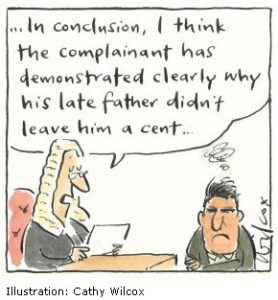
The court warned the Barbanera children about the consequences of not resolving a dispute over the will of their late father.

“The findings in this case, whatever its outcome, would be unlikely to make comfortable reading for any of them or for any of their acquaintances,” according to NSW Supreme Court judge Michael Slattery.

However, the three siblings could not co-operate to prevent the public airing of their acrimonious family history.

Peter took his siblings Nancy and Peter to court after he was left out of his father’s will. He sought up to $300,000 from his father Antonio’s estate, which included a house worth more than $2 million and $50,000 cash.

Antonio Barbanera attached to two of his wills a detailed explanation of why he had excluded his oldest son.

“While living at the family home at Haberfield, he was constantly abusive towards me, my wife and his siblings,” he wrote. “He was often physically violent towards his siblings, beating each of them on a number of occasions.”

In deciding he was not entitled to a portion of his father’s estate, Justice Slattery found John’s relationship with his parents was “extremely turbulent and volatile” and was characterised by abuse, threats and intimidation.

The judge said John behaved in a controlling manner towards his siblings, detailing an incident involving his deceased sister Angela Barbanera.

“I accept that on one occasion in 1983 when John discovered that Angela had a boyfriend, John became enraged and punched Angela very hard in the face, causing her to fall to the kitchen floor with her face heavily bleeding,” the judge said. “He then stepped on her and kicked her while she lay motionless on the floor.”

On another occasion, John chased Angela with a firearm, threatening to kill her, after she ended a relationship with one of his friends.

Justice Slattery said the three siblings’ evidence “was profoundly distorted by their personal prejudices”.

The judge criticised John’s obsession with Nancy’s romantic life as a teenager, and his claim that she had an affair with a married man.

“He demonstrated an unshakeable sense of entitlement to judge the private life of his female siblings that was difficult to comprehend,” he said.

The judge was also critical of Nancy, who he said displayed “profound revulsion” and an “uncontrollable courtroom abhorrence” of John.

“At one point in her testimony, Nancy turned to John in the court room, ignoring both counsel and the court, and delivered an obscene and vitriolic rant directly towards John,” he said. “She accused him of many things, but in substance of ruining her life.”

Justice Slattery said Peter nursed a “powerful resentment” against John based on their childhood and a falling out over business that involved Peter attempting to hit his brother with a crowbar.

The judge said Nancy and Peter tried to keep John away from their dying mother. They also humiliated John and his wife Pina Barbanera at their mother’s funeral by hiring security guards to watch him.

“The other major act of humiliation was the complete deletion of John’s name from mention at the funeral,” Justice Slattery said. “So effective was this that I accept Pina’s evidence that after the ceremony, the priest conducting Maria’s Requiem Mass approached John and her to apologise.”

But Justice Slattery rejected John’s claim for family provision because of his “comfortable” financial position of more than $5 million as well as his “capacity and a propensity to work” despite health issues. Other family members, in contrast, had “real and oppressing financial concerns”, he said.

The judge also pointed to the “tumultuous family history”, describing John as “the prime aggressive mover in creating family chaos and disharmony over the years”.

Prue Vines, a professor in the University of NSW Faculty of Law, said John’s history of violence did not necessarily mean he should be cut out of his father’s will.

“In this jurisdiction the testator is supposed to be wise and just, and sometimes forgiving as well,” she said. “It is the combination of the violence, unwillingness to end the estrangement along with the fact that he was clearly the best-off sibling that meant there was no evidence that he had been inadequately provided for.”

Professor Vines added: “This is an extreme case of a family’s dirty laundry being exposed. It is extremely sad.”

Phillip McGowan, the director of De Groots wills and estate lawyers, said taking a will dispute to court can be highly emotional and is usually expensive.

“While a legal resolution may be obtained, this is often at the expense of personal or family ties or emotional wellbeing,” he said.

5 Smart Phone Apps for Spying on your Spouse

spy on spouse appsAmerican lawyers are heading into the busiest time of the year for divorce filings. Big Brother is watching your every move — and so is your spouse.


Americans have good reason to wonder if there is such a thing as privacy anymore. Last year, two baseball fans reportedly busted a woman for “sexting” a man who was not her husband. After former National Security Agency contractor Edward Snowden revealed in 2013 that the U.S. government monitors calls, emails and texts, many people might think twice about what they share online. But that same technology is being used for another purpose: “There are a growing number of apps that will spy on your husband or wife and keep tabs on your kids,” says Theodore Claypoole, privacy attorney and co-author of “Privacy in the Age of Big Data: Recognizing Threats, Defending Your Rights, and Protecting Your Family.”

These apps may raise moral and legal questions, too. The most invasive can be downloaded onto a phone and will quietly forward emails, calls and texts. It’s a criminal offense under the Computer Fraud and Abuse Act of 1965 to access a computer — including modern computers like tablets and smartphones — without authorization. But if ownership of the smartphone in question is under someone else’s name — say, a spouse, a parent or an employer — it’s a legal gray area, Claypoole says. “That raises the question of whether the user has a reasonable expectation of privacy,” he says. “If you own your husband or wife’s smartphone and you’re paying your child’s phone bill, it could be a moral issue rather than a legal one.”

Apps regularly pop up in divorce cases, experts say. Over 80% of U.S. divorce attorneys say they’ve seen a rise in the number of cases using social networking, according to the American Academy of Matrimonial Lawyers, and more than a third of divorce filings contained the word Facebook, according to a 2011 U.K. survey by Divorce Online, a legal services firm. Gary Traystman, a divorce attorney in New London, Conn., says 80% of contested divorce cases involve smartphones and/or computers.

Of course, many tracking apps are designed to serve an innocent purpose: to keep tabs on an ailing parent, to keep children safe from a potential predator, or even to help find a lost or stolen phone, says Adam Levin, co-founder of online security company Identity Theft 911. Trouble is, “people store way too much personal data in their smartphones,” he says. For people who fear snoops, there are apps for that too. Vault Stocks (.99 on Google’s Android) and Best Secret Folder (free on Apple’s iOS) hide pictures and videos in a secret online vault. “The moral of the story is to lock your phone,” says Rick Singer, CEO of GreatApps.com, an app marketing company.

With that in mind, here are five apps that allow you to legally keep track of your friends and family:

Connect

This app for iPhone or iPad can follow your husband, wife, children and even your friends on sites like Facebook, Twitter, Instagram, Google Contacts and LinkedIn. Most social contacts are jumbled and split up across multiple devices, platforms and apps, but this app collects them in one place, says Ryan Allis, chairman and co-founder of the app. “Your Connect map has hundreds of your friends on it the first time you use the app,” Allis says. Unlike similar apps like Foursquare, it doesn’t use virtual check-ins, which can prompt users to activate their location settings (many people don’t realize that when they turn on location settings on their phone, location information can be embedded in shared photographs and status updates too). What’s more, the other person doesn’t need to have Connect installed or to accept an invitation from the app.

Find My Friends

Find My Friends for iPhone and Android allows you to keep up to speed on when your spouse leaves work, your child leaves school or even when a visiting friend arrives at the airport. “Friends who share their locations with you appear on a map so you can quickly see where they are and what they’re up to,” according to the app’s official site. The app syncs with phone contacts and maps on the iPhone. Users can also select what other Find My Friends users they want to interact with on their network. Not to be confused with Find My iPhone (free on iOS), which will give the location of a lost or stolen phone via Apple Maps on a map and also works for iPod, iPad Touch.

Trick or Tracker 3.0

Many parents want to keep track of their kids — and not just on Halloween. Wayne Irving, a father of four and the president and CEO of Laguna Niguel, Calif.-based technology company Iconosys, has a novel solution. Trick or Tracker can be used by up to seven family members at one time. The app must be downloaded on both parties’ smartphones — with their permission, of course. It can send text alerts when a child has traveled out of a previously agreed area, and it has a latchkey-kid feature that can ping a parent when a child arrives home. It tracks the phone using the geo-location data contained in text messages and sends the person’s location every 15 minutes. Irving says it could also be used to track a child in the unlikely event of an abduction, although some online reviewers have complained about its accuracy. Originally $4.99 when launched in 2013, it’s now free.

Phone Tracker

Phone Tracker is marketed to families with busy schedules and employers who want to track employees during work hours. It combines mapping and GPS technology to let you track your phone plus one other for free on Android and iPhone (follow 10 users with a 99-cent upgrade). The app doesn’t have to be open to work, and it can locate another person’s movement within the previous 24 hours and within 30 feet (10 meters). It can be programmed to log locations every two to 60 minutes. To follow another person, they must use the app too. A similar app — Glympse — free on Android and iOS — shares estimated arrival times and even the speed your spouse is traveling at. While the app is free, it has also received mixed reviews on the iTunes store.

AccuTracking

Pitched for GPS vehicle tracking for companies and a way for parents to keep a tag on their children, AccuTracking has been around for over a decade even before the advent of Google Maps. “Our vision is to provide low-cost and simple to use applications that enable the tracking of any number of targets wherever and whenever the user chooses,” the company states. “Knowing where your vehicles, employees and physical assets are in real-time on your desktop computer is a valuable management and cost-control tool.” It costs $5.99 a month. The app is downloadable through the phone’s web browsers. Singer advises caution when downloading software onto your phone that is not approved; Apple’s App Store does not support AccuTracking. “Apple has done an exceptional job protecting its phones,” he says. “Once you jailbreak the phone, all bets are off.”

Family Court examines difference between Discipline & Child Abuse

Justice Stewart Austin, pictured here in 2009, said the punishment inflicted by a father on his sons was "abuse", not discipline.

Justice Austin said the punishment was abuse.

When does physical discipline of a child become unlawful abuse?

The question arose in the case of a father who had beaten his two eldest children with a cricket bat, but who argued he should still be allowed to see his six-year-old son.

The boy lives with his mother, who opposed her estranged husband having any contact with their boy.

Both she and the father had previously smacked the boy, the Family Court in Newcastle heard. But the mother claimed he was at risk of physical abuse if left with the father, because of the way the man punished his older sons from a previous relationship.

Under the NSW Crimes Act, the defence of lawful correction permits a parent, or someone acting with their authority, to punish a child with physical force. But the force must be reasonable in light of the child’s age, health and maturity, as well as their alleged misbehaviour. Force applied to any part of the child’s head or neck, or elsewhere on their body in a way likely to cause harm “for more than a short period”, is not considered reasonable.

The court heard that from around the time they were aged aged six or seven, the father hit his two eldest sons with a cricket bat and once left them with bruises and welts after beating them with a broken broom handle. In what judge Stewart Austin called a description of “cruel brutality”, a sibling recalled hearing the boys beg for mercy and scream with pain, saw the bat used with such force it broke and saw welts on the boys’ bottoms.

The boys are now in their early teens and in state care. The three other children in the household had not been abused by the father.

In determining the case, Justice Austin said it was necessary “to differentiate between physical ‘discipline’ and physical ‘abuse'”.

“Despite modern society’s changing opinion about the morality of corporal punishment of children, the law of NSW still envisages the legitimate administration of physical discipline by an adult to a child, subject to certain constraints,” he said. “It is only when the discipline transcends those constraints that it becomes abusive and ceases to be lawful correction.”

Justice Austin described the two older boys as “very troubled children”, throwing objects, damaging property and “using weapons like knives, broken glass, hammers and loaded spear guns to threaten people”.

But the fact that their behaviour “presented an extraordinarily difficult parenting challenge was not an excuse for the severity of their treatment”, he said. Their punishment amounted to abuse and “criminal assaults”.

However, the judge granted the father unsupervised visits with his six-year-old son, ruling it was in the child’s best interests.

The father was not “so unfit as a parent that he is utterly incapable of safely caring for the child for short stints”, Justice Austin said. He noted that the father had undergone parenting courses and the little boy was unlikely to be as challenging as his older stepbrothers.

Man sues ex-fiancee to recover cost of engagement ring

engagement-ringA Canberra man launched legal action against his former fiancee in a bid to recoup the money he’d spent on her engagement ring after their relationship broke down.

The man had first contacted the Melbourne woman and her parents with a view to marriage in late 2014 and they got engaged the following year.

But the pair’s relationship soured, partly due to tensions over where they would live, and ended last October.

The man had asked his former fiancee to give back her engagement ring, as well as gifts from his parents, but he claimed the items were never returned.

He took the case to the ACT Civil and Administrative Tribunal, seeking to recover the cost of the ring and gifts.

Under the Marriage Act, a person can no longer sue for damages linked to social or economic loss arising out of a breach of a promise to marry.

But the law doesn’t apply to gifts given in anticipation of a marriage, meaning a person can try to recover an engagement ring, or its monetary value, if the recipient has broken off the engagement.

Section 111A of the Marriage Act 1961 provides as follows:

111A Abolition of action for breach of promise

  • (1) A person is not entitled to recover damages from another person by reason only of the fact that that other person has failed to perform a promise, undertaking or engagement to marry the first-mentioned person.
  • (2) This section does not affect an action for the recovery of any gifts given in contemplation of marriage which could have been brought if this section had not been enacted.

The man’s matter went to a hearing to decide whether the tribunal had jurisdiction to handle the case.

His application hinged on whether there had been a breach of the pair’s agreement to marry, and whether that breach had taken place in the ACT. This would bring into play section 22 of the ACT Civil and Administrative Tribunal Act 2009 (ACAT Act).

If the man’s bid failed, any further attempts to recover the gifts would need to be pursued under Victorian law, ACAT senior member Graeme Lunney said in his decision.

Mr Lunney noted there had been dispute about who had ended the relationship, saying the engagement failed after “unhappy differences arose over which there is great controversy”.

He said the phone conversation the pair had last October, when they had broken up, “was one between two people in a decaying relationship unable to find a way forward any further”.

He found there had not been a “unilateral withdrawal by one party in breach of a prior promise”, rather a recognition by two people that their relationship had reached a tipping point and was over.

“Consequently, in my view there was no ‘breach’ that occurred in the ACT which would give this tribunal jurisdiction in the proceedings brought by the applicant,” Mr Lunney said.

“It was mutual recognition of an unhappy state of affairs that was beyond repair. In those circumstances the tribunal lacks jurisdiction to adjudicate the dispute.”

Mr Lunney dismissed the man’s application. The parties were ordered to bear their own legal costs.

The decision is published online as Omari v Yassine (Civil Dispute) [2016] ACAT 112