Single Dads with Custody – Research into their psychological wellbeing

man-feeding-childMany men in Australia are the primary custodians of their children, but little is known about the psychological well-being of these fathers. The current study defines primary custodial fathers as men who have acquired primary custody of their children following separation, divorce or the death of the child/ren’s biological mother. Fathers who have since been in a defacto relationship or have re-married are also included within this definition.

This study will explore variables that might affect the psychological well-being of primary custodial fathers, including traditional masculinity beliefs, skills and self-efficacy, and social support. It is hoped that this research will advance our understanding of the well-being of fathers who are primary custodians of their children.

CRITERIA:

If you are a father:

  • who has primary custody of your children – (full, majority or shared/50-50)
  • with dependants under the age of 18
  • who is living in Australia

If you know anyone who matches this criteria and is willing to participate, or if you yourself would like to volunteer to participate in this research, which consists of an anonymous online questionnaire.

Please share this page, take note or click on the link below to enter the survey for more information.It should only take approximately 10 – 15 minutes and can be completed at a time convenient to you.

surveyDo the Survey Now

The online questionnaire will ask for demographic information such as age, relationship status, approximate income, place of residence and questions relating to the age and number of your dependants. Other questions will ask about your confidence and skills as a parent, how much social support you receive from friends and family, and questions about your current psychological well-being. Some of the questions also address concepts that have been associated with traditional masculine ideals, and will therefore ask about your attitudes towards women (e.g., “a man should always be the boss”), sexual behaviours and attitudes towards homosexuality.

Participants who have successfully completed the online questionnaire will have the opportunity to go into the draw to win one of three $30 gift cards. Thank you for considering participation in this study.

If you have any questions or concerns, feel free to contact my supervisor using the email address below, additional contact details of Federation University’s Human Research Ethics Committee are also available on the second page of the online questionnaire using the SurveyMonkey link.

Researcher: Gavin Duarte

Gavin-Duarte

Gavin Duarte

I am a Bachelor of Science graduate from Melbourne University, currently studying the Graduate Diploma of Psychology at Federation University. I am also a volunteer research assistant, collaborating over the past two years on a number of studies at the Murdoch Children’s Research Institute based at The Royal Children’s Hospital. I have experience working in a diverse research environment filled with professionals such as Clinical Psychologists, Clinical Neuro-psychologists, Developmental Psychologists and Post-Doctoral researchers. These studies involve the use and manipulation of large databases, statistical and brain- imaging software. Career wise, I am passionate about working with adults and children of all ages and from all walks of life.

https://twitter.com/Mindful_Gavin

https://www.linkedin.com/in/gavinduarte

Principal Supervisor: Dr. Denise Corboy

Wives at War – money, property and pets – a very Sydney Divorce

Les Young and third (common law) wife, Josephine Smith.

Les Young and new wife, Josephine Smith.

It’s a nasty divorce that has already led to the liquidation of one pub and two fox terriers. Now it’s threatening a wealthy Sydney woman’s luxury waterfront penthouse and potentially a lot more.

The ex-wife and current partner of former multi-millionaire hotelier Les Young live in very different circumstances.

Ex-wife Joanne lives in a Campbelltown housing commission block. She was Mr Young’s second wife. His current partner, Josephine Smith, resides in a three-level Pyrmont penthouse.

After 10 years and a tortuous legal battle dragging through the NSW courts, these fortunes could reverse.

Joanne Young has been battling for years to secure a $3 million settlement from her ex-husband. So far she hasn’t got a cent.

On Tuesday her ex-husband’s partner, Josephine Smith, was found guilty of contempt of court for failing to respect a court order preventing her from using assets transferred to her by Mr Young.

Mr Young split with his second wife years ago. But the split became truly acrimonious in 2006, when he kicked her out of the Wiley Park Hotel, accusing her of stealing.

To add injury to insult Mr Young also ordered his ex-wife’s two terriers, Fluffy and Molly, be put down.

Joanne Young... seeking payment. Photo: Channel 7.

Joanne Young… seeking payment. Photo: Channel 7.

But the stealing allegation was found to be malicious. In 2013, a court ordered Mr Young pay his former wife $2.7 million, including $165,000 in damages after he was found to have deceived police for levelling the stealing claim against his former wife.

Mr Young’s assets were at the time found to be worth $9 million.

Five months later, Mr Young transferred the entire $5 million Pyrmont apartment to Ms Smith. His remaining share was sold to her for $1.8 million.

The next year, Mr Young went bankrupt, owing Ms Smith $4 million.

A court then froze Ms Smith’s assets. On Tuesday she was found guilty of breaching that order.

The court found Ms Smith, through a company, secured a large loan against the Pyrmont penthouse and used it to buy a new hotel, the Lucky Australian in St Marys.

A judge had earlier found that Ms Smith never told the bank, Westpac, that the apartment was subject to a court-ordered freeze.

On Wednesday  of the NSW Supreme Court found it was “inconceivable in the circumstances […Ms Smith] was unaware” of the order restraining her from encumbering diminishing or disposing of assets worth more than $1000.

Westpac sold the Lucky Australian earlier this month. It failed to recoup the sizeable loan.

Lawyers for Ms Young are continuing to fight for her share and other recent costs orders in her favour. Late last month her lawyers filed an application to declare Ms Smith bankrupt fearing their may be nothing left of her ex-husband’s former assets.

Now other financial companies are making moves in the Supreme Court on Friday to seize the Pyrmont penthouse to secure it and other debts.

Related Family Law Judgments

The Other (Overlooked) Victims of Domestic Violence

hassam-el-masri-secret-recording-domestic-violence

Appearing in Court

In October 2015, former Australian rugby league football star Hazem El Masri was charged with an alleged domestic assault against his 25-year-old then-wife, former receptionist Douah El-Cherif.

The 39-year-old retired NRL player had been charged with assault occasioning actual bodily harm and common assault.

The charges related to an alleged incident at the former footballer’s home.

It was alleged that in the midst of negotiating living arrangements during the couples separation, El Masri tried to secure the keys to one of his homes, however his then wife, El-Cherif, refused to provide him the keys and to move out of the home. During this argument, El-Cherif accused El Masri of pushing her.

El Masri is a devout Muslim and a former ambassador for White Ribbon Day, a national campaign to stop violence against women.

He split with first wife of 13 years, Arwa El Masri, without incident in 2014, and remarried in 2015.

Although the Australian legal system is intended to work on a presumption of innocence, no such presumption of innocence, as evidenced by events that followed soon after the allegations, seem to have been afforded Mr El-Masri.

Among a number of  commercial arrangements being put on hold or severed, arrangements which were El Masri’s primary source of income post his football days, El-Masri was understood to have been unceremoniously dropped by the NRL, the ruling body of the sport he excelled in.

El Masri was abruptly dropped from a number of high profile roles sponsored by the NRL, roles he undertook since his retirement, including according to Mr El Masri his most cherished role, that of ambassador for White Ribbon Day.

This is despite the broad understanding by the authorities at that time that the allegations made against El Masri were weak and inconsistent.

Forward 5 months and it was further revealed by the authorities that more than a dozen police working on the case have not been able to substantiate the allegations, even though Ms El-Cherif, 25, wanted to continue to pursue the matter.

audio-recording-with-iphoneThis is nothing new in cases of domestic violence, and contrary to what many may expect, charges are not necessarily dropped because of a lack of evidence, given that people’s safety, and at worst their lives, may hang in the balance unless preventative measures are taken, often in the absence of any hard evidence.

But in this case, as a result of an indisputable piece of evidence, not only have the charges been dropped, but news has seeped into the media that El Masri has been completely exonerated.

As a result the Police stated that all charges would be dropped.

“I want to make it clear what’s happened here today,” El Masri’s lawyer Chris Murphy said outside court.

“Mr El Masri has been totally exonerated. And he hasn’t been exonerated because somebody dropped off or something happened. The police have examined the evidence. There is overwhelming forensic evidence that shows his innocence.”

“There is a recording that he made of the event in which he allegedly misbehaved. It didn’t happen.”

All very well and good. But what if this recording did not exist? I think the outcome would have been markedly different.

It can be argued that El Masri is the exception to the rule, being lucky enough to have irrefutable evidence of an incident that often relies on he-said, she-said.

And in these cases, the Courts tend to priorities the potential safety of the alleged victim, over and above the injustice against the alleged perpetrator.

So what lesson can you extract from this news item?

According to Jacob Romano, editor of Family Law Express, he states that in a period of extreme public sensitivity towards domestic violence issues, the pendulum has swung firmly in the direction of a priority on prevention of abuse against women.

There seems to be a general acceptance in the community that if push comes to shove, protecting women from domestic abuse should be the priority, even at the cost of prosecuting innocent men.”

Whether this practical but imperfect application of the law is in itself just, perhaps relies more on who the victim identifies with, the alleged victim of abuse, or the alleged victim of false allegations, then any objective measure of justice.

But if we are genuinely interested in better separating genuine allegations from false allegations, then the use and reliance of audio recording software, should not only be encouraged, but should perhaps become the new forefront on prevention and detection of domestic abuse, in high risk families, similar to our reliance on CCTV on public areas.

One Nation Pushing for a Fairer Family Court System

The head of Australia’s Family Court has warned against “simplistic” reforms to the troubled system, saying the vast majority of cases are complex and involve family violence, mental health and substance abuse issues.

Pauline Hanson’s One Nation party is calling for the Family Court to be abolished and be replaced with a family tribunal made up of people from “mainstream Australia”.

Key points:

  • Pauline Hanson says current Family Court system is “unworkable”
  • Member for Flynn Ken O’Dowd says he is open to working with Ms Hanson on the issue
  • Australian Institute of Family Studies says system has been vastly improved recently

“Respected” members of local community, social and health groups would be invited to participate, according to the party’s policy.

Pauline Hanson, Family Court

Pauline Hanson wants a fairer Family Court System.

Joint custody should be the option of choice, and there should be recognition that “a child’s standard of living following divorce cannot be maintained at pre-divorce levels”, the policy says.

But Chief Justice Diana Bryant told ABC Radio National on Thursday the main issue for the Family Court had been a lack of federal funding to employ new judges, which would tackle the glacial progression of cases.

The funding shortfall has seen waiting times balloon to more than two years; a situation Justice Bryant said was “unacceptable”.

The idea of a tribunal may have some merit for simple matters that did not involve making orders, she said, but could run into constitutional hurdles.

“I’m actually in favour of people putting this on the agenda … but I think we have to be fairly careful about looking for simplistic solutions to complex problems,” she told the ABC.

The British family court tribunal system is presided over by judges, and members that are non-legal experts in relevant fields, like child psychologists.

One Nation is not the only voice calling for Family Court changes.

Family violence advocate Rosie Batty, and the Women’s Legal Services Australia in May launched a campaign calling for reforms, including domestic violence training for court staff and judges.

Ms Batty also wants an end to victims, overwhelmingly women, being directly cross-examined by abusers in court.

New senator Derryn Hinch has also called for a senate inquiry into the Family Court and child welfare agencies.

In Australia, only about 5 per cent of Family Court cases make it as far as a trial, but of these, about 85 per cent involve family violence, mental health or substance abuse issues.

Professor-Patrick-Parkinson

… Family Law system needs to be fixed

Over the past 10 years courts have been dealing with more complex situations which take longer, but in the same period the government had not put more money into courts, said Justice Bryant,

Australia’s family law system is “almost dysfunctional”, with families caught for years in expensive, long-winded battles, says Professor Patrick Parkinson, the former chair of the Family Law Council.

“We desperately need solutions to this problem and we shouldn’t reject them out of hand simply because it’s One Nation,” Professor Parkinson says.

“The easiest thing in the world would be for me to criticise One Nation, everybody does. But let’s look at what they have said.”

Abolishing the Family Court is constitutionally impossible, he says, but an alternative courtroom to deal quickly with property matters, for example, might be a sensible option.

One Nation’s family court policy on child support is clearly influenced by the concerns of men’s and father’s rights organisations, he said.

The Nationals Member for Flynn, Ken O’Dowd said “I’ll work with anyone that can resolve the issue and make it a fairer system.”

Divorce goes out of fashion as couples wait to commit

Australian divorce ratesDivorce is on the wane in Australia as people think more carefully about their choice of life partner before saying “I do”.

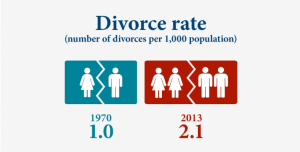
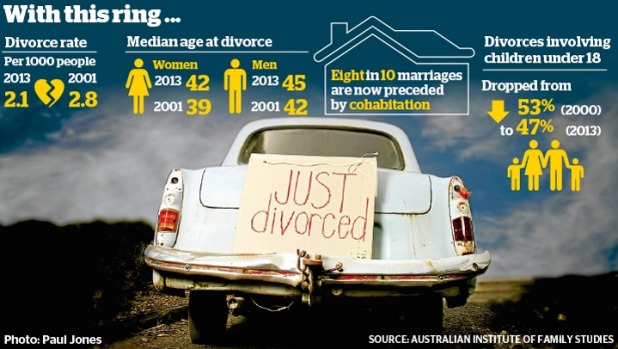
Statistics from the Australian Institute of Family Studies show divorce has gone out of fashion this millennium, with the crude divorce rate falling from 2.8 per 1000 people in 2001 to 2.1 in 2013. The decline in divorce is particularly noticeable among couples aged 25-40.

“Marriage has become a more considered decision than in the past,” the institute’s researcher Lixia Qu said.

Divorce peaked in 1976 after the introduction of no-fault divorce.

Couples are also road-testing relationships by living together before marriage. Eight in 10 marriages are now preceded by cohabitation. “Cohabitation serves as a weeding-out process,” Dr Qu said.

Relationships Australia Illawarra manager Rhonda O’Donnell said couples have become more cautious about making a life commitment. The median age for first marriages is now 30 for men and 28 for women.

“People are delaying marriage until later, they’re older, they’ve often lived together and they’re being more considered about their choice [of partner],” she said.

family-facts-and-figures-divorceMs O’Donnell noted that many couples had experienced the divorce of their parents growing up, and did not want to end up in the same predicament.
Those that do marry are increasingly choosing a secular ceremony. Whereas an equal number of marriages were performed by a civil celebrant as a religious minister at the turn of the century, now only a quarter of marriage ceremonies are religious.

The proportion of divorces involving children under 18 has also dropped this century, from 53 per cent to 47 per cent. While the average length of a marriage that ends in divorce is 12 years, one in five divorces now involve couples who have been married for 20 years or more.

Trends in registered marriagesCouples are increasingly waiting until their children have left home before splitting up, to protect them from the fallout. Women are also likely to be back in the workforce, putting them in a more independent financial position. The median age for women who get divorced is now 42 (compared to 39 in 2001) and for men it is 45 (compared to 42).



“There is less stigma attached [to divorce] than when they got married, there are no concerns about the impact on the children, and there are less concerns about the financial difficulties they face,” Dr Qu said.

When parents do separate, only 6 per cent of children under 17 spend their time equally with both mother and father. Three in 10 children see their non-resident parent daily or weekly, but an equal proportion sees that parent less than once a year or never.

Half of all children whose parents are separated do not spend any nights at their non-resident parent’s house. Dr Qu said many of these children were either too little to stay away from home, or older teenagers who preferred to spend time with their friends.

Secret Phone Recordings Justified to Protect a “Legitimate Lawful Interest”

michael-lawler-phone-recordings

In 2012, former Perth barrister Lloyd Rayney was found not-guilty in the August 2007 murder of his wife, WA Supreme Court Registrar Corryn Rayney.

Although many remain unconvinced of his innocence, the as-yet un-resolved issue of his secret recordings of his wife’s phone conversations is still making its way through the system.

His reasoning for needing to record his wife’s phone conversations remains far-fetched, but it has been sufficient it seems given that midway through a subsequent trial on illegal phone tapping, the case was thrown out, with the judge ruling Mr Rayney had no case to answer.

Rayney is now battling it out with the Legal Practice Board, where he is striving to regain his practicing certificate.

His practising certificate was taken from him because he was deemed to not be a fit and proper person to hold a practicing certificate, given that he engaged in these recordings without the knowledge or consent of those being taped.

His justification for the recordings, he believed it was legal to record conversations without consent – and when one was not party to them – to protect a “legitimate lawful interest“.

Another prominent Australian who is also using the defence of “legitimate lawful interest” to justify his countless of hours of phone recordings, many of which are extremely damning on him regardless of whether the recordings themselves are deemed to be lawful or not.

Fair Work Commission vice president Michael Lawler recently revealed he has been covertly recording phone conversations with his boss.

“It’s become necessary these last four years to assemble evidence,” he told the ABC’s Four Corners program.

“I was a specialist fraud prosecutor; I understand the importance of evidence and maintaining it.

“I’ve been assembling evidence with great care and effort for four years now.”

HC spoke to Alan McDonald, managing director of law firm McDonald Murholme – where secret workplace recordings are a topic commonly brought to the firm’s attention.

According to McDonald, Lawler’s intentions legitimise his actions.

“It is legitimate to record conversations to be used to protect oneself later, which is clearly the advice and opinion of Vice President Lawler,” he said.

“By having the recording, it provides first class evidence so people can focus on the real issue.

“Judges are not troubled by the issue of who to believe in an oral conversation because it is recorded.

He added that everyone benefits when evidence is clear and unambiguous, as it is in a recording.

“It also allows the conflicting party to respond knowing precisely what the allegation is,” McDonald said.

McDonald also said that Ross – whose conversations were recorded by Lawler – can provide a response, if he wishes to do so, to the allegation that the secret tape recordings are in stark contrast to his public statements.

“One would expect that President Ross would make a detailed response without the need for a costly public inquiry or Royal Commission to investigate what is really going in the Fair Work Commission,” McDonald said.

Related Family Law Briefs

  • No items found in feed URL: http://www.familylawexpress.com.au/family-law-brief/category/evidence/audio-recordings-evidence/feed/. You requested 15 items.
  • Online Domestic Violence Order Applications could save lives

    Online DVO applicationsVictims of domestic violence should be able to apply online for protection orders which can then be dealt with urgently by judges at any time, a family law expert says.

    The system of applying online for a domestic violence order (DVO) which is sent to the Family Court and urgently dealt with by an “E-Judge”, or electronic judge, is currently operating in New Zealand.

    Jennifer Hetherington, from family law firm Hetherington Legal, says this system would be perfect for Australia.

    Domestic violence victims in Australia currently have to seek a DVO through a magistrates court, while other matters such as child custody are dealt with by the Family Court.

    “Here we have different courts dealing with various aspects of family law issues,” Ms Hetherington said.

    “New Zealand has a system of one court for all family law matters and it means there’s also less chance of child protection issues falling between the cracks of the laws.”

    She said an online system would allow E-Judges to review all documentation relating to the case anywhere and anytime.

    “They could do it at home in their PJs if they wanted to,” she said.

    The judge would then fill in the required conditions, hit send, and any orders would instantly be available in the court registry for the victim to collect, she said.

    Ms Hetherington said E-Judges in New Zealand were currently assessing and making decisions on up to 100 protection and parenting order applications each day.

    “There’s no way we can do that here with our system where each parenting application has to go through the formal court process which in some cases can take weeks to organise,” she said.

    “Domestic violence order applications in Queensland take less time but are in a different court and a person in need of protection still needs to go to court to obtain the order – sometimes when they are in really urgent need and time is critical.”

    The Queensland government on Tuesday introduced new domestic violence laws to parliament that will give harsher penalties to domestic violence offenders.

    NSW Lawyer Banned From Practising Law for Fraud

    sydney-lawyer-on-right

    Sonny Wilson with rugby league great Darren Lockyer

    A western Sydney lawyer has been banned from practising after he falsely invoiced Legal Aid NSW for more than $30,000.

    Sonny Wilson, a Liverpool solicitor, charged Legal Aid for barristers’ and translators’ fees on behalf of his clients when no such work was provided.

    Between 2012 and 2013, he misappropriated trust funds and made five false certifications to the service, which has struggled with federal funding cuts. Several times Mr Wilson told Legal Aid that barristers had appeared in court when Wilson himself represented his clients.

    On Monday, the Civil and Administrative Tribunal found Wilson guilty of “egregious” dishonesty. The solicitor, pictured below with rugby league great Darren Lockyer, had his name struck off the roll of NSW lawyers.

    Mr Wilson, representing himself, did not formally oppose the removal of his name but asked for a suspension instead.

    “I am willing to learn from my past mistakes and errors,” he said in an affidavit. “Hopefully I can obtain another opportunity in the near future to practice as a solicitor and to be of some use and benefit to others.”

    The tribunal found his dishonesty was so extensive they had no option but to remove his name from the roll.

    “Despite his good intentions, we are far from satisfied he has achieved this redemption in the relatively short time that has elapsed since his practising certificate was suspended,” the tribunal panel wrote.

    But the panel said Mr Wilson’s chance to return to law “may not be lost forever”. He is now studying full-time for a three-year degree in theology at Alphacrucis College in Parramatta.

    The tribunal’s decision came one year after the Productivity Commission recommended the Abbott government add $120 million to legal aid services around Australia. The government is yet to respond to the recommendation.

    What impact does the Ashley Madison hack have on Family Law matters?

    ashley-madisonRecent articles confirm that data disclosing the identities of the “anonymous” users of the website Ashley Madison (a website that facilitates and encourages partners being unfaithful to each other), has been leaked online.

    Many of these articles speculate that, as a consequence of that information, there will be a serious spike in the amount of family law matters as people learn that their spouse/partner has been unfaithful.

    In circumstances where Ashley Madison advertises itself as having 37,565,000 anonymous members, there may well be some truth to the claims. What people may be surprised (and disappointed) to learn, however, even if there is an influx of family law matters, and the release of the Ashley Madison data is the reason for it, the fact that a person has been using the website bears little, if any, relevance to family law matters.

    Since 1975, Australia has been a “no fault” jurisdiction. What this means is that, unlike the United States for example, it’s unnecessary to demonstrate to the Court that that one or both parties are at fault in order to dissolve a marriage.

    The parties just need to have been separated for 12 months with no prospects of reconciliation. People often believe that unfaithfulness is in some way, disentitling behaviour when it comes to spending time with the children – that’s not the case. The Court’s paramount consideration is the best interests of the children (and unless they have been exposed to some form of unsavoury behaviour, it’s unlikely that a person being unfaithful affects the best interests of the children – at least as far as the Court is concerned).

    In relation to property matters, there is no impact upon the way in which assets are divided by one person or another’s unfaithfulness to their spouse (unless there has been extravagant spending on the third party).

    In my experience, unfaithfulness is not the main reason that parties separate. It’s certainly one of them, but stands alongside factors such as money difficulties, children, complacency in a marriage and the interference of an extended family.

    I have no doubt however that there are over 37 million concerned people who are right now wondering how the Ashley Madison hack will affect their personal lives. Marriages may indeed end as a consequence. However, use of that information to determine what should happen with arrangements for children, or how property should be divided, is likely to have little impact on the way in which that family law matter is decided. 

    Incompetent Family Law Lawyer Ordered to Repay Client

    erasing-the-scales-of-justiceA lawyer has been ordered to repay more than $100,000 to a family law client after the WA Supreme Court found he charged too much because “he did not know what he was doing”.

    The lawyer, identified only as Mr K, represented the client, Mr M, in family law proceedings between November 2008 and April 2010.

    He charged the man more than $330,000, for what Supreme Court registrar Christopher Boyle found was excessive, technically deficient and inappropriate work.

    Registrar Boyle expressed concern about the records produced by the lawyer to show the work he had done.

    He found he seemed to have spent an excessive amount of time doing work of an administrative or clerical nature, while charging $270 an hour.

    Registrar Boyle described one charge, for “research”, as disturbing and extraordinary and also noted that in some instances the lawyer charged for up to 20 hours of work in a day.

    “The inevitable conclusion is that Mr K’s time records cannot be accepted as uncorroborated evidence even of time spent, let alone whether that time spent was properly chargeable to the client,” he said.

    Registrar Boyle said Mr K was not an accredited family law specialist and he should not have accepted Mr M as a client.

    “If he did, it should have been only on the basis that he would engage specialist counsel to provide him with the expertise he lacked,” he said.

    He also noted criticisms of Mr K by the Family Court judge who heard Mr M’s case.

    That judge expressed concern about the adequacy of the representation provided by Mr K and noted that Mr M and his former wife had accumulated legal fees of more than $1.1 million, which was “staggering” and “totally disproportionate to the pool of [their] assets.”

    Registrar Boyle said the fact Mr K did not reflect on and consider his position as a result of those criticisms reflected poorly on him.

    Registrar Boyle did accept the case was contentious and difficult and that the conduct of Mr M’s wife and her lawyers significantly increased Mr M’s legal costs because they did not attempt to resolve any disputes between the parties.

    However he said it was clear Mr K was out of his depth and floundered in the task of identifying and presenting relevant evidence.

    The registrar ruled the fees should be reduced to $220,000 because, in his view, a competent and properly resourced practitioner could have done what was needed for no more than that amount.

    “That gives Mr K roughly two-thirds of what he claimed, and I think that properly reflects wasted or otherwise inappropriate work,” he said.