
Sydney dad will fight child abduction charges

police-carA SYDNEY man charged with abducting his teenage ex-girlfriend and their baby at knifepoint has denied the allegations and will fight the charges using a series of text messages.

The 24-year-old, who is also charged with having sex with his ex-girlfriend when she was underage and breaching an apprehended violence order, appeared briefly via video link in Parramatta local court today.

He did not apply for bail, which was formally refused, but expects to apply at a later date.

His lawyer Ben Archbold said his client will fight the abduction and assault charges.

“He wishes to deny the allegations at this stage,” Mr Archbold told the court.

“There’s a series of SMS that largely refute the claims.”

The man is accused of entering the Chester Hill home of his 16-year-old ex-girlfriend and their eight-month-old son on the evening of last Thursday and forcing them into his car using a steak knife.

He allegedly assaulted her on their way to Campbelltown.

They stopped at a rest area before she got out of the vehicle and he allegedly drove off with their son.

Police located his abandoned vehicle Friday morning at Bargo, south of Sydney, after it had hit a tree.

Hundreds of emergency services personnel combed the area until late on Friday when the accused’s sister handed the baby over to police.

He remained missing for five days until he turned himself in to Bankstown police with his lawyer.

The man will appear in Campbelltown local court on August 12 when he is expected to apply for bail.

Relocating children after divorce: when is it ok?

relocationAs more families become “international” many are faced with the dilemma that on divorce (or separation) one partner wants to go back home with the children and the other wants them to stay here. This article outlines what to consider if you’re thinking about leaving Australia.

Globalisation has led to us seeing more international families. With the increasing divorce rates, many marriages do not turn out to be the happily ever after that the couple had hoped for. At the end of the marriage, many find themselves living in Australia while all their family and support networks are in their home country. Some may want to go back home with their children.

The legal term for this is ‘relocation’.

In Australia, a parent cannot leave Australia with the children without first obtaining the permission of the other parent or approaching the court for permission to relocate.

In the event that a parent packs up and goes home without obtaining that permission they can be brought back to Australia.

We always recommend that parents speak to the other parent to obtain their permission first and as a last resort, approach a court.

In Australia, a parent cannot leave Australia with the children without first obtaining the permission of the other parent or approaching the court for permission to relocate.

Often by speaking to your partner you will be able to put their mind at rest that you have thought of ways to ensure that they don’t lose touch with their children.

WHAT SHOULD YOU DO IF YOU’RE THINKING ABOUT LEAVING AUSTRALIA?

Do your homework and think about it very carefully before speaking to your partner. Make sure you have considered things such as:

  • job prospects
  • support system
  • school applications
  • accommodation options
  • proposal for time to be spent with the other parent.

The better prepared you are the greater likelihood that you will be able to agree. Be sure to have insight into how hard this might be for your partner.

If you can’t resolve it and still want to approach the court for permission remember the court is going to look at it from what’s in the children’s best interests. The more time a parent spends with children at the time the application to court is made the less likely a court will agree to allow you to go. This is because the greater role the other parent is playing in the children’s lives the greater the damage may be if the children are to relocate and be separated from that parent.

It’s best to reality test and make sure your motivation is in the right place. Are you trying to reduce your former partner’s time with the children or are you seeking a better life for you and your children?

As the world shrinks this issue will be continue to be on the rise for family lawyers.

NSW set to back same-sex marriage

NSW Same Sex Marriage InquiryA NSW Liberal politician who supports gay marriage has said he is ”grateful” to Premier Barry O’Farrell for setting up an inquiry that yesterday cleared the way for NSW to introduce a bill to legalise same-sex marriage. ”This is what democracy is about,” said the Liberal member for Coogee, Bruce Notley-Smith.

NSW could become the first Australian state to legalise same-sex marriage after the inquiry found NSW has the power to introduce its own law, although this was likely to be challenged in the High Court by opponents of gay marriage.

A group of MPs from across the political spectrum have redrafted a Same Sex Marriage Bill that will be introduced in the upper house of the NSW parliament in the next session. Mr O’Farrell has promised a conscience vote on the issue, and is the first Liberal leader to do so.

Independent Sydney MP Alex Greenwich said the inquiry has ”made history”.

”Submissions in favour of reform came from across the community – parents, clergy, health and mental health organisations, and prominent individuals from all sides. The number and breadth of submissions in support of marriage equality demonstrates that it is only a matter of time before a change in the law occurs. We look forward to making this a reality in NSW,” Mr Greenwich said.

The cross party working group, comprised of Mr Greenwich, Mr Notley-Smith, Labor MP Penny Sharpe, Nationals MP Trevor Khan, and the Greens Mehreen Faruqi, said they are confident their private members bill ”is constitutionally valid and would withstand any challenge to the High Court”.

The bill makes it clear it is about the marriage of same-sex couples only. Trans-sex marriages are not allowed, and churches are explicitly exempted.

The bill will also only recognise same-sex marriages from other Australian states, and not those conducted overseas, because of constitutional concerns.

Ms Sharpe will introduce the NSW bill into the upper house, and expects a vote by the end of the year.

”There have been arguments put forward that marriage equality laws were solely for the Federal Parliament and that progressing same-sex marriage is not an issue for the states. For the first time we have a clear statement from a multi-party standing committee that recognises, not just the right of the Legislative Council to debate the issue, but the constitutional basis for the NSW Parliament to pass a same-sex marriage law,” Ms Sharpe said.

Ms Faruqi said: “In the seven months since this inquiry began, six countries have enacted laws to legalise same-sex marriage. I hope these historic steps in NSW will encourage others campaigning for equality, at both the state and federal level, to keep up the fight and make Australia the seventh.”

The chairman of the parliamentary inquiry, Niall Blair, said the volume of responses, with an unprecedented 7500 public submissions made, both in favour and against, highlighted ”the strength of feeling in the community about same-sex marriage”.

The inquiry found the best way to achieve equal marriage rights would be to amend Commonwealth legislation. But a bill was defeated in Federal Parliament last September after Opposition Leader Tony Abbott refused Coalition members a conscience vote.

On Thursday the South Australian parliament defeated a same-sex marriage bill after the Liberal Party refused a conscience vote on the issue because it was uncertain if state law would be overturned in the High Court.

But the South Australian Liberals have said they will change their position if the NSW inquiry found it was likely to be constitutional. Victoria, and Tasmania, where a bill was defeated last September, are also watching the NSW Parliament on the issue.

The political push to allow gay and lesbian couples to marry has been made under the ”marriage equality” slogan and an earlier draft of the bill carried the goal of marriage equality in its title.

But constitutional law experts have warned using this term in legislation will only increase its chances of being overturned by the High Court.

Legal experts, including George Williams and Anne Twomey, told the parliamentary inquiry that the best chance for a state law to survive a challenge was to confine its content to ”same-sex marriage”.

In 2004, John Howard’s federal government changed the Commonwealth Marriage Act to explicitly be a union between a man and a woman. Professor Williams says this now creates space for state law to fill the gap and cover same-sex marriage, because it is not dealt with by federal law, so there may be no conflict.

Paid leave for domestic violence

Swinburne Tafe ALMOST 3000 employees have won the right to extra paid leave to help them deal with domestic violence, under a landmark deal between Victoria’s Swinburne University and the National Tertiary Education Union.

Under the deal, which the union said went further than previous agreements struck in the tertiary sector, any Swinburne employee experiencing domestic violence will have access to additional paid leave of five days a year. Previous deals struck with universities have not guaranteed extra paid leave.

The Swinburne deal allows extra leave beyond the five days to be granted by the university’s director of human resources, in consultation with the employee and their manager.

Swinburne vice-chancellor Linda Kristjanson said the university recognised the “significant adverse impact domestic violence has on those who experience it”.

“This is a significant issue for too many Australian women and men,” Professor Kristjanson said. “In reaching this agreement, we want to signal very clearly to all of our people that we will be there to support them if they are experiencing domestic violence.”

The five days’ paid leave could be used to attend medical appointments, legal proceedings or to seek new accommodation.

Two staff who are trained in the handling of domestic violence situations will act as contact points for affected workers. The agreement will cover 2872 staff.

The union’s national president, Jeannie Rae, said research showed that two-thirds of women who had experienced domestic violence were in paid jobs. “Staying in employment is critical to successfully surviving the impacts of domestic violence, so providing additional paid leave and supporting staff by recognising their situation and enhancing their safety at work will make a real difference to the lives of individuals and their children,” she said.

Employers have previously agreed to give workers access to paid domestic violence leave but Ms Rae said the Swinburne agreement went further than other deals struck with universities.

The union is currently bargaining with other universities and is seeking clauses similar to the Swinburne arrangement to be inserted into other enterprise agreements.

The Central Queensland University deal contains a domestic violence provision but does not provide for additional paid leave.

That deal’s provision enables staff to access current leave and additional leave without pay, make flexible working arrangements and potentially have assistance to change their work arrangements.

These provisions are similar to a deal struck with the University of NSW in 2011, the first agreement in the tertiary sector to have some form of domestic-violence provision.

Michelle Brocker, the research training co-ordinator at Swinburne, said yesterday that “income security through employment is a key structural support for people experiencing domestic violence”.

“As the first Victorian university to adopt this initiative, Swinburne leads the tertiary sector in providing assistance to victims on their pathway out of violence,” she said.

Centrelink fraud cases dropped following High Court ruling

CentrelinkTHE federal government has dropped cases against 18 people charged with welfare fraud following a High Court ruling over retrospective legislation.


The Commonwealth Director of Public Prosecutions withdrew the cases following Victoria Legal Aid’s successful High Court challenge to backdated welfare fraud laws.

On May 8, the High Court ruled that social security legislation passed in July 2011 and backdated to March 2000 was invalid when applied retrospectively.

The court found that people who failed to report changes which might affect their benefits during this period were not liable for criminal charges because there had been no obligation to report them at the time.

The cases against Kelli Keating, the applicant in the High Court case, and others facing similar charges, were withdrawn at the Heidelberg and Melbourne magistrates’ courts earlier this month.

Ms Keating said she was “over the moon” with the result and delighted the battle to clear her name from the stigma of welfare fraud was over.

Ms Keating had been charged with welfare fraud for receiving an overpayment of $6942 from Centrelink. The overpayment occurred when Ms Keating was working irregular shifts with fluctuating income.

“I certainly never set out to do anything wrong but like so many others, I misunderstood my obligations to Centrelink,” Ms Keating said. “I was overwhelmed, at a time in my life when I was under a lot of pressure as a newly-separated mother trying my best to manage with three small children.

“It can happen so easily, and I know there are many others who find Centrelink confusing. It must be incredibly difficult for people who do not speak English well, the elderly, and others like myself.”

Victoria Legal Aid’s Kristen Hilton said many people who had been overpaid by Centrelink weren’t welfare cheats, but had made a genuine mistake.

“Being overpaid is often due to a genuine mistake and is not the same as fraud. Also, Centrelink can already reclaim overpayments through administrative processes without having to prosecute someone.

“Taking on this case is part of Victoria Legal Aid’s commitment to improving government decision-making at the first step, such as when a person’s Centrelink payment amount is decided, so that more expensive reviews, appeals or criminal charges aren’t needed down the track.”

Orphaned NSW girl allowed to start hormone treatment to become a boy

gender-re-assignmentA 13-YEAR-OLD orphaned girl has been authorised to start hormone treatment to become a boy, despite having “no parents” to consent to the decision in a landmark legal case.

The orphaned NSW girl, known as “Lucy”, will start treatment after a Family Court judge found her guardian didn’t need the court’s permission for the procedure to be authorised.

Justice Peter Murphy made the decision after finding the process would ease the mental trauma Lucy would experience from gender dysphoria – a medical condition where she was born a female but identifies and behaves as a male.

The judge concluded the procedure, known as “stage 1” treatment, didn’t need the court’s approval because it was a therapeutic treatment for Lucy’s medical condition which would prevent her from developing a “psychiatric disorder”.

Lucy has identified as a boy since age four and will now receive injections of an oestrogen restricting substance known as Lucrin to put the puberty process “on hiatus”.

Experts said the case sets a precedent where families will no longer have to front the Family Court to get permission to undergo “stage 1” treatment – the first step of the transformation process.

Lucy’s birth mother “died many years ago” and her father “is unknown”, the court heard.

The matter was also torn on whether the “chief executive” of a government department, which can’t legally be identified, could make the application for Lucy as her guardian, the court heard.

The judge found the government representative had been granted “guardianship rights” over Lucy and the way the legislation was written meant they had legal standing to make the application.

Justice Murphy found that forcing Lucy to remain a female could lead to depression or even suicide. He told the court the effects of the treatment were “not invasive” or “irreversible” and that Lucy could revert to being a female if she wanted to. If Lucy began the treatment plan now it would reduce the severity of any “invasive surgery” needed later in life to become a man, the court heard. Accredited family law specialist Rachael Wallbank said the case reclassified the stage 1 process as a “therapeutic” treatment that parents can approve rather than a “special medical” procedure which only a court can authorise. Ms Wallbank said families wouldn’t need to get court permission to start the process and could access it with approval from a combination of medical experts.

“It means parents no longer have to go to court to get the treatment,” she said.

“Without the treatment young people can suffer irreversible unwanted physical changes … which can result in self-harm or even suicide. That parents haven’t been able to have their children receive this crucial medical treatment without court authorisation is a human rights disgrace.”

“Phase 2” treatment, which begins around age 16, still requires court approval, Ms Wallbank said. Lucy was born in 2000 and put into foster care in 2006. Although not old enough to legally make her own decisions, Justice Murphy told the court Lucy had “insight with respect to gender … far advanced for his age”.

Triangle tangle in lesbian feud

lesbian-couple-in-family-courtA LESBIAN couple and their sperm donor are fighting over the custody of their two children in a case that has become the new reality for family court proceedings.
Same-sex couples, adopted families and children born to surrogate parents have made the traditional definition of parents a tricky legal area, legal experts said. An expert said in a report to the court: “Children can have three parents”.

“It is tricky because it is not, so to speak, the way things used to happen,” Turner Freeman Lawyers family law expert Les Stubbs told The Daily Telegraph.

The most recent case, heard in the Federal Circuit Court of Australia, involves two lesbian social workers and their daughters, aged nine and 11. The biological mother, 47, has been given the pseudonym Ms Irwin, her previous partner is known as Ms Packer, 46, and the sperm donor for both children is known as Mr Jeffries.

The couple split in 2008 and Ms Packer later moved in with her new partner, a female doctor who has two children of her own.

Ms Packer, who had let contact with her own daughters drop off, including missing Christmases and birthdays, began court proceedings last year seeking to have the two girls stay with her every other week.

Mr Jeffries, who is close to the girls and babysits for them regularly, was allowed to intervene in support of Ms Irwin because, although he had no legal status as father, he has been actively involved in their welfare. The girls had always known that he was their biological father. The problem was: who would they call mother?

WHAT DO YOU THINK OF ‘MODERN’ PARENTING? TELL US BELOW

They live with Ms Irwin and call her “Mum” but Judge Leanne Turner said Ms Packer had caused the children stress over her insistence on being called “Mummy”.

The 11-year-old told the court: “Ms Packer tells everyone, ‘these are my girls, I’m their mother’. She is absolutely not my mother. Why would she say that? She doesn’t even know me, not at all.

“(I have) a million times better relationship with Mr Jeffries.”

Judge Turner slammed as “ludicrous” a suggestion by Ms Packer that she would decide a custody case any differently if it was a heterosexual couple.

She ordered the two girls continue to live with Ms Irwin and spend time with Ms Packer, at times to be organised between them and with the consent of the children.

Ms Packer must be named as a parent on their birth certificates and Mr Jeffries will continue to see them as he wants. Family law expert Michael Taussig QC said, while the number of such cases had been growing, they had to be decided the same as any other case – in the best interests of the children.

The Family Court has previously ruled that a sperm donor, while not named on the birth certificate, could be legally considered a parent.

Legal access warning over ‘surrogate grandparents’

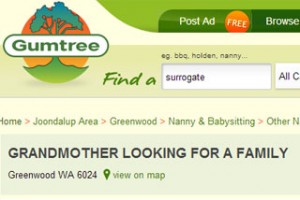
surrogate-grandparentsGreenwood woman “Penny” is in the market for somebody else’s grandchildren.

The mother-of-two has a degree in children’s studies, a Working With Children card, a car seat and foldable cot.

But she’s not looking for babysitting work.

Older West Australians like Penny with time on their hands have turned to online free classifies website Gumtree and organisations like ‘Find a Grandparent’ to connect with families “in need of a grandparent in their life.”

And there’s a growing market for them, as families seek out “surrogate grandparents” to enrich their childrens’ lives in lieu of available or able blood relatives.

“We don’t have much family in Perth and our kids are missing out,” a Balcatta mother posted on Gumtree in June.

“Please contact me if you are calm, kind and patient and want to know more.”

But prominent law firm Slater and Gordon has warned families that “surrogate grandparent” relationships may be mutually beneficial, but also come with potential legal issues.

“I am not looking for financial gain however I will say that I do want a give and take relationship,” Penny wrote in her advertisement.

“If you are lonely and needing help looking after your children and don’t have access to your own grandparents then please make contact with me as I think we can make a friendship that is mutually beneficial.

“Children are great company I have two sons but I would like a granddaughter to spoil.”

Slater and Gordon family law specialist Ian Shann said people were having children later in life,  pushing the age of natural grandparents up, which coupled with separations and reallocations, was seeing more children miss out on the benefits of a grandparent in their life.

“Instead of being in your 50s or 60s as a grandparent you’re in your 60s or 70s and you’re less capable of looking after grandchildren,” he told 6PR’s Jane Marwick on Friday.

And with nearly 50 per cent of child care in Australia provided by grandparents, according to Mr Shann, surrogate grandparents also promised a welcome reprieve for parents lacking family support.

“Because of these social changes and people having children later a bit of a movement has sprung up of surrogate grandparents: people who put themselves up to look after kids as if they were their grandparents because kids are missing out on the grandparent relationship,” Mr Shann said.

While Mr Shann acknowledged these arrangements could fill important needs for both parties, he warned of the possible legal complications.

“People then become involved in your family as if they were a grandparent,” he said.

“But there are some issues here because not only grandparents have rights under family law, but theoretically surrogate grandparents could have rights as well.

“Anybody who has got an interest in the welfare of a child can bring an application in the family court so if you fall out with your surrogate grandparent, don’t think that’s the end of the story.”

Asperger’s father loses almost all access to his children

court-judgmentA father with Asperger’s syndrome is reeling from a judge’s decision that the time he spent with his children was so poor it should be cut from 30 hours to four hours a fortnight.

The man, who was given the pseudonym “Mr Bratsch” by the Federal Circuit Court, previously spent every second weekend with his children, but their mother sought orders requesting sole parental responsibility and for his time to be reduced to six hours a fortnight.

He told the court that statistically it was more dangerous for his son to get into the car with a P-plater than to stay in his cot unattended.

She said his Asperger’s syndrome meant he lacked empathy, misread the children’s emotions and there was ” no fun, joy or humour” in the relationship between them.

He believed that after-school activities were a waste of time that took them away from their homework, and read them books that were beyond their years, such as The Magic of Reality by biologist Richard Dawkins.

Many hours were spent trying to improve his 11-year-old daughter’s maths skills, and his son, 9, felt hurt and rejected when he was left to his own devices.

He responded by throwing things at his father or flicking the lights. Once he knocked over a table, which pleased Mr Bratsch as a sign that he felt free to express himself.

Judge Robyn Sexton said there were numerous examples of Mr Bratsch displaying poor insight and lacking parental capacity, including the time he left his then infant son in his cot with a box of chocolates while he dropped the daughter at daycare.

Questioned about this decision, he told the court that statistically it was more dangerous for his son to get into the car with a P-plater than to stay in his cot unattended.

He taught the children about sex when they were aged 8 and 10, including the subject of sexual assault, since the daughter was by then “old enough to be raped”.

And he strongly disapproved of the children attending scripture lessons, to the extent that on two separate occasions he went to their school and wandered in and out of classrooms until he found them and pulled them out of class.

Judge Sexton went further than the orders sought by the mother, reducing Mr Bratsch’s time with the children to four hours, to be spent in “positive engagement … not merely for the sake of spending time”.

If the father wanted to take them on an outing that would interest them, the time could be extended, she said.

Mr Bratsch had lodged plans to appeal.

A clinical psychologist, Julie Peterson, said the children of people with autism or Asperger’s were sometimes traumatised by their parents’ behaviour.

But even though they appeared to be emotionally limited, those parents were devastated when courts elected to remove the children from their care.

“We know they love their children, most of them,” Dr Peterson said. “They feel the grief and loss.”

Single mum caught in $17,000 Centrelink rort

centrelink-fraudA SINGLE mother will have to repay more than $15,000 in Centrelink overpayments she claimed while working for an insurance company.

Shandell Trace Preston, 36, had already started paying the total amount of $17,165.29 when she appeared in Toowoomba Magistrates Court on Tuesday.

Documents obtained from Commonwealth Director of Public Prosecutions Ben Satiu showed Preston was under declaring her income when claiming single parenting payment.

The offending began in April 2010 and continued for nearly two years. Preston was working on a permanent basis as a claims assistant for Suncorp Metway at the time. Defence solicitor Claire Graham said her client was the primary carer for her nine-year-old child and eight-year-old twins.

Ms Graham said her client was suffering depression at the time of the offending and did hope to keep her job. Magistrate Roger Stark noted a psychologist’s report as well as other matters which had made Preston’s life difficult.

He placed her on probation for 18 months and ordered she make $15,322 in reparations to the Commonwealth.