Melbourne mum faces breath-testing in $20m custody fight at Family Court

breath-testing deviceA MELBOURNE mum has been ordered to install a breath-testing device in her home as part of a $20 million custody and property fight.

The woman’s former partner asked for an alcohol interlock device to be put in her car to ensure the safety and wellbeing of their sons.

But she opposed the order claiming it was “unduly harsh and oppressive”.

The Family Court heard the pair are locked in a dispute about how to divide their property and organise custody of their 10 and 14-year-old boys.

The mother currently has her eldest son overnight once a week and the youngest for three hours after school one day.

She agreed to court orders banning her from consuming alcohol 24 hours before having the children in her care and attending random blood-alcohol screening.

The court also allowed her to attend her sons’ sporting or school events as long as no alcohol was available.

But the mother denied the orders were necessary and made no admissions about her drinking.

The father pressed for an interlock device to be installed on the mother’s car and was backed by a doctor who said it would give the children “an increased sense of confidence and security”.

The mother said she had not had a drink in 14 months and had no “alcohol-related driving conviction”.

Justice Peter Young said the interests of the children could be satisfied by having a breath-test machine in the mother’s home or garage.

He said she would have to observe a zero alcohol reading before driving the children anywhere within suburban Melbourne.

The court heard the readings would be recorded, along with a photograph, and provided to the court’s children’s lawyer.

The court orders also provided for the children to travel to their mother’s house from school by tram and be driven by their father on other access days.

Gillard flags Fair Work changes

julia-gillard-fair-work-actParents will have the right to request part-time work when they return from having a baby under changes to workplace relations laws, Prime Minister Julia Gillard says.

Ms Gillard says the government wants to take some off the burden off modern families who are struggling to balance work with caring for children and sometimes elderly relatives.

Labor will seek to legislate as soon as possible to allow parents to request a return to flexible and part-time work as it works through the recommendations of its review of the Fair Work Act last year, she says.

“And their employer will have to respond to that (request),” she told reporters in New Zealand on Sunday.

About 80 per cent of requests were satisfactorily resolved, but Ms Gillard said formalising the right would make employees more comfortable asking and the legislation would apply to mothers and fathers.

She said the government would deal with the second tranche of announcements this week and flagged further changes later in the year.

“The focus this week will be on that part of the workplace relations agenda which is really about work and family life,” she said.

The prime minister said the government would also discuss some protections for roster changes and the onus on employers to consult their workers ahead of any changes.

Giant legal leap for gay dads

Gay Dads-parental-rights-judgmentTwo gay dads have become the first in Australia to have started a family via overseas surrogacy and successfully gained full parental rights.

Australian gay fathers who’ve travelled overseas to start a family through commercial surrogacy are still not recognised as parents, state or federally, but a recent court ruling may have cleared a way for other WA gay couples, and possibly set a precedent in other states.

The Western Australian Family Court allowed a co-father to adopt his twin children, who were born via a commercial surrogacy agreement in India, on January 10.

Charles Blake and James Marston, whose names were changed, applied for Blake to become a step-parent to the twins.

The court heard both Blake and Marston, who was the biological father, had raised the children since birth.

The surrogate mother, Mrs Sengupta, had relinquished her full parental rights as part of the surrogacy process.

In order for Blake to have received any parental rights over the children, he could have sought a parentage order or adopted them since WA allows same-sex adoption.

In her ruling, Justice Jane Chrisford said while the court was satisfied Marston was a father in its ordinary meaning, state law did not recognise him or Blake as a step-parent.

“To suggest that Mr Marston is anything other than a parent or a father within its ordinary meaning is to turn a blind eye to the reality of ‘family’ in present day society,” she said.

While most biological dads are recognised by the Department of Immigration and Citizenship on entry into Australia, they are only recognised as sperm donors by the federal Family Law Act 1975.

Gay Dads Australia spokesman Rodney Chiang-Cruise said it was a significant ruling despite it only really affecting WA dads.

“Firstly because the biological dad was legally recognised by the court as being a parent and up until fairly recently the treatment was the biological dad was determined to be a donor under the federal legislation,” he said.

“Because of that, that meant his partner was eligible to adopt the child and also be considered the legal parent.

Harrington Lawyers family lawyer Stephen Page told the Star Observer many people who went overseas for surrogacy wanted to be recognised as parents.

“They’ve got kids, they want them to be recognised as their own,” he said.

“If they go to the Family Court and get a parenting order that won’t show them as the parents, that’ll just show they have parental responsibility over the child.

“What’s significant about the WA case is the judge says let’s look at the reality – I think that’s just illuminating.”

Lesbian co-mothers can be recognised as parents under federal law, and can have both names added to birth certificates.

Springwood father takes battle for lost son to Canberra

Springwood father Daniel Wass

Springwood father Daniel Wass

Springwood father Daniel Wass took his ongoing battle to find his missing three-year-old son on the road on Saturday, cycling to Canberra to increase political pressure to find a solution to his parental nightmare.

Mr Wass’s son, Sean Jukia Wass, has vanished in Japan after being taken from Australia by his former partner, Yuka, when he was just 14-months-old.

Despite numerous court orders, including a Find and Recovery Publication Order from the Family Court of Australia, Mr Wass does not know the location or welfare of his son.

His situation has seemingly been put in the diplomatic ‘too hard basket’ as Japan is not a member of the Hague treaty which deals with abducted children.

“In addition to Japan’s family law, Australia’s policy, procedure and assistance in international parental child abduction cases to non-Hague countries is very poor. It’s almost non existent to the extent there is a preserved reluctance to assist,” said Mr Wass.

He was due to meet with opposition foreign affairs spokeswoman Julie Bishop when he arrived in Canberra yesterday (February 5) although the outcome of the meeting was not known at the time of going to press.

He also planned to present a petition supporting his case to Federal Member for Macquarie Louise Markus, who wished him well before he left Springwood early on Saturday morning.

The petition calls on the Australian Government to “take a stance, strengthening domestic policies and developing a bilateral agreement with Japan that facilitates the return of children who have been abducted from Australia until such time as Japan becomes a signatory to the Hague Convention”.

“In addition to Japan’s family law, Australia’s policy, procedure and assistance in international parental child abduction cases to non-Hague countries is very poor. It’s almost non existent to the extent there is a preserved reluctance to assist,” said Mr Wass.

It also requests the government take “immediate action to confirm the location, safety and welfare of Sean Jukia Wass”.

Mr Wass rode part of the journey with Ken Thompson, another dad whose child was abducted.

“I was lucky enough to have Ken join me at the 70km point through to Bowral (120km) and then the next day all the way to Goulburn,” he told the Gazette from the road.

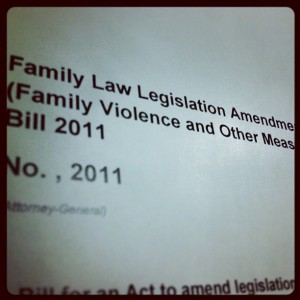
Family Violence Amendments: developments by the Federal and NSW Governments

Family-Violence-AmendmentsSix months on

Amendments to the Family Law Act that changed the way the law addresses family violence in family law matters came into force from 7 June 2012. These changes were introduced by the Federal Government following more than two years worth of lobbying and input by the Australian Law Reform Commission, members of Parliament, various representatives of the legal profession and other groups of interest.

Importantly, the changes apply to all family law cases before the Family Court and the Federal Magistrates Court, regardless of whether the proceedings were started before or after 7 June 2012.

What are the amendments?

Prior to 7 June 2012, “Family Violence” was defined by the Family Law Act as “conduct, whether actual or threatened, by a person towards, or towards the property of, a member of the person’s family that causes that or any other member of the person’s family reasonably to fear for, or reasonably to be apprehensive about, his or her personal wellbeing or safety“.

From 7 June 2012, Family Violence has a more succinct definition and the legislation goes further and actually sets out a list of examples of what can include domestic violence and examples of situations that may constitute a child being exposed to domestic violence (Family Law Act, s 4AB).

Whenever a Court hears a parenting matter, the benefit to a child of having a meaningful relationship with both parents and the child’s right to be protected from physical or psychological harm are the two primary factors in considering what is in a child’s best interests. The amendments now require the Courts to give greater weight to the need to protect a child from physical or psychological harm over the benefit to the child of having a meaningful relationship with both parents.

Why were the changes introduced?

The changes to the Act were brought about for a number of reasons. Primarily, it was due to the increasing statistics of domestic violence in Australia, the apparent reluctance of victims of domestic violence to report acts of violence and the need for clarity when applying the law to parenting cases involving allegations of domestic violence. This last reason is particularly significant because more than half of the parenting cases heard before the family law courts involve allegations of domestic violence.

What do the changes mean for your family law matter?

The main changes we will see as a result of the amendments to the Family Law Act will include:

  • Greater priority will be given to a child’s safety and welfare (the benefit to a child of having a meaningful relationship with both parents is not forgotten however; it remains one of the two primary considerations in determining a child’s best interests);
  • There will be greater onus on advisers such as lawyers and counsellors to appropriately advise parents in matters relating to children;
  • The family law courts will now have clearer access to evidence relevant to family violence which will help to improve the suitability and appropriateness of any parenting orders;
  • The new definition of family violence will give greater understanding to parents of what family violence means, and clearly sets out what behaviour is unacceptable;
  • Clients and their lawyers will be able to prepare clear and relevant evidence in their case as a result of the new definition of family violence (in the past it was more ambiguous);
  • Child protection authorities, such as the Department of Families, Housing, Communities and Indigenous Affairs (formerly the Department of Community Services) will be able to act with greater certainty.

Despite the aim of the amendments being to assist victims of domestic violence to properly disclose relevant acts of violence and better understand what actually constitutes family violence, it is sometimes the case (unfortunately) that allegations of domestic violence raised in a family law matter are false. If a person is found to have knowingly made false allegations of domestic violence, the family law courts will continue to have the power to make costs orders against the accuser and it remains a criminal offence to knowingly make a false statement in court proceedings.

In cases that do not involve family violence, the amendments to the Act will have little impact upon how the family law courts will determine those matters.

In the future

At a State (New South Wales) level, the Government is in the process of preparing a Domestic and Family Violence Framework. This Framework is being set-up following a number of recommendations made by a Parliamentary Committee that was formed to review the current domestic violence legislation and the services available for victims of domestic violence.

The recommendations made by the Committee included the funding of specific domestic violence liaison officers throughout New South Wales, changes to Apprehended Domestic Violence Orders, particularly at an interim level, and greater attention being given to early intervention practices.

We expect to hear more about these changes when the Framework is released for public comment later in 2013. Overall, however, we can be assured that both the State and Federal Governments are trying to streamline legislation and put adequate systems in place to address family violence and to prioritise the safety and wellbeing of children.

The content of this article is intended to provide a general guide to the subject matter. Specialist advice should be sought about your specific circumstances.

Specific Questions relating to this article should be addressed directly to the author.

Gotcha tapes disliked by court

audio-surveillanceIT COULD be called gotcha litigation, except that it usually backfires on the party laying the trap.

Family court lawyers have observed a trend among litigants to secretly record themselves in conversation with their partners in an attempt to gather evidence against their foe.

It rarely pays off.

Federal magistrate John Coker said of one such recent case that the recording held little probative value and reflected worse on the person who made it.

”It is a matter which arises all too frequently, particularly in family law proceedings, and seems to have gathered support not only from parties to proceedings but also from legal representatives,” Mr Coker said in his judgment earlier this month.

”It would seem, clearly, to be an evidence-gathering exercise and one that, in my view at least … gives rise to serious concerns as to the behaviours of the party who records such evidence.”

Rachel Stubbs, a family law solicitor based in Wollongong, said it was a common technique among parents, but one she did not encourage.

One client recently wanted to use videotape evidence of her child refusing to go to her father at handover to prove the girl was unhappy in his custody.

Ms Stubbs refused to use the footage in court, and the client took her business elsewhere.

”I think [judges] see it as adding to the conflict, and it does add to the conflict,” Ms Stubbs said.

”I’ve seen it happen where parents have coerced children into making allegations of abuse by the other parent where there’s little other evidence. It reflects extraordinarily badly on the parent.”

The Family Court has grappled with the admissibility of such evidence.

A judge ruled in Hazan v Elias last year that the father’s recording of his conversation with the family consultant was inadmissible under the Evidence Act.

But in a 2008 decision, Latham v Latham, the court allowed the father to tender recordings of the mother that ”painted her as a seriously bad child abuser”, because the benefits of the evidence outweighed the way it was obtained.

The case before Mr Coker was a custody dispute in which a friend of the mother taped conversations to hold up as evidence that the father publicly denigrated the mother.

In one recording the father described the mother as ”old”, which Mr Coker said was clearly spoken in jest.

”There is little weight that can be put on evidence gathered in that manner,” he said.

The party who knew the recording was being made was likely to be on their best behaviour. But the behaviour of the other person could not be taken as typical, given the emotional nature of marital disputes, and especially those involving children.

Graeme Page, SC, who represented the father, said recordings could be a useful evidence-gathering exercise, but they were worthless in court.

”They quite often give information to counsel as to what has taken place and the nature of the person and the way that [counsel] will cross-examine them,” Mr Page said.

Family provision – are parents obliged to provide for an estranged adult child?

will-and-testamentThere is a tension between the right of a Will-maker to choose who will benefit from his or her estate and the frequent expectation by adult children that they will be the primary beneficiaries of their parent’s estate.  The law recognises this tension and attempts to balance competing interests by allowing a Will-maker to leave their estate as they choose and also allowing disappointed children to make a legal claim for some or further provision from a deceased parent’s estate.

Estrangement

The question of appropriate provision is further complicated when the relationship between the adult child and the parent was marred by estrangement.  Estrangement is a rift in relations and may be used by a parent as a reason to reduce a child’s benefit under a Will or to deny them any benefit at all.  The Court must weigh this factor against the child’s need for provision from the estate by determining what moral duty (according to prevailing community standards) the parent had to provide for the child.

The Succession Act (2006) (NSW) allows a child to make a claim for some, or further, provision from a deceased parent’s estate.  The Court may make an Order for a child’s proper maintenance, education or advancement if satisfied that there is justification for doing so.

The Succession Act contains a list of matters that the Court may take into account when considering whether or not to make provision from an estate for a claimant.  These include the:

  • family relationship between the child and the parent, including the nature and duration of the relationship;
  • nature and extent of any obligations or responsibilities owed by the parent to the child; and
  • character and conduct of the child before and after the parent’s date of death.

The Court will look at the reasons behind the estrangement and may find fault with either or both the parent and the child, and if appropriate, adjust entitlements in the estate accordingly.

Two matters determined in the NSW Court of Appeal in 2012 provided further commentary on estrangement between an adult child and their parent.

Keep v Bourke

Joyce Keep left her entire estate to two of her children, to the detriment of her other child, Marion Bourke, from whom she was estranged for 38 years.  Mrs Keep’s Will included the following statement:

“I HAVE made no provision in this my Will for my daughter MARION GAY BOURKES [sic] because of her complete lack of concern or contact with me and other members of my family over a long period of time”.

The breakdown in relations commenced in 1971 when Marion’s parents did not approve of her marrying and returned their wedding invitation with a note saying “we do not want anything to do with you”.  Marion saw her mother five times in the ensuing 38 years, the final time being Marion’s only deliberate effort to see Mrs Keep, having been notified of her impending death.  Mrs Keep had made no attempt to see Marion at all.  Mrs Keep was held to be the instigator of the separation, though Marion did not attempt reconciliation.

The Supreme Court made a determination that Marion had a need and was entitled to provision of $200,000 from an estate worth $623,000, despite the competing claims of her siblings, who were also in need of provision.  The Court of Appeal adjusted Marion’s provision to $175,000, there being “a reduction recognising Marion’s contribution to the estrangement”.

Andrew v Andrew

Like Keep v Bourke, this case involved a long estrangement between a daughter, Lynne Andrew and her mother, Rita Andrew.

There was no hostility between Lynne and her mother, rather, the relationship simply faded after Lynne graduated and left home in the early 1970s.  Lynne later suspected that Mrs Andrew would disown her for having a child out of wedlock and also on account of her homosexuality.  No evidence was tendered that Mrs Andrew disapproved of the illegitimate child or that she was aware of Lynne’s homosexuality.

Having received a legacy of $10,000 in the Will, the Supreme Court had determined that Lynne should receive no additional provision from Mrs Andrew’s estate.  However, the Court of Appeal determined that Lynne should receive an additional $50,000 from an $800,000 estate despite initiating and maintaining the estrangement:

“As explained by the primary judge, the term “estrangement”, which was aptly applied, does not describe conduct, but the condition which results from the attitudes or conduct of one or both parties…  At least when kept within reasonable bounds, the negative consequences of such a process should arguably be ignored or at least not given disproportionate significance when assessing the expectation that a parent will provide for a child whose condition in life is financially disadvantageous, when compared with other claimants on the testator’s conscience.”

Conclusion

These two cases are similar in that they involved estrangements of over 35 years between a daughter and her mother.  Both daughters demonstrated that they had need for provision from their mothers’ estates but the outcomes were substantially different, in part according to who was considered to have initiated and maintained the estrangement.

Every family provision claim is different and will be judged upon the facts (importantly, including the needs of the claimant and the other beneficiaries).  Whilst estrangement can certainly be a factor in reducing a child’s claim on their parent’s estate, the Court will not necessarily regard it as justification for virtually or totally excluding an adult child as a beneficiary.

New science would let Folbigg go free

Kathleen Folbigg - child murderer

Condemned … Kathleen Folbigg was convicted of murder.

ONE of Australia’s top forensic law authorities believes the convicted child killer Kathleen Folbigg would walk free from jail if granted a retrial today – because of inaccurate evidence presented at her original trial.

Gary Edmond, a legal expert in forensic science at the University of NSW, believes a recent review of case material demonstrates that Folbigg’s trial was tainted by unreliable, misleading and now outdated medical evidence.

”It is quite likely that experts provided evidence at the trial which they might not give today – and this needs to be reconsidered because you can’t have someone remain in jail just because they were prosecuted at a particular point in time … especially if the science has moved on,” he said.

Professor Edmond pointed to Jeffrey Gilham and Gordon Wood, both of whom suffered a miscarriage of justice due to flawed forensic submissions, and argued there was a ”very real possibility” that Folbigg had suffered the same fate.

”In the past few years, there have been startling revelations about problems across forensic science and medicine which should give us even more pause for what has gone in the past, particularly in controversial areas.”

Folbigg is serving a reduced sentence of 25 years after she was convicted in 2003 of murdering her children Patrick, eight months, Sarah, 10 months, and Laura, 19 months, between 1991 and 1999, and the 1989 manslaughter of her son Caleb, aged 19 days. While the causes of death were never determined, a picture emerged during the trial of an emotionally fragile mother with a personality disorder – whose damaging diary entries were interpreted as literal admissions of guilt.

But Folbigg has always maintained her innocence and Professor Edmond argues that with no scientific evidence proving any of her babies were murdered, the diary extracts alone are ”insufficient” to keep her in jail, adding: ”They add verse but, you also have to say, they’re pretty ambiguous.”

Once, four infant deaths in the same family automatically pointed to murder but as the legal academic Emma Cunliffe has demonstrated through six years of extensive research, that is no longer the case.

Doctor Cunliffe has written to the NSW Attorney-General, Greg Smith, attacking the medical research presented at Folbigg’s trial as incomplete and misleading.

A detailed legal submission is also being finalised – confirming how expert knowledge surrounding multiple infant deaths has increased dramatically since Folbigg’s trial a decade ago.

Dr Cunliffe, who has published her findings in a book titled Murder, Medicine and Motherhood, said: ”Folbigg was prosecuted at a moment in time when there was a particularly punitive account of multiple infant deaths in a given family. That moment passed.”

Dr Cunliffe cites at least eight similar cases worldwide in which mothers, in recent years, have been accused of infant murders – many of them multiple crimes. They include the Melbourne woman Carol Louise Matthey, who was charged in 2005 with smothering four children over five years. ”All the other women subjected to that form of prosecution have either been acquitted by courts of appeal or have had the evidence against them excluded by judgment,” Dr Cunliffe said. ”Folbigg is the last one standing.”

Dr Cunliffe and Professor Edmond are not the only voices calling on Mr Smith to reopen the case. Professor John Hilton, who conducted the autopsy on Folbigg’s second child, Sarah, in 1993, agrees a review is ”warranted”.

Professor Hilton, who was called by the prosecution as a witness in the Folbigg trial, said: ”We live in a changing world. Medicine and science never stand still – they progress. Now obviously, I sit on the medical and scientific side of all this … but it seems to me the conviction stood, or was based on, the diaries … which were open to multiple interpretations.”

He added: ”If you read the court transcripts, you will see that my evidence was hardly favourable to the prosecution’s case.”

Professor Stephen Cordner, who is foundation director of the Victorian Institute of Forensic Medicine, believes Dr Cunliffe’s analysis demonstrates Folbigg was ”wrongly convicted”.

”It can only be a matter of time before there’s a formal review of this case … it’s been happening all over the world,” he said.

He added: ”While homicide was a possibility, there was no pathology evidence to support it.”

Of Folbigg’s diary extracts, Professor Cordner said: ”It is well recognised that self-blame is a common response to infant death.”

While all of Folbigg’s legal avenues have been technically exhausted, a spokeswoman for the Attorney-General confirmed on Saturday an application for review can be lodged under the Crimes (Appeal and Review) Act 2001.

How the case against a mother unfolded

FEBRUARY 19, 1989 Caleb dies; aged 19 days. Originally thought to have died of Sudden Infant Death Syndrome. Now deemed to have died of suffocation.

FEBRUARY 13, 1991 Patrick dies, aged eight months. Originally believed to have died of a blockage of the airways due to an epileptic fit. Now deemed have died of suffocation.

AUGUST 30, 1993 Sarah dies, aged 10 months. Originally thought to have died of SIDS. Now deemed to have died of suffocation.

MARCH 1, 1999 Laura dies, aged 19 months. Cause of death not determined.

APRIL 19, 2001 Kathleen Folbigg is arrested at home after a two-year police investigation.

MAY 21, 2003 Found guilty of murdering Patrick, Sarah and Laura and of the manslaughter of Caleb; found to have inflicted grievous bodily harm on Patrick in 1990.

OCTOBER 24, 2003 Sentenced to 40 years’ jail with a non-parole period of 30 years.

FEBRUARY 17, 2005 Sentence reduced by 10 years and her non-parole period by five years. Appeal against sentence dismissed.

DECEMBER 21, 2007 Loses a second appeal in the NSW Supreme Court. Will be eligible for release in 2028, at age 61.

Mrs X siphoned off 3 million from vulnerable husband

mrs-x-financial-fraud

Fraudster siphoned $3m from husband.

AS she smiled for the camera, the bride knew her wicked plan was on track. Soon she would fleece her new husband of his millions and be set for life.

Dressed in a demure gown and holding a simple bouquet, the bride exchanged vows with the man before her, and in the eyes of the law, became Mrs X.

For legal reasons, The Sunday Mail cannot name the South Korean woman or her husband.

Lonely after the death of his second wife, the Brisbane man, 82, was pining for companionship, and in May 2011, Mr X met his wife-to-be.

The millionaire’s deteriorating health was a blessing and a curse for the 55-year-old bride.

Mr X, once an astute and successful businessman, began losing his short-term memory and the ability to make complex decisions after he suffered two strokes in 2011.

It meant sometimes he also forgot he was married or the name of his new wife.

Between July and November 2011 – only weeks after they met – Mr and Mrs X married three times, in South Korea, Australia and the US.

It wasn’t long after their first ceremony that Mrs X began transferring cash from Mr X’s bank accounts into new accounts that she had set up.

Queensland Supreme Court documents reveal Mrs X moved the money to South Korea, then back to Australia to fund a new company.

Within eight months she had siphoned more than $3 million out of her husband’s accounts and bought three businesses in Brisbane and properties in South Korea.

Mrs X knew arrangements were in place at Suncorp’s Chermside branch that prevented large amounts of cash being transferred without “certain protocols” being met, so each time she took her husband to different branches in Queensland and NSW to move his money.

If it wasn’t for the man’s family, and their application to appoint the Public Trustee as the official administrator of his assets, the “unconscionable” fraudster would have stolen more and got away with it.

Now the Public Trustee has sued her and her company for dishonestly stealing her husband’s money.

And on October 9 last year, becoming concerned that the South Korean national had advised she would soon leave Australia, the Public Trustee sought and won orders that froze her and her company’s assets and interests. It also seized her passport.

But the woman’s passport was returned when she gave assurances to the court she would return to Australia by October 26 to give evidence.

The next day she left the country and has not returned.

In December, Justice Anthe Philippides ordered she repay the Public Trustee more than $3 million on behalf of the ageing Brisbane man.

“I am satisfied that (she) implemented a scheme to orchestrate and effect the transfer of moneys to her and (her company),” Justice Philippides said.

“I am satisfied that (Mrs X) . . . (deliberately took advantage and exploited her husband’s) known vulnerability and mental impairment.”

On January 15, Mrs X filed an appeal but is is not known if the court will grant her leave to file the matter.

Mr X now receives 24/7 care in his home and cannot recall the cruelty inflicted upon him.

‘Split’ pair war under same roof in Family Court saga

seperated-under-one-roofWARRING parents have continued to live under the one roof in one of Queensland’s most exclusive precincts while waging an ugly legal battle over a family fortune by communication via their high-powered lawyers.

The extraordinary property saga is laid bare in a recently released Family Court judgment, which gives the go-ahead for an unprecedented property fight between the couple who have tried for seven years to salvage the marriage through religious counsellors.

Family Court Judge Elizabeth O’Reilly rejected a legal bid by the wife for a “summary dismissal” of her husband’s application to give her the lion’s share of a 60-40 property split if they divorce.

According to the judgment, the wife had rejected his previous attempt to reach a consensual financial agreement – even funding her legal fees to the tune of $41,000 – to “secure certainty” for his work as a “last ditch attempt to salvage the marriage”.

She is now fighting his attempt for a court-ordered property settlement, arguing it is an “abuse of process” as he is trying to protect the “succession arrangements” of his work.

If successful, it could be the first property split in an “ongoing” marriage in Australia. The husband is relying on a legal loophole that allows property proceedings not only in cases of separation or divorce, but in any other “fact or circumstance”.

While fighting through the courts, the couple have stated in court documents they are trying to make the marriage work. But the husband has accused his wife of “openly and strongly criticising him to friends and family”.

His barrister said the couple were living as “single people under the one roof” and “dealing with each other through solicitors” for three years in the lead-up to the court case.

He said the marriage was “plainly a distressed one”, with “constant arguments” and close to “non-existent” physical relations. The wife had also made legal threats to have him “removed from the home”.

“He believes in the institution of marriage . . . (and) has thus far remained in an unhappy marriage he says due partly to his religious convictions,” the barrister said.

He argued the husband was “concerned to protect” the interest of others involved in his work.

“He sees the achieving of this financial certainty as essential; to have it would provide the foundation he requires to continue to pursue the married relationship.”

Judge O’Reilly said the case was “unusual, if not novel”, but said the husband had “jurisdiction” to pursue it despite the wife’s arguing it did not take into account future property purchases and more children.

She also rejected the wife’s bid to “stay” the legal action as the court was legally bound to have regard to “the need to preserve and protect the institution of marriage”.

However, a fact sheet on the Family Law Courts website provides details of the process for couples “separated but living under the one roof”.

Family and Relationship Services Australia executive director Steve Hackett said the practice was growing.

“They are doing it for a variety of reasons, primarily financial because dividing up the assets means that everyone is less well off and under more financial stress,” he said.

Women’s Legal Service lawyer Angela Lynch said the GFC had led to an increase of couples opting to separate under the one roof.

“Possibly a lot of the times it has been an economic decision,” she said. “When it is a situation of violence, they are putting up with verbal and physical abuse and it is often . . . being played out in front of the kids.”