
Japan to finally join Hague Convention on child abduction

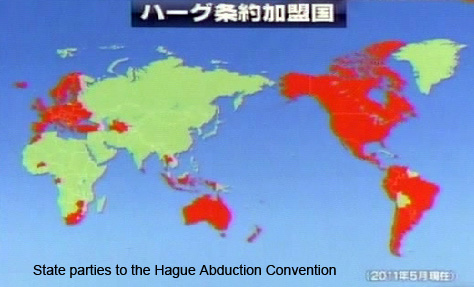
hague-member-statesIt may have taken more than 30 years, but Japan is finally joining in the 1980 Hague Convention, in which it is required to return abducted children to their usual place of residence in case of failed international marriage.

A government spokesman said that Prime Minister Shinzo Abe’s Cabinet has already given its approval and will immediately submit the necessary legislation to parliament.

Japan is the only Group of 8 member who was not a signatory to the convention. Thus, for the longest time, non-Japanese parents, usually the fathers, are left without a recourse should their former spouse remove the child from wherever they used to live and bring them to Japan.

It is to be noted that unlike other western countries, Japan does not recognize joint custody and it often grants custody to the mother of the child. It looks that things are starting to change now. Chief Cabinet Secretary Yoshihide Suga said, “It is important for our country to join the Hague Convention that sets international rules on dealing with illegal kidnapping of children, now that the numbers of international marriages and international divorces have increased.”

During Abe’s visit last month with U.S. President Barack Obama, he had promised that Tokyo will take part in the treaty. In the past few years, the Japanese government has always said that they will sign the treaty, and yet, it never did. In fact, this issue has been one of the few conflicts between the two countries. This time, perhaps, because Abe seeks to find favor with the U.S. government, he has made good with this promise, whereas others before him obviously have not.

Related Family Law Judgments

Legislation passed to facilitate the merger of the Family Court of Australia and the Federal Magistrates Court of Australia

family-court-of-australiaThe Family Law Act 1975 has been amended by the Courts and Tribunals Legislation Amendment (Administration) Act 2013.

This Act makes amendments to the administrative structures and processes of the Federal Court of Australia, the Family Court of Australia and the Federal Magistrates Court of Australia.

In particular, the Act will amend the Family Law Act and the Federal Magistrates Act 1999 to facilitate the merger of the administrative functions of the Family Court of Australia and the Federal Magistrates Court of Australia.

The Explanatory Memorandum provided that the changed administrative structures and processes will allow these agencies to achieve savings and operate more efficiently and effectively into the future.

Final confirmation is awaited in relation to the commencement date.

Anti-Vaccination network faces deregistration for misleading public

The AVN has been blamed for a growing number of parents refusing to vaccinate their childrenTHE future of the Australian Vaccination Network is in doubt, following the government rejection of five suggested new names for the group because they don’t reflect its anti-vaccination stance.

The AVN has until March 21 to change its name or it faces deregistration, after NSW Fair Trading Minister Anthony Roberts issued a formal order that its name misleads the public.

The organisation does not present a balanced case for vaccination and has no medical evidence to back its anti-vaccination stance, he says.

The controversial group has been attacked by doctors and scientists for discouraging parents from vaccinating their children and NSW Fair Trading has received complaints about its name.

The organisation will this week attempt to thwart the minister’s order through an appeal in the NSW Administrative Decisions Tribunal.

AVN president Greg Beattie told News Limited it was vital the words Australia and Vaccination remained in the group’s name because they defined what the organisation was about.

The organisation does not present a balanced case for vaccination and has no medical evidence to back its anti-vaccination stance, he says.

He said the group had sent a letter to the Fair Trading Department to ask whether they would accept one of five suggested name changes.

These include Australian Vaccination Information Network and Australian Vaccination Choice.

“We can’t just change our name under the Association’s Incorporation Act, we must go through a process of consulting with our members and we need a 75 per cent majority vote,” Mr Beattie said.

“We’ve had the name for 19 years, so we want as small a change as possible.”

Mr Roberts said he was demanding the name change “because we will not tolerate parents being misled by its name and children’s health being put at risk”.

“Here’s my tip for the AVN, suggest a name which reflects your anti-vaccination stance.”

Australian Medical Association president Dr Steve Hambleton said parents visiting the AVN’s website may think they were getting a balanced view of immunisation, rather than just the case against.

“The name changes they are proposing still suggest they are providing both sides of the argument when indeed they don’t,” he said.

The lobby group has been blamed for a growing number of parents refusing to vaccinate their children, a move that reduces the herd immunity from vaccination and potentially exposes babies and children to deadly diseases like whooping cough and measles.

Late last year, the Academy of Science published a guide for parents on the importance of vaccination to fight the group’s influence.

The number of Australian babies not fully immunised is now one in 12 and the number of parents registering a conscientious objection to immunisation has leapt from 4271 in 1999 to more than 30,000.

Professor Ian Frazer, who developed the cervical cancer vaccine, has warned immunisation levels for some diseases were falling below those required to prevent deadly outbreaks.

Parents’ war over daughter’s schooling ‘insidious’, claims Magistrate

Federal Magistrate Tom Altobelli

Federal Magistrate Tom Altobelli

A FRUSTRATED magistrate has declared the hatred of two parents engaged in a war over the schooling of their daughter so “insidious” it would constitute a “weapon of mass destruction” if bottled.

The scathing attack by Federal Magistrate Tom Altobelli followed a bitter court-room brawl between the mother and overseas-based father of a Grade Seven student, who narrowly-avoided being uprooted from her school earlier this year

The ruling, after a seven-day trial, has set up another legal showdown as the “resilient” 12-year-old, who is one of three children caught in their parents’ cross-fire, faces a possible challenge from her father to move her at the end of 2013.

Mr Altobelli declined to give exact details of the conflict, but declared the father the “winner by a nose” in the race for most “toxic communication” in the five-year marriage breakdown.

“(It) is a photo finish, but this steward finds that (the father) was ahead by a nose,” Mr Altobelli said.

“Clearly the father has no insight that toxic communication from him invites a toxic response, a criticism that might equally be levelled at the mother.”

He ruled in the mother’s favour after the girl requested to remain at her mother’s chosen school.

“(If) it were possible to bottle the hatred between the parents it would constitute an insidious weapon of mass destruction,” Mr Altobelli said.

“Unless the court expresses indignation on behalf of the children for what the parents have done, for what the parents are doing, and for what the parents are likely to do in all probability in the future, the children’s voice will most likely never be heard.”

“The behavior of both the mother and father in this case is appalling.

“It is an understatement to say that the communication between the mother and father tends to be toxic.”

While the father won the title for “most toxic communicator”, Mr Altobelli singled-out the mother for her arrogance and totally self-absorbed behaviour.

He said she was “plainly” motivated by child support issues.

Mr Altobelli refused to grant the mother an order which would see the daughter complete her secondary schooling at the current school.

It is now open for the father to launch a second legal challenge at the end of the school year.

Mr Altobelli said the ugly reality of the conflict appeared set to exist whatever school she attends.

“Quite frankly, she cannot help having the parents she does,” he said.

“One would have thought that the prognosis for the children, if this were to continue indefinitely into the long term is a poor one.

“It is nothing less than tragic that the mother and father cannot perceive the impact on her and her sisters of the chronic conflict that exists between them.”

Family Court stops dad putting transfer tattoos on son

kids-temporary-tattooA FATHER has been banned from sticking transfer tattoos on his four-year-old son.

A court heard the boy was caught in a conflict between the different personalities of each of his parents.

His father had a free-flowing attitude to life and a more relaxed household.

The Family Court heard the father “from time to time” put the transfer tattoos on his son because it was something he enjoyed doing.

But when the boy went back to his mother’s house they were immediately removed, a process the boy described as “painful”.

Justice Margaret Cleary said this left the boy in a difficult position even though it was not a matter of any significance.

“It is not the issue of the tattoo itself, it is respect for the child’s dilemma,” Justice Cleary said.

“It should not happen that the child runs into trouble over having those tattoos on him.

“It simply should not happen, not because it is good or bad, but because it creates a difficulty for him.”

Justice Cleary said it left the boy with the dilemma of some behaviour being acceptable in one house but one for which he could be “very sharply reprimanded” in the other.

The court heard the parents had a very poor relationship, communicating through text messages and not seeing each other face to face.

Justice Cleary said the boy had never had a chance to see his parents in any kind of positive light.

Despite this, the court heard they had been able to agree on most issues but were in serious dispute about how much time the boy spent with each parent.

The father was not involved in the court hearing but “has a genuine interest and commitment” to his son.

The boy’s preschool had reported he was “struggling”, tired and emotionally fragile.

He had become physical with other students and was not inclined to engage with others during the day.

Justice Cleary said it might be a symptom of the difficulties he was having living in two households.

She made orders to improve communication between the parents and for the son to spend more time with his father.

Naughty lawyers slipped off the book

OLSC-legal-Practitioners-Disciplinary-RegisterThis week there was a flurry of activity at the Bureau de Spank.

This is the name informally nominated for the creaking disciplinary mechanism to which members of the legal profession are subjected.

More often than not it involves the application of wet lettuce leaves to the buttocks of those unlucky enough to have been caught.

It’s a squid-like apparatus with the Legal Services Commissioner, the Law Society and the Bar Association all waving disciplinary fronds at members of the profession.

The overriding feature is that at each stage of this ”independent” regulatory process lawyers are regulating their colleagues, whether it is the council or committees of the Law Society, the Bar Association or the Legal Services Commissioner, Steve Mark, himself, or the judges.

One job the law requires of Mark is that he keeps a disciplinary register of lawyers who have been birched for unsatisfactory or unprofessional conduct by the state’s Administrative Decisions Tribunal.

You wouldn’t think that was too hard a job; after all the decisions of the tribunal are public, and many of the cases are brought by Mark’s office, so he would have more than a passing acquaintance with the cases.

Registers for offenders have been a growing fashion. Sex offenders, paedophiles, perpetrators of domestic violence all have their names inscribed on these special rolls.

Naughty lawyers are not immune from register fever and their prior misdeeds are supposed to be online within the website of the Office of the Legal Services Commissioner, within the website of Lawlink, the online manifestation of the Department of Attorney-General and Justice. Good luck finding it.

Zealous citizens keep an eye on the naughty lawyers shame sheet, hoping to see listed someone from the legal caper with whom they’ve had a run-in.

So it came to pass that it was discovered that 16 names were missing from the register, some from disciplinary cases in 2006 and 2007 and then through 2009 to January this year.

Among those missing in action were the high-profile names of Robert Bryden and Bandeli Hagipantelis, from the big personal injury law shop, Brydens. They had been spanked and fined $48,000 each last year for breaches of the lawyers’ advertising regulations.

The odd thing was that proceedings against these two prominent Sydney lawyers were brought in the Administrative Decisions Tribunal by the Legal Services Commissioner himself.

I sent the list of those missing in action to Steve Mark, asking for a comment.

Well, it was all a schemozzle.

Bryden and Hagipantelis had ”slipped through the cracks” and were straight away added to the register – only four months late.

”We must thank you for the notice,” although Mark thought the delay ”unlikely to have resulted in any damage to the public”.

A day or so later others from the missing 16 began to creep onto the register. Martin Piper, missing from the register for more than six years (failing to comply with undertakings to the Legal Services Commissioner), Anthony Margiotta, also appeared six years later (a caution for failure to comply with court orders), and Brett Hurley, an absence of nearly four years from the register (impersonating a solicitor acting for the other side), Ren Hai Jiang (unethical conduct), Peter Kaiser Simpson (delay in payment of disbursements), Paul Stokoe (obstructing investigators)

There were also three solicitors from decisions made last year whose names speedily appeared on the register this week after we inquired of Mark what was going on: Peter James Martin, Jinhi Kim and Trevor Butt. And there was solicitor Joseph Adam Johnson who was spanked in January this year for failure to assist in the investigation of complaints. Two other names remain unposted.

By now it was evident Mark’s ”cracks” were really chasms.

He tried to explain: ”As you would be aware, we administer the disciplinary register and when the disciplinary decision is made by the Law Society or Bar Association they supply us with information for placing on the register. We do not otherwise have this information.”

In fact, Mark was told in correspondence from October 2007 that the register was ”badly maintained”. It would not be too impossible a task simply to follow-up the public findings by the Administrative Decisions Tribunal with the bar and Law Society.

It’s easy to overstate things, but it does seem the regulatory arrangements for lawyers are not operating as seamlessly as they should.

Certainly, there’s the lingering belief that the Keddies fiasco was badly handled, to the detriment of the profession’s reputation.

The problem is the design of the system, whereby complaints about lawyers are batted between the Legal Services Commissioner, the Law Society and the bar. The commissioner sends some of the complaints to the professional bodies. If the customer is not satisfied with the outcome the commissioner can be asked to review the findings.

The solicitors’ and barristers’ trade unions insisted on having a co-regulatory role, arguing that to allow an ”independent” body to look at disciplinary matters would threaten lawyers’ independence.

The government swallowed the reasoning, spurious as it was. It means the Law Society, the Bar Association and the Office of the Legal Services Commissioner share in the dwindling kitty that funds the regulatory system, the Public Purpose Fund, which is the income earned on the balances of clients’ money held in solicitors’ trust accounts.

You could say that clients are paying for the privilege of having their complaints about lawyers’ conduct handled by associations whose job it is to protect the interests of solicitors and barristers.

It seems cock-eyed.

The Legal Services Commissioner has to limp along on a budget of just over $4 million, regulating more than 25,000 lawyers in the state.

The solicitors’ and barristers’ unions should surrender their regulatory functions and associated funding so they can concentrate on nice things like parties and PR.

It would save them the discomfort of the straddle on the barb wire fence.
With these assets, I thee wed

PrenupWHILE the likes of Kim Kardashian and Tom Cruise appear to attach a prenuptial agreement with the marriage certificate, the future of financial agreements in Australia is looking uncertain.

An upcoming decision in the Family Court is set to test the controversial legislation on which these prenups are based.

As it stands, the law in this area seems so uncertain that many lawyers will no longer be involved in drafting financial agreements for fear of being sued in the future by disgruntled clients.

There is an increasingly strong view among lawyers that the normal property settlement procedures of the Family Law Act are a fairer and easier means to follow in a divorce.

The issue arose after a case where a bloke fell in love and married a pole dancer soon after splitting from his first wife. The couple entered into a prenup where the new wife would receive $3.25 million if the marriage broke down within four years – he was worth $16 million.

Sadly, the couple split after two years. He claims she lied about being in love with him before the marriage.

In 2004, changes to the Family Law Act required solicitors to certify they had ensured their clients fully understood their financial agreements. This led to litigation where people avoided paying out their prenup, claiming they weren’t given sufficient legal advice.

As you can see, the whole area has become a minefield.

But the point is that more Australians are marrying later.

They have been working longer and have usually built up their own assets such as a home unit or house, car or other investments. The future ownership of these assets, particularly when one partner has more than the other, can be a very sensitive decision.

Marriages should be built on mutual trust, but does this extend to giving away joint ownership of hard-fought investments to spouses who may have blown all their savings on a good time?

That’s why many financially-mismatched couples have followed the US trend of prenups, especially if kids and assets from a previous marriage are rolled into the equation.Each couple is different and the answer depends on what both are comfortable with.

Many family lawyers point out that, given the uncertainty surrounding financial agreements, the normal process of the Family Law Act can be the fairest outcome.

The court will take into account all property initially brought by each party to the relationship and then assess the contribution of each person during the relationship. These may include:

  • Any property bought during the marriage;
  • Gifts and inheritances received by each party;
  • Property each party owned before the marriage
  • Assets and goodwill that a party has built up in a business.

According to the lawyers, protecting the assets you have brought to a relationship starts with good records. Getting assets valued at the time the relationship starts as a base level and clearly valuing any assets from inheritances and windfalls you may receive is important.

Ongoing monetary housekeeping can also keep some sort of financial independence in a relationship.

There may be reasons for each of the partners to continue with separate bank accounts into which their wages are deposited and specific expenses are paid.

A budget should be completed as soon as the marriage starts, particularly if separate bank accounts are to be maintained and each spouse is responsible for their expenses.

It’s also a good test of whether you are both financially compatible.

There is nothing more horrifying than finding you’ve married a compulsive shopper if you’re a spendthrift.

Such incompatibility can ruin a marriage.

How to own a property is also an interesting decision. There are two choices, tenancy in common or joint tenancy.

Tenancy in common assigns each of the spouses direct ownership of a nominated portion of the property. It means each spouse is responsible for their own mortgage and share of the property.

A joint tenancy agreement means that each is jointly and severably responsible for the entire property as well as the mortgage.

Also remember that marriage automatically negates previous wills. It is essential that wills be rewritten after marriage and regularly updated to take into account new offspring and changed circumstances.

FINANCIAL AGREEMENT SCENARIOS

  • One party brings substantially more to the marriage.
  • One has an ongoing business enterprise or farm which would have to be sold or divided.
  • Shares, employee bonus scheme entitlements, superannuation or trust entitlements need to be protected.
  • There are assets that one party wishes to exclude from the communal assets.
  • There is an international consideration (one party is a non-Australian) and overseas assets may be in jeopardy.
  • Assets or children from a previous relationship need to be protected.

Millionaire donor dad battles for custody

ivf-custody-battleA JUDGE has likened parties in a custody feud between a millionaire businessman and the former flame whom he helped to conceive a child through IVF to warring Shakespearean families.

A Family Court heard the duo kept their IVF treatment a secret from the man’s family because they hated the woman.

“What this is telling me is I’ve got the Montagues and the Capulets,” Justice Paul Cronin said.

The man is seeking joint parental responsibility and regular access to the child born after years of IVF treatment.

He is also asking the court to rule on whether he is legally the boy’s parent, a finding that could have ramifications for hundreds of donor conceptions.

The court heard the woman always intended to raise the child as a single mum.

After the child was born, the man would regularly visit him at the woman’s home, until the relationship between the two deteriorated in late 2011.

Notes from IVF counselling sessions read to the court stated the woman felt deceived after the man revealed he had a secret girlfriend of two years, who discovered he was the biological father of the child and threatened to tell his parents.

A clinical psychologist said the biological parents were intelligent and articulate people, who could make good decisions for the child, in a bad situation.

He said they both feared that if ordered to share parental responsibility the other party would use it as a weapon of control.

Under Victorian law, a man who donates sperm is not considered the father of any resulting children.

The man’s legal team are arguing the Family Law Act, which is silent on the issue, overrides state law because it is Commonwealth legislation.

Justice Cronin said the case was “a little odd, a little different”, but dealt with the same issues of mistrust and even dislike seen in many custody battles.

The hearing will continue today.

On-the-spot apprehended domestic violence orders to protect women

nsw-policePOLICE will be able to issue apprehended domestic violence orders on the spot without court approval in what the government says is the “single most practical meaningful reform in combating domestic violence in memory”.

The state government will announce today that police ranked sergeant or above will be able to issue provisional ADVOs, allowing officers to detain an alleged attacker for up to two hours for the purpose of making and serving such an order.

The government will argue the laws are similar to police bail, whereby police can make a judgment to hold a defendant in custody before they face court, and will stop police having to chase defendants around to serve ADVO papers.

At present, police have to request a defendant to wait at the scene of a domestic violence incident while they obtain an ADVO in a move which, perversely, often forces the victim to leave.

The detention powers will also avoid the common situation where police obtain an ADVO but cannot serve it as, when they return to the scene, the defendant has left.

This leaves the victim unprotected until police can locate and serve the alleged attacker. This also often means court dates are missed and have to be re-listed.

The change comes with police already successful in about 94 per cent of all applications for ADVOs and mirrors other states like Victoria and South Australia where interim orders can be issued by police.

“Four out of five ADVO applications are made outside of court hours, causing potential delays in getting an order to protect the victim from the alleged perpetrator,” Attorney-General Greg Smith said. “After a provisional ADVO is issued by authorised police, the case will be listed before a court within 28 days – much quicker in most metropolitan courts. Interim and final ADVOs will still only be issued by a court.

“In an additional safeguard, the defendant can apply to the court to challenge the police-issued ADVO before the first listing date.”

This proposal to amend existing domestic violence laws acts on a recommendation of the upper house inquiry into domestic violence trends and issues, and follows inquiries by the NSW and Australian law reform commissions.

Police Minister Michael Gallacher said this proposal would save police time travelling between the scene of the incident and the police station to seek the order, while the victim and defendant had to remain in their home.

“The legislation empowers police to order the defendant to accompany them to the station or another designated place to keep the victim safe in their home,” he said.

“Police will also have powers to detain any defendant who refuses reasonable directions for up to two hours.”

About 30,000 personal or domestic violence orders are issued per year by court registrars and magistrates.

You say I do, then I don’t, then you sue

prenuptial-agreementsTHE Olympic swimmer Grant Hackett has one and so, apparently, does Russell Crowe. Nicole Kidman made sure she got one before walking down the aisle with Keith Urban.

In Sex and the City, Charlotte negotiates the terms of one with her fiance’s overbearing mother, and Kanye West wrote a song about one called Gold Digger.

While prenuptial agreements, or prenups, are the stuff of Hollywood and celebrity magazines, their legal validity here is under question.

She estimates that at least 10 applications a year are being made to the Family Court in NSW to have the agreements set aside.

Gossip columnists are tittering over the story that Hackett is suing his former lawyers over a bungled prenup.

In the corridors of the Family Court in Goulburn Street and in city cafes full of family lawyers, the chatter is all about who’s taking them on, and who’s not, as a rising number of prenups are challenged in the Family Court.

”We’ve made a decision here that we’ll probably stop doing them,” a partner at the family law firm Blanchfield Nicholls, Cathie Blanchfield, says.

She estimates that at least 10 applications a year are being made to the Family Court in NSW to have the agreements set aside.

”Enough of the applications have been successful to cause family lawyers to give serious consideration to whether they’ll continue to do that area of work. People who are unhappy are starting to say, ‘I’m going to sue my lawyer now’.”

The decision of some lawyers not to take on prenups has been a boon for others.

A director at Meyer Partners, Maya Sen, has noticed an increase in inquiries through referrals by firms declining to do them. Still, Ms Sen and her colleagues do not draft prenups lightly. ”It’s a debate we’re constantly having: do we really want to take on this risk?”

Ms Sen is more comfortable doing prenups for older clients, who may be into their second or third marriages. Michael, a 44-year-old businessman who asked that his last name not be used, fits the bill.

Before he remarried recently, he and his partner talked at length about a prenup. Each had brought about the same value of assets to the relationship and each had two children from their previous relationships.

”My relationship with my ex-wife is not good, to say the least; we just felt it was in the interests for both of us,” Michael says.

The couple were concerned that, should something happen to him, his former wife might attempt to contest his will.

Michael says he hardly fits the prenup stereotype: ”You see in the movies that some 84-year-old man is marrying a 21-year-old young lass who has no money and he’s a billionaire … but I’m not 84 and I’m not a billionaire!”

Related Family Law Judgments

Related Legal Documents

Related Services

  • No items found in feed URL: http://www.familylawexpress.com.au/legal-services-market/feed/?post_type=job. You requested 15 items.