Liberals look for post-election push on same-sex marriage

same-sex-marriage-debate-in-australiaLiberal MPs are quietly lobbying to change the party’s position on same-sex marriage to ensure a conscience vote on the issue, but are not pushing for a result before September’s federal election.

MPs are privately raising concerns with Opposition Leader Tony Abbott about the Coalition’s stance against same-sex marriage, but are aware that any major push to alter the party’s position before the election could damage its campaign.

There is also a view that the party room is not yet ready to back a conscience vote and if MPs were forced to make a decision before September, it would lock in a status quo position.

But supporters are optimistic that post the election, the chances of the party room agreeing to a conscience vote would be boosted by new MPs in the parliament and growing support within Liberal ranks.

It understood that the number of MPs who currently support a conscience vote is significantly greater than those who have publicly stated their position, such as communications spokesman Malcolm Turnbull, South Australian senator Simon Birmingham and Melbourne MP Kelly O’Dwyer. It is also understood that when the matter last went before shadow cabinet, the decision was close.

Ms O’Dwyer told parliament last month that she believed Coalition policy would “evolve in step with society’s views.”

Queensland Liberal Senator Sue Boyce, who will not contest the September election, has called for the Coalition to go further and change its policy before the election.

“I would hope that we would take a conscience vote on same sex marriage by the next election,” she said.

This comes as the public pressure mounts on Mr Abbott to allow a conscience vote, in the wake of New Zealand passing marriage equality laws this week and NSW Premier Barry O’Farrell backing same sex marriage.

While Mr Abbott’s opposition to changing the Marriage Act is well known, he appeared to open the door to a conscience vote last week. On Friday, Mr Abbott told reporters: “Our position, my position going into the next election is that what our policy is on this will be matter for the post-election party room.”

Frontbencher Christopher Pyne also told Channel Nine on Friday that the party did not have a “clear policy on a conscience vote” in the next parliament.

This also comes as same-sex marriage activists say they plan to target particular Coalition MPs before the federal election.

Australian Marriage Equality national convener Rodney Croome said local campaigns would focus on Liberal MPs in city seats, such as Julie Bishop, Joe Hockey and Mr Pyne, where there is already strong support for same-sex marriage. The aim would be to use voter pressure to convince Coalition MPs to support marriage equality or at the least, advocate for a conscience vote.

“Much of our focus will be on the Coalition, although we will also target Labor MPs who refuse to support reform” Mr Croome said.

He said a conscience vote on same-sex marriage was possible sometime in 2014, if Mr Abbott and his team was elected. He could not predict the result in parliament, but said that it would be close.

Earlier this month, Greens leader Christine Milne said that there was more chance of influencing the Coalition on same-sex marriage than the staunchly Catholic elements of the Labor Party.
Call for court fee increases to finance support for at-risk children

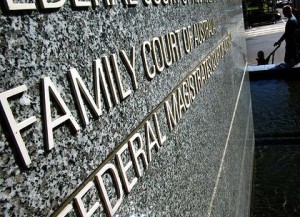
family-court-of-australiaFAMILY Relationship Centres have called for the revenue from court fee increases of 20 per cent intended to deter vexatious litigants to be redirected to mediation services to help at-risk children.

Family and Relationship Services Australia says the charges intended for public companies with considerable resources have been blindly applied to broken and struggling families appearing before the Family Court.

In a submission to a Senate inquiry, FRSA quotes a Law Council of Australia estimate that $68 million of the $100m raised by the increased filing fees and mediation conference charges over the past four years has not been fed back into the court system.

FRSA executive director Steve Hackett said the 65 centres across the country had been feeling the full effect of funding cuts enforced last year and were in no position to manage additional clients.

“Which is what may occur if this policy has the desired effect of redirecting individuals away from the court,” he told The Australian.

“Essentially, family and relationship services will continue to be overburdened with clients looking for help and the longer vulnerable families have to wait, the longer children, in particular, will remain at risk.

“It is not appropriate that the same policy tool used to deter corporate litigants would also be used to discourage individuals and vulnerable families from seeking relief through the judicial system.

“The revenue raised from the increases needs to be directed to supporting families to access services outside of the court system, such as improving the capacity of mediation services.”

Family Relationship Centres were set up by the Howard government to keep children out of courtrooms, reduce the cost to government of break-ups and battles in the Family Court, and to cut the number of custody battles.

The Attorney-General’s Department has defended the charges in a submission, arguing it wanted to put families off court.

“Family law proceedings can be a highly emotional event in a person’s life. However, appropriate pricing signals can encourage litigants to consider whether they should engage in litigation, and the approach they take in relation to the conduct of that litigation, while also ensuring that meritorious litigants are not deterred from seeking redress,” the department said.

The National Family Violence Prevention Legal Services Forum says the increased charges have hurt families.

In its submission, it argues that the impact of fee increases of most concern was that victims of family violence often have limited access to financial resources and are living on very low incomes.

“Economic abuse is very common in situations of family violence,” the forum says. “Clients may feel pressure to settle cases earlier, or accept unfavourable terms to avoid higher costs.”

Teen must have blood transfusion, judge rules

blood-transfusionA 17-year-old Jehovah’s Witness suffering from a lethal form of blood cancer and refusing treatment threatened to rip the IV needle out of his arm if doctors attempted a blood transfusion.

But the NSW Supreme Court has overruled the wishes of the patient, known only as ”X”, and his parents, ordering him to undergo the potentially lifesaving procedure.

The case is unusual because at the time of the court’s ruling on March 28, X was just 10 months away from turning 18 – by which time he would be considered an adult and entitled to refuse blood products.

Usually, such court cases involve much younger children whose parents have refused to allow lifesaving treatment.

In his judgment, Supreme Court Justice Ian Gzell said X had been ”cocooned in faith”.

Professor Glenn Marshall, who is treating X for Hodgkin’s lymphoma at Sydney Children’s Hospital, was told by the patient being sedated for a blood transfusion would be akin to being raped.

On a whiteboard in his hospital room, X’s father wrote a scripture reference to abstaining from blood, which is forbidden for Jehovah’s Witnesses.

X was admitted to the hospital in January last year, and he and his parents consented to chemotherapy which continued for seven months. The treatment resulted in remission, but in November Professor Marshall found cancer in the patient’s lungs, spleen and lymph nodes. He recommended X receive more intense chemotherapy but, because that treatment was likely to lead to a blood transfusion, X and his parents refused.

Instead X had two cycles of chemotherapy at the lower dose, but scans in February showed only a 25 per cent to 50 per cent reduction in his tumours.

”Professor Marshall was disappointed with these results,” Justice Gzell’s said in his judgment.

”Based on his experience treating patients of similar age with similar disease type, he would normally expect no tumour to be present after treatment with higher doses of different cytotoxic chemotherapy agents.”

By March, X developed severe anaemia and chemotherapy had to be stopped. Professor Marshall feared that once it was restarted X would again become severely anaemic. He told X and his parents if he suffered severe bleeding or his blood pressure dropped to dangerous levels, blood would immediately be brought to the ward and administered. In response, X said he would ”rip the IV out”.

Professor Marshall, who has 20 years’ experience treating children with cancer, told the Court X had an 80 per cent chance of dying from anaemia without a blood transfusion.

If he was allowed to administer his preferred treatment, he said X would have up to a 50 per cent chance of survival.

Apart from ripping out the IV if he could, X and his father would otherwise obey the court order, Judge Gzell found.

”The sanctity of life in the end is a more powerful reason for me to make the orders than is respect for the dignity of the individual,” Justice Gzell said in his ruling. ”X is still a child, although a mature child of high intelligence.”

The judge has given the green light for doctors at the Kids Cancer Centre at Randwick (part of the Sydney Children’s Hospital) to give the boy blood.

Last year the NSW Supreme Court made similar orders for a four-year-old girl from South Australia.

Related Family Law Judgments

‘Deadbeat dad’ owes former lovers $450k in child support

supreme-court-queenslandA FATHER is about to be hit with an almost half-million dollar bill he owes two former lovers after a court ruled he had paid them virtually no child support.


The saga to access part of a $3 million cash and property pool belonging to a Queensland farming family is one of a growing number of cases behind a huge nationwide child-maintenance debt.

According to the latest figures, one in four parents has fallen behind in child support payments, with the Federal Government recovering $110m in debts last year by intercepting their tax refunds.

In the latest case, the father has accused the court of “trickery and bias” after he missed an appeal deadline and was ordered to pay $450,000 in outstanding expenses related to his children, who are now aged 18, 13 and 12.

“I am entitled to appeal this absurd travesty,” he told the court.

The nine-year litigation is now headed for the Supreme Court in Queensland after the father lost his latest appeal in the Full Court of the Family Court of Australia.

According to the latest figures, one in four parents has fallen behind in child support payments, with the Federal Government recovering $110m in debts last year by intercepting their tax refunds.

His parents have launched a legal challenge against the trustee appointed to oversee the fire sale of part of his family’s 161ha farm.

They have lodged a caveat to stop the sale of two land parcels proceeding after they were sold at auction last year.

The statutory injunction follows three failed attempts by their son to stop the sale with a caveat, including one lodged at the 11th hour of the sale.

Court files show 11 judgments in the case since 2007.

Long-serving Family Court Judge Michelle May said the case had gone to court 23 times.

“To state that this matter has a long history would hardly convey the background to these proceedings,” she said.

Justice May said the mothers were granted their wish for the children to live with them but “have never received an adequate level of child support.

“They have been primarily responsible for the financial burdens cast upon them by their parenting responsibilities,” she said.

“Whilst (the father) has, in the past, paid some modest level of child support, he has paid none since July 2008, yet at the same time he has had the use and enjoyment of substantial property.”

Related Family Law Judgments

Don’t feed the frenzy of lawyers

calculating-divorce-costsIT’S A sad reality of modern life that marriages that have taken decades to build can be thrown away in under a year.

These days a marriage can be dissolved literally with the click of a mouse with the online divorce portal available through the Family Courts of Australia and if statistics released by the courts are anything to go by, this is a trend being widely accepted by Australians.

Broadly speaking, one-third of all marriages in Australia end in divorce, so if you are going through this, you are certainly not alone.

If you do find yourself or a loved one in the midst of a relationship break-up, it is important to remember to draw a clear line between emotional issues and legal issues.

There is no use going to a family lawyer and spending upwards of $350 per hour simply to let off steam.

Firstly your lawyer likely isn’t qualified to provide you with psychological or counselling advice, and secondly there are always better ways to spend your hard-earned than lining the pockets of a lawyer.

There is no use going to a family lawyer and spending upwards of $350 per hour simply to let off steam.

Although family law matters include many aspects such as care arrangements for children, domestic violence allegations and property divisions, often foremost in the minds of couples who are separating is the question of money.

Rumours of wives leaving husbands and taking the lot are fed by Hollywood movies and quite often do not have a basis in reality, at least in the Australian family law jurisdiction.

To avoid the expenses and uncertainty of going to family court, which can be massive, separating couples are now able to form what is known as a “Binding Financial Agreement” or “BFA”.

This type of agreement is enforceable in the family courts and is designed to be a once-and-for-all settlement of all property matters.

Practically speaking, each couple sees a lawyer and the lawyers negotiate with each other to form an agreement which sets out in detail who is to receive what (eg the house is to go to the wife and the cars, boat and truck are to go to the husband).

The idea behind the BFA is to ensure that there can be no argument at a later date as to how property is to be divided and also to limit legal costs involved with separation, since a BFA usually costs $1500 – $3000, whereas going to court costs many times more than this with uncertainty thrown into the mix.

As the word ‘agreement’ suggests, a BFA does require agreement to be reached between the husband and wife (or former de facto partners, as BFAs also apply to relationships other than marriage).

The idea behind the BFA is to ensure that there can be no argument at a later date as to how property is to be divided and also to limit legal costs involved with separation, since a BFA usually costs $1500 – $3000…

There is no judge involved in forming a BFA, rather only clients and lawyers.

If you don’t feel as though agreement can be reached, court action may be required so that somebody else can make a binding decision.

Obviously this course of action should be avoided at all costs, though in some situations people simply cannot agree and court is unavoidable.

Another important point to note about BFAs is that they can be formed before and also during marriage and in most cases it is best to form them while a relationship is strong and healthy.

If couples wait until separation is looming, or has occurred to sort out their financial affairs in this way, greed and hatred may hijack proceedings and cost everyone far more than is necessary.

So if you or a loved one are about to go through a separation, or are currently separating, ensure you speak to a lawyer about all options available to you to make sure matters are resolved at the lowest cost and in the fairest manner.

Related Family Law Judgments

Trial By Social Media – a Problem for the Courts

trial by social mediaOne British juror who could not reach a verdict on a child abduction and sexual assault trial turned naturally to Facebook.

”I don’t know which way to go, so I’m holding a poll,” she announced.

Another sitting on a drugs trial befriended the accused and traded messages with him on Facebook.

But a Californian juror needed no such help. ”Guilty! He’s guilty! I can tell!” he tweeted.

Advertisement

In the age of social media, the only way to guarantee that jurors are not exposed to prejudicial material about their trials would be to abolish juries altogether, according to a report commissioned by the Australian attorneys-general.

The report by the Centre for Law, Governance and Public Policy recommends sending jurors on training courses before trials and constantly warning them against external influences, with written directions, daily reminders and signs in the jury rooms.

It does not advocate the increased use of trials in which only judges delivered verdicts.

But Patrick Keyzer, the lead author, said there was always a risk that jurors would have regard to information gleaned from outside the court.

”No system that can be developed to account for this will be fail-safe,” Professor Keyzer said.

”Jurors, unlike lawyers and journalists, are not trained in principles of media law and sometimes they simply won’t appreciate what they’re doing is wrong.

”They may disregard judicial directions and if they do there’s not much a judge can do about that.”

Research quoted in the report indicates that jurors have neither the willingness nor ability to disregard material that they regard as relevant, even if they are told to do so.

Jurors admit to checking the internet even when a judge has told them not to, but they more likely to heed written directions than oral ones.

The standing committee on law and justice, which is made up of state and territory attorneys general, is investigating how to mitigate the impact of social media on the right to a fair trial.

NSW cuts funds to Welfare Rights Centre

Welfare-Rights-CentreThe New South Wales Government has defended a decision to end funding for the Welfare Rights Centre.

The centre helps individuals and families negotiate Centrelink decisions, with clients including vulnerable families, young people, those with disabilities, the unemployed and the elderly.

It has been co-funded by the State Government for the past 30 years.

Centre director Maree O’Halloran argues its work also directly benefits the state.

“Although Centrelink is a Commonwealth agency, the realised benefits happen for New South Wales citizens living in New South Wales, making sure that they have proper income support and no debt and also taking pressure of other New South Wales services,” she said.

Ms O’Halloran says the state’s money will be devastating.

“I hope it’s not a fatal blow,” she said.

“We’re determined to make sure our service can keep providing help to the people we do.

“We have so much case work preventing homelessness, stopping children being removed from homes.

“We are a very important service.”

But the Community Services Minister Pru Goward says her department’s core responsibility now is protecting vulnerable children.

“That’s what our money should be spent on,” she said.

“It’s the Commonwealth’s job to ensure that the Welfare Rights Centre is properly funded to assist it with advice and representation around Centrelink payments and social security law.

“It’s Commonwealth law so it should be Commonwealth funded.”

Woman finds out her husband has another wife after changing status on Facebook

facebook-messageA newlywed found out her “husband” was already married after getting a message on Facebook.

The Melbourne woman, 38, was married to her 40-year-old partner in a civil ceremony.

The Family Court heard that the couple’s celebrant had asked for evidence to confirm the man’s divorce.

He told the celebrant and his fiancee there was no record of his marriage from 16 years earlier and the union had never been valid. The wedding went ahead.

A short time later the woman received a Facebook message.

“Hello, new Mrs Keyet. How can you be Mrs Keyet when I am still Mrs Keyet? From the old Mrs Keyet,” it said.

The woman replied, suggesting “the old Mrs Keyet” check her marriage records because it was her belief it was not valid.

The couple then separated and she contacted the other woman asking for a copy of the marriage certificate. She remained unconvinced until she searched divorce registries and found no record of the marriage being dissolved.

The man did not appear at court. He sent a text message that said: “I think I’ve put you through enough hurt.”

Justice Kirsty Macmillan granted the woman’s application to have the marriage annulled.

The woman has asked police to consider laying bigamy charges against her former partner.

Carers making claims on clients’ wills prompts call for scrutiny of estate law

wills-estates-dementiaSOME carers are ripping off the very people they are supposed to look after by demanding money be left to them in wills, an estate lawyer has revealed.

One of Queensland’s leading estate lawyers, John de Groot, urged debate about whether existing laws were good enough to protect the ageing population.

Mr de Groot said he had seen several cases where carers argued they had been a de facto of the deceased – to the surprise of families – and should receive some of their estate.

“It’s become more of a prevalent issue because of the ageing population,” Mr de Groot told The Sunday Mail.

“What we are finding is that there are some cases where carers say they were in relationships with the deceased.

“Wills are getting challenged in favour of the carer by the testator, who are completely wiping family either in full or by a generous amount.”

He said some carers had also blackmailed their elderly or disabled clients, who did not want to leave their houses and go to nursing homes.

“They basically say, ‘you better leave me something to make it worth my while (to stay)’,” he said.

Mr de Groot said the community needed to become extra vigilant to protect its most vulnerable.

“As a community we have to look at it and ask, ‘does the existing law suit?’ ”

The Courier-Mail yesterday revealed more family members were making claims on estates, and were willing to air the family’s private business and secrets to bolster their chances in court.

However, there also have been cases where carers were bequeathed a large piece of an estate.

Barrister and accredited specialist in estate law Caite Brewer said there were various ways to challenge the validity of a will.

The most common was to argue that the testator lacked the capacity at the time they made the will because they had advanced dementia or due to the effect of medication, Ms Brewer said.

It can also be argued that a testator was unduly influenced by someone else to make their will, or they did not know and approve the will’s contents.

In Queensland, a spouse, de facto, child, adult, step children and some financial dependents have a right to make a claim for family provision on an estate.

In 2004, the Law Reform Commission recommended the laws be changed to limit the eligibility of adult children who made claims on their parents’ estate. Children and dependent adult children would still be eligible under the recommendation.

Related Family Law Judgments

Estates Lost as Adult Children Fight over Inheritances

CLAIMS RISE: Supreme Court Justice and Queensland Law Reform Commission chair Roslyn Atkinson

Supreme Court Justice Roslyn Atkinson

ADULT children are demanding a greater share of their parents’ estates and are eating into assets to fight for more money.

Siblings and other family members are squabbling among themselves for more cash and property, airing secrets and other private information to bolster their chances in court.

Current and former judges believe succession laws could work better and point to a Law Reform Commission recommendation that would limit family provision claims made by non-dependent adult children.

The Public Trustee, the judiciary and lawyers say the number of family members asking for a bigger slice of the family estate is increasing.

More blended families, the “it’s not fair” factor and greater assets, such as property and superannuation, are contributing to claims.

Charities, caught in the middle of family wars and often losing money bequested to them, are now fighting back.

But the cost of mediation is eating into estates.

Barrister and accredited specialist in estate law Caite Brewer said some people were mortgaging their homes to help pay for claims.

Supreme Court Justice and Queensland Law Reform Commission’s chairwoman Roslyn Atkinson said the 2004 Law Reform Recommendation would limit the circumstances in which adult children could apply for family provision in Queensland.

ADULT children are flouting their parents’ final wishes, chewing up inheritances in legal fees as they fight for more money, and legal experts say it’s time to change the rules.

“I think it’s undesirable if people are making claims on people’s estates where they have no need and anecdotally from my colleagues and from people at the bar the number of claims does seem to be increasing,” Justice Atkinson toldThe Courier-Mail.

The booming area of estate law has also identified conflicts of interest in the system, with some solicitors appointed executors of estates, then appointing themselves as the lawyer for the executor and racking up hours of work that can be unnecessary.

Queensland Legal Services Commissioner John Briton said the issue was concerning.

Lawyers, who did not want to be named, said some firms were acting unscrupulously, and taking on no-win-no-fee clients, wrongly believing they would be paid from the estate whether they win or lose.

A spokeswoman for Attorney-General Jarrod Bleijie said he was “open to considering suggestions for improvement to the law in this area if it is considered to be operating unfairly” but it was not a priority.

In Queensland, a spouse, de facto, child, adult child, step children and some financial dependents have a right to apply for provision. Courts also consider the need of any application.

Justice Atkinson said statistics on the number of people who made successful claims for family provision were not known because the majority of cases settled after mediation.

“The wills that tend to be the subject of these claims are the ones where the estate is not left to the children equally or nothing is left to the children at all or, in blended families, something is left to one set of children but not the other set.”

One of Queensland’s best known estate lawyers, John de Groot, said there were circumstances of mean-spirited parents who left their adult children meagre offerings, even if they cared for their parents until death or worked for little on family farms for decades.

Related Family Law Judgments