
Divorce: Who gets the air miles?

frequent-flyer-points, dividing marital assets

REACHING a divorce settlement agreement is largely about dividing marital assets. You’ll negotiate a division of your jointly-owned real estate, stock portfolios, cash and even more unusual assets such as expensive collections of art, wine, antique guns or whatever else you have come to own together over the years.

With all that under discussion, it may seem a bit ridiculous to bring up something that seems as trivial as frequent flyer miles. Who cares, right?

Maybe it’s difficult to imagine anyone taking a strong stand over air miles, but don’t laugh. Questions like these are very real, and the stakes may be higher than you think. I’ve known divorcing couples to fight intensely about rewards points earned from various travel and credit card companies over the years of their marriage.

After all, if one or both of you travels often, especially internationally, rewards points can accumulate significantly before you’ve had time to enjoy the benefits of redeeming them. When you’re talking about hundreds of thousands of frequent flyer miles – well, that can make for some very nice first class travel!

So, how exactly do the air miles, or other rewards points, get sorted out?

The first step is to check the terms and conditions of your various rewards programs. This can be some of the most tedious reading imaginable, but it can give you definitive answers. Take Marriott’s reward program, for example. It specifically states that points in this program are not transferable to a spouse as part of a divorce.

Rather than trying to get around this with a court order, it probably makes more sense to assign a value to those points and negotiate for something of equivalent value in your settlement, instead.

Of course, it isn’t always straightforward to estimate the monetary value of loyalty program points. Some travel programs provide a cash value equivalent for their points, but many do not. If yours doesn’t, you may have to do a rough conversion of miles or points into trips or other rewards, and then estimate the value of those.

For instance, if an airline requires 50,000 bonus miles to be redeemed for a first class ticket that would cost $1500, you can reasonably estimate $1500 as the cash value of the 50,000 miles.

However, that value could vary depending on the destination and time of year. As with most things, you’re best served by being proactive. Do some research and come up with a value that’s both realistic and defensible.

Another strategy, if the company awarding the points will allow it, is simply to have the airline or other reward-granting program divide the points equally into two separate accounts. Keep in mind that if you go this route, there will likely be fees incurred for transferring the points and/or resetting their expiration dates. Have a plan for handling these fees fairly.

My advice is always to think financially, not emotionally about your assets during the divorce process. I know, I know … Sometimes that’s easier said than done. If you genuinely love a piece of art, for example, it can have value to you in excess of its worth in dollars. But, if your spouse knows that’s how you feel, they can exploit it.

I’ve seen spouses develop sudden, intense attachments to objects they didn’t even realise they owned, until noticing their partner hoped to keep them. Trust me, their enthusiasm is not borne of newly discovered appreciation for the art in question. They’re seeing the cash value of these things, and are unwilling to lose out on that.

More importantly, if the item is disproportionately important to you, your spouse will see it as a way to get you to give up something else with greater monetary value. Set aside your emotions, and see things in dollar signs, at least for the time being. As impossible as it may seem while you’re in the middle of divorce proceedings, there is other art in the world to love. Don’t let yourself be pressured to make a foolish financial decision, just to keep that one special painting.

It can be difficult to set aside emotions with regard to air miles, as well. People can be very possessive of their travel rewards points – especially since, in many ways air travel is just not as much fun as it used to be, we see the bonus miles as a kind of badge of honour for having endured so much of it.

If you’re like me, you store up the miles for a time when you can use them for a truly pleasurable trip. It’s something to look forward to, and having that taken away can leave you feeling cheated, or even robbed.

But remember, when negotiating your divorce settlement, all air miles and other reward points really do come down to money. If you give up the air miles and make a good financial move elsewhere, you’ll likely find you can still take that special trip you’ve been dreaming of – and you might just enjoy it even more.

Jeff Landers is the author of the new book, Divorce: Think Financially, Not Emotionally – What Women Need To Know About Securing Their Financial Future Before, During, And After Divorce.

Homework fight between divorced parents hits Federal Circuit Court

Homework OrdersA DIVORCED Sydney dad with shared custody of his daughter has asked a court to order his ex-wife to ensure their child does her homework.

But the Federal Circuit Court judge who heard the case has resisted making a “homework order” for the 12-year-old, saying it would likely be “unenforceable”.

“It involves an undesirable micromanaging of the parties in the performance of their role as parents,” Judge Stephen Scarlett said in his decision handed down in Sydney.

The mother, who cannot be named for legal reasons, told the court her child did not want to do homework at her dad’s house either.

“I have trouble getting (the child) to take homework, projects and her (musical instrument) – to her father’s place to complete and practice,” the mother said.

The parents were together for two years until they separated in 2001, when their daughter was only eight months old. The father has remarried.

Relations between the pair have been so strained that they have only communicated by email and they have been arguing about which high school she should attend.

They have been battling in the courts since 2003, when the Family Court made orders dealing with their daughter’s surname, where she should live and how much contact each parent should have.

In 2007 the Family Court ordered the parents should have equal shared custody of their child but she should live primarily with her mother.

Judge Scarlett made interim orders on June 18 that she should live with her father. He said the father should have sole responsibility for making decisions about “major long-term issues” concerning the child’s welfare.

The girl will visit the mother on alternate weekends during school terms and for a part of her school holidays.

A “family consultant” who interviewed the pair in 2010 found they had a “very poor parenting relationship which is resistant to change”.

Janet Carmichael, a family relationship centre manager with Relationships Australia, said she understood Judge Scarlett’s reluctance to make orders about the “finer details” of a child’s daily life.

“We know kids’ lives are complicated,” she said, adding court orders could mean parents were “stuck with arrangements” that can’t be changed without returning to court.

Ms Carmichael said parents with shared custody “don’t need to like each other” but they need to try to build a “constructive relationship”.

Landmark federal ruling in custody battle involving IVF mum and her ex

sperm-imageA MILLIONAIRE businessman embroiled in a bitter custody battle after secretly helping his ex conceive through IVF has been declared the child’s legal father in a landmark ruling.

A Family Court judge has awarded the man equal shared parental responsibility of the two-year-old boy – despite Victorian law stating sperm donors are not considered the father.

The man had also signed a document acknowledging he had no legal claim in relation to the child and wished to just be a sperm donor.

His ex told the court she always intended to raise the child as a single mum with the man having only an avuncular role. But she permitted regular visits and a bond formed between her son and her ex.

Justice Paul Cronin held the state laws were inconsistent with, and therefore overridden by, federal legislation, which says a parent is a child’s biological parent.

The parties, who cannot be identified for legal reasons, lived together as a couple for six months before breaking up in 2002.

Now in their 40s, they remained friends and began IVF treatment in 2008 after the man agreed to donate sperm. The couple kept the parentage of the boy, born in 2010, a secret.

The man attended the birth of the child and visited him regularly, until the relationship between he and his former partner deteriorated in late 2011 after he revealed he had a girlfriend.

The judge said the woman had effectively “stonewalled” the man, fearing he “would use his family’s wealth and power” to gain effective control of the child.

He said concerns that sperm donors could be considered parents were irrelevant, as legislation did not impose obligations on unknown donors.

The judge said each case could be determined on its own facts. Shared parental responsibility concerning major long-term decisions was in the best interests of the child.

The judge granted the father custody in an arrangement that graduated to alternate weekends and half of the school holidays.

Slater & Gordon family law specialist Heather McKinnon said the case was more about the child’s attachment to the biological father than how he was conceived.

“The mother relinquished and allowed the child to form a relationship with the man. That is when she waived the rights under the legislation,” she said.

Related Family Law Judgments

Family Court prevents ATO from using documents filed in proceedings

australian-tax-officeThe Family Court has dismissed an application by the Commissioner of Taxation to be released from an implied obligation not to make collateral use of certain documents filed in a Family Court proceeding.

The facts

Mr Darling and his wife were parties to a Family Court proceeding. The Commissioner sought to use the documents filed in the proceeding to ‘assist with’ the audit of Mr Darling and his related entities for the 1991 to 2010 income years.

The Commissioner searched and inspected the Court records on several occasions and made copies of the relevant documents.

Implied obligation

Having inspected and copied documents from the Court records, the Commissioner had an implied obligation not to use those documents for a purpose that was not related to the Family Court proceeding.

The Court noted that the purpose of this obligation was to preserve the parties’ privacy and to encourage full and frank disclosure. The party obtaining the disclosure cannot, without the leave of the Court, use it for any purpose other than that for which it was given.

In determining whether it should exercise its discretion to release a party from the implied obligation, the Court must determine whether ‘special circumstances’ existed.

‘Special circumstances’

To establish special circumstances, the Court needed to be satisfied that there was some special feature that was not usually present that merited the release of the obligation.

One of the relevant public policy considerations was whether the disclosure of the documents will contribute to achieving justice in the Commissioner’s audit.

In his application for release, the Commissioner was required to:

  1. specify the documents for which release was sought;
  2. specify the purpose for which release was sought; and
  3. satisfy the Court that the special circumstances relied upon warranted or justified the release sought.

The decision

The Court held that the Commissioner did not discharge his obligation to adequately specify the reasons why certain documents were necessary and relevant to the conduct of an audit.

In reaching its decision, the Court made the following observations:

  • There was no evidence as to the nature of the audit of the husband’s affairs or what information may be required to complete that audit.
  • There was no evidence as to what information had been obtained and why that information might be insufficient to complete the audit. (This was significant given the wide powers the Commissioner had to obtain information.)
  • There was no evidence presented to support the belief that the documents would be relevant either generally or in relation to specific documents.

The Court refused to release the Commissioner from the implied obligation. It was not satisfied that the release was necessary in the public interest to enable the Commissioner to fulfil his statutory function.

Man ordered to repay Centrelink $11,500 over child support payments

court-judgmentA DEADBEAT dad has been ordered to repay an $11,500 Centrelink debt after child support payments were paid directly to him while his daughter was living with her paternal grandmother.


The grandmother has won the right to raise the eight-year-old Queensland girl interstate after she complained of being verbally “menaced” by her son over caring for the child.

“Not only has the father never paid any child support … he continued to receive a Centrelink payment for the child,” Family Court Judge Stewart Austin said.

“The father improperly received … some $11,500, which … is being repaid in small increments.

“The only evidence of financial support … was his purchase of an Ipad for her.”

The Family Court of Australia has moved to protect the girl from her biological parents after it was revealed she was repeatedly moved by the Department of Child Safety in Queensland.

In a scathing assessment of DOC’s handling of the case, Justice Austin said she endured a “grossly disrupted residential history” after six moves in two years.

“The child endured frequent exchanges between the mother and father following their separation,” he said.

According to a judgment, the girl was bounced back and forth between her father and paternal grandmother after she was placed in foster care to get away from her troubled mother in 2006.

He said she had stayed with her paternal grandmother since 2011 after being too scared to stay overnight with her father, who was hospitalised for substance abuse.

“The father presented at hospital with the mother … for treatment of a stab wound (and) medical notes suggest he admitted consuming one litre of bourbon,” Justice Austin said.

“Significantly, he also told staff he had last injected himself … with drugs the week before.”

Justice Austin said the paternal grandmother’s push to move interstate was “quite reasonable” considering a verbal spray she received from her son.

“He has previously pushed his face into physical contact with her face and threatened menacingly through gritted teeth ‘Don’t you touch my daughter, you f…ing c…’,” he said.

Justice Austin said the custody battle had created a “schism” in the family which was made “achingly apparent” during a trial when siblings took the stand against one another.

He said “rancour” felt by the son and one of his brothers towards the paternal grandmother was “unlikely to subside any time soon”.

Doctors fight to kill South Australian euthanasia bill

A group of Australian doctors opposed to the introduction of euthanasia and assisted suicide has written to all South Australian House of Assembly MPs condemning Hon Bob Such’s ‘Ending Life with Dignity Bill’ 2013..

Hon. Bob Such

Hon. Bob Such

’s ‘Ending Life with Dignity Bill’ 2013.

Senior South Australian neurologist Dr Timothy Kleinig, the chair of Doctors Opposed to Euthanasia (DOE), said the bill confuses the deliberate killing of a patient through euthanasia with the withdrawal and withholding of treatment at a patient’s request.

“[A]s the AMA (Australian Medical Association) and others have pointed out, (this) is not euthanasia,” said Dr. Kleinig, “but the refusal of medical care, the legality or ethics of which is not in dispute.”

This bill has also been criticised by the South Australian branch of the AMA, who said it is “fundamentally and irretrievably flawed.” Similar concerns were also raised by the state’s Palliative Care Council and the Law Society.

Dr Such’s ‘Ending Life with Dignity Bill’ 2013 is his 9th attempt to legislate for euthanasia and/or assisted suicide, and is the 16th attempt to have a bill passed in South Australia in over ten years. In 2011 there were three separate euthanasia bills on the parliamentary notice paper at once.

Dr. Such has also introduced a second bill in an attempt to amend the current Consent to Medical Treatment and Palliative Care Act. The AMA has said the bill shows a fundamental misunderstanding of the role and intention of palliative care. In describing both bills, AMA (SA) President, Dr Patricia Montanaro said:

…these Bills have major elements that are ill-conceived, indicate a fundamental lack of understanding of current concepts in end-of-life care, and show a confusion in understanding of the critical difference between palliative care and euthanasia. They therefore have the potential to confuse and compromise the provision of good end-of-life care, with resulting distress to patients and their families.

Kleinig also railed against what Doctors Opposed to Euthanasia calls the “forced referral provision” in Such’s bill that says that a doctor may refuse to comply with a euthanasia request, but that he or she must advise the patient that another doctor may be willing to cooperate. While the bill does not force a doctor, under pain of penalty, to refer the patient to another doctor known to support euthanasia, DOE says the provision could still “make doctors who are morally opposed to euthanasia accessories to the fact.”

Such’s bill also requires the cause of death to be listed as the underlying illness, and not the euthanasia, which critics have said is effectively asking doctors to lie. This could also have significant implications for the life insurance industry.

The bill also fails to define critical terms such as ‘Terminally Ill’ and ‘Unbearable suffering’. Kleinig said that without any such definition, “any illness which is associated with a decreased life-expectancy (e.g. Multiple Sclerosis) (that) could be defined as a terminal illness and suffering of any nature (e.g. diagnosis-related anxiety) could be grounds for euthanasia.”

Such claims that this bill is his “tightest ever” in terms of legislative safeguards.

Paul Russell, director of HOPE: Preventing Euthanasia & Assisted Suicide, said in response:

“The law in terms of euthanasia & assisted suicide is a very blunt instrument which can never take into account all of the risks involved and can never adequately protect the rights and welfare of vulnerable people. Such has effectively proved that point in this bill.


“The only true way to protect vulnerable people from abuse in such circumstances is the maintenance of the current prohibition in our criminal code – anything less than that is an unacceptably high level of risk.”

Such’s previous bill failed in 2011 by only two votes. The debate on this bill continues over the coming weeks.

Spectre of dead spouse haunted second marriage, says annulment claim

marriage-annulmentA WOMAN has tried to have her marriage annulled because her husband was obsessed with his first wife and kept her ashes.


The woman said she wed under duress and was mentally unfit to consent to the union.

The Family Court heard the pair was introduced at a church dance not long after the death of the man’s first wife.

They then moved in together, which the wife claimed she was encouraged to do by members of her family and church.

The wife claimed she became anxious about the man’s “obsession with his deceased wife” very early on in the relationship.

Her husband, it was claimed, kept his first wife’s ashes on the mantelpiece, photographs of her in the house and tried to “set up a shrine for her in a room with her clothes and personal objects on display”.

The woman said her husband also spoke every day about his first wife, telling her the marriage had been perfect and he wanted to “reach for the stars with someone else”.

The wife said she found it intolerable to live in the “shadow of death” and felt humiliated by his attitude.

The court heard she sought the intervention of her priest, who encouraged the husband to bury his first wife, which he did.

Before their wedding, she left the home and stayed with her friend for a week.

She said she was persuaded to return by family, friends and her priest who told her to go through with the wedding.

But she told the court she felt like she was “drowning” in pressure.

The woman argued she became ill with depression in 2008 and two doctors had expressed the opinion that she “lacked the mental capacity to consent to the marriage”.

She argued the marriage should be annulled because of her mental state and the duress she was under from her priest, husband and relatives.

The court’s judgment said: “She established that she has a lifelong connection to her church and that the counsel and guidance of her priest and members of her congregation were very important to her.”

But Justice Judith Ryan said a nullity decree was not granted lightly and the husband’s consent to the order was not enough to satisfy the court.

In dismissing the application, Justice Ryan said medical evidence did not establish the woman’s depressive disorder had deprived her of judgment or that the opinions of others had overborne her will.

Australia’s divorce rates: the real statistics

New figures show a big increase in people divorcing after 20 years or more of marriage. But it’s not as big as some would have you believe.

New figures from the Australian Institute of Family Studies have shown a big increase in people divorcing after 20 years or more of marriage. However, it’s not exactly as big as some media outlets would lead you to believe as most publications got the numbers wrong.

Rate of divorce after 20 years of marriage doubles‘, according to one story. And ‘Parents wait until children go, then do the same thing‘ from another.

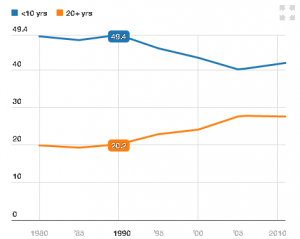
The headline statistic is that people are waiting longer to divorce. This is based on an analysis of the proportion of marriages lasting 20 years or over before ending in divorce. A media release from the AIFS put this figure at 13% in 1990 and 28% in 2011, which many people erroneously reported.

However, the actual report shows 20.2% in 1990 to 27.6% in 2011. The same figure for ‘final separation’ is 13% to 18.3%. They’ve mixed up the separation and divorce numbers. There’s actually a much more mild 7.4% increase between 1990 and 2011. So we are seeing an increase in the duration of marriages that end in divorce, just not quite as much as all that.

Proportion of marriages that lasted less than 10 years and greater than 20

Proportion of marriages that lasted less than 10 years and greater than 20

So, what are the other trends coming out of this new report?

You’re more likely to get divorced when you’re younger.

And of younger people who are married, women are more likely to experience divorce than men. In fact the rates of divorce are higher for women than men up until the 40-44 age bracket, where men then have higher rates up to 65 and over, likely due to an overall tendency for men in marriages to be older, and women younger. The AIFS report also suggests older men have a higher tendency to remarry than older women.

Age-specific divorce per 1000 people, married men and women, 2011

Divorce is down, and has been for a while.

From 2007-2011 the rate per 1000 people has stayed around 2.2 and 2.3. This is down from 2.9 in 1996, and very far down from the biggest peak of 4.9 in 1976 after the Family Law Act 1975 came into effect.

The age that people get divorced has increased dramatically.

The median age of divorce for men is at the highest its been since 1970, with 44.5 in 2011. Women are similarly high at 41.7. This is up from a historical low of 35 and 33 for men and women respectively in 1980.

Divorce and marriage rate – number per 1000 people

Divorces that involve children are decreasing too, which the AIFS suggests means people actually are staying together for the sake of the kids. This fits with the increase in the proportion of longer marriages ending in divorce we saw above.

The report also highlights the relative instability of people who are unmarried, but living together, versus married couples. Citing numbers from the Growing Up In Australia report – for infants who were living with married parents in 2004, 12% were with only one parent by 2010. The same figure for unmarried couples cohabiting is 27%, suggesting unmarried couples are more than twice as likely to break up.

Empty nesters divorcing in droves

middle-aged-divorce

Instead of the seven-year itch, Australia’s married couples are increasingly calling it quits once they’re past the 20-year mark.

For a growing number of couples, “till death do us part” seems to translate into “until the kids leave home.”

The Australian Institute of Family Studies has released a report titled Working Out Relationships , which reveals that the number of couples divorcing after 20 years of marriage has more than doubled from 13% in 1990 to 28% in 2011.

Director of the institute, Professor Alan Hayes, told 1233 ABC Newcastle’s Jill Emberson that while most divorces still occur in the first 10 years of marriage, more and more couples are splitting after two decades together.

“It’s a big proportional increase,” he says.

In the majority of cases divorces are initiated by the wife, and middle-aged men are more likely to remarry than divorced women.

Professor Hayes says often the husbands are taken by suprise when their wife wants a divorce, and even though they recover better financially from their marriage ending, the emotional toll on men seems to be worse.

“While men may recover financially, the depth of the emotional scars seems to be much greater,” he says.

The statistics seem to indicate that couples are staying together for their children, with the number of divorces involving kids under 18 declining.

“We have a generation now who are better educated and have better life prospects and choices,” the director says.

“Women are able to exercise choice when they’re in a relationship which is starting to be less than emotionally fulfilling.

“People can paper over the cracks while they’re focused on raising children, and then of course when children leave the nest sometimes the depth and width of the cracks starts to become more apparent.”

Overall, the professor says Australia’s divorce rate is dropping, perhaps due to 80% of couples now living together before they marry.

And he says while couples are more aware of the impact on children, divorcing later doesn’t avoid that problem entirely.

“You can’t just assume that adult children won’t be as gutted as younger children,” he says.

“It often comes as a great surprise, particularly to the man involved, but also to those around the couple.”

Professor Hayes says more attention needs to be paid to supporting middle-aged couples when they develop problems in their marriage.

Related Family Law Judgments

Australian judge warns warring parents to not use social media as a ‘weapon’

Social-MediaParents involved in divorce and custody battles must beware of using social media as a ‘weapon’, an Australian judge has warned.

In a recent hearing at the Federal Circuit Court, Judge Warwick Neville ordered a marshal to investigate Facebook postings made by a father involved in an acrimonious child custody dispute.

The unnamed father had reportedly made harsh criticisms of the court system on the social networking site. The man had also revealed confidential information about the case, claimed the magistrate and expert witnesses had been duped by the mother and even alleged that the mother abused their children.

According to a report on Perthnow.comsuch posts could be in breach of the Australian Family Law Act 1975, which prohibits the publication of court proceedings.

The judge described Facebook and other social media sites as an “unfortunate and increasing feature of modern litigation”.

“It is a veritable Aladdin’s cave which parties (and lawyers) readily and regularly explore for (invariably incriminating) evidence to be used in litigation. As a weapon, it has particularly insidious features.”

Social media users:

“…inhabit the cyber-sphere and operate as `Facebook rangers’ who `hit and run’ with their petty and malicious commentary, and seem to gloat (or be encouraged) by the online audience that waits to join the ghoulish, jeering crowd in the nether-world of cyber-space.”