
Japan finally signs Hague convention governing international child custody disputes

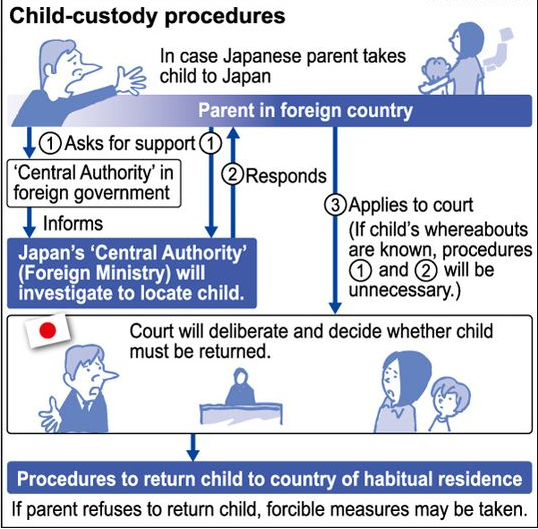
japan-hague-convention-how-it-worksAfter years of refusing to sign, Japan on Jan. 24 officially joined the Hague convention that governs cross-border child custody disputes that result from broken marriages.

Japan came under heavy pressure from the United States and European countries to become party to The Hague Convention on the Civil Aspects of International Child Abduction. The treaty spells out the guidelines that govern cases in which children of separated or divorced couples are taken to the home country of one parent without the consent of the other.

Nearly 20,000 international marriages a year involving Japanese nationals result in divorce. In certain cases, the Japanese parent returned to Japan with their children without the consent of the other parent.

The convention goes into effect from April 1 in Japan, at which time the Japan’s Foreign Ministry will be obliged to locate children that result from such marriages if requested to do so by a parent overseas. The ministry will then be required to take steps to resolve the dispute through arbitration or other means.

According to the convention, if a marriage fails and the parents start living in separate countries, the decision on who receives parental rights to raise children under 16 falls under the jurisdiction of the country where the family resided with the child before the breakup.

If a parent who takes a child to Japan from overseas does not agree to return the child to the country of former residence, one of two family courts located in either Tokyo or Osaka will decide the matter.

The court has the authority to judge whether to return a child to another country if it believes the child might be subjected to danger or abuse, both mental and physical, if handed over.

Cases involving children taken to Japan before April 1 will be exempt from the convention. A parent overseas can still call on the Japanese government to assist in setting up a meeting with the child in such cases.

The children of Japanese couples will also be subject to the treaty if one parent flees with a child or children overseas.

The Supreme Court has already drawn up detailed guidelines on how to resolve such disputes.

The top court is now working on a manual for family court officers outlining how they should take custody of children in the event a court decides to return them overseas.

The Supreme Court estimates the cases that will go before the two courts will number in the dozens each year, with most disputes expected to be settled out of court.

A senior official with the Supreme Court said only a few of the cases are likely to require the need for officers of the court to physically separate the children from a parent living in Japan.

Judiciary officials said the first case may go before one of the courts as early as July.

Same-sex parents ‘more caring’, research shows

same-sex-parenting-researchCHILDREN in same-sex families experience higher quality parenting and do as well emotionally, socially and educationally as those from heterosexual couple families, research shows.

An Australian Institute of Family Studies report states that “research to date considerably challenges the point of view that same-sex parented families are harmful to children”.

The report notes that a remaining area of inequality for same-sex couples was their access to adoption.

South Australia and Queensland are the only places where single people cannot adopt, which further excludes people in a committed same-sex relationship.

In Australia, about 11 per cent of gay men and 33 per cent of lesbians have children.

The children may have been conceived in previous heterosexual relationships or raised from birth by a co-parenting gay or lesbian couple or single parent.

The report says some benefits for children raised by lesbian couples, in particular, were that they experienced higher quality parenting and displayed more open-mindedness towards sexual, gender and family diversity.

“Lesbian co-parenting couples display a range of parenting strengths, for example, less authoritarian parenting styles, and report higher quality relationships with their children than matched samples of heterosexual parents,” the report says.

“They also tend to spend more time with their children.”

On the negative side, the report shows that children raised in same-sex parented families worry about being teased, harassed or bullied, particularly by peers at school.

“Despite this, children with lesbian mothers are only modestly more likely than their peers with heterosexual parents to be teased or bullied about their family composition or parents’ sexuality,” the report says.

It concludes that more could be done to develop policies and practices supportive of same-sex parented families in the Australian health, education, child protection and foster care systems.

Divorce ruling leaves wealthy husbands with less

special contribution doctrine knocked down- benefits womenWEALTHY husbands who split from their wives after a long marriage are less likely to walk away with the lion’s share of the assets following a landmark full Family Court decision.

The decision, known as Kane & Kane, signals the end of the “special contribution” doctrine that has allowed some successful businessmen to walk away with 60-72.5 per cent of matrimonial assets, particularly in so-called “big money” cases.

The Kane case involved a couple who split after a 28-year marriage in 2009. They had an asset pool of $4.2 million and four children.

The trial judge had initially awarded the husband, a retired businessman from the Newcastle area north of Sydney, two-thirds of the couple’s $3.4m superannuation fund, and the wife one-third. However, the full Family Court overturned that decision, ruling the trial judge had given unacceptable weight to the husband’s “special skill” investing their money in a self-managed super fund.

He paid $539,500 for the shares, against her wishes.

By the time of their divorce they were worth $1.85 million, taking the total value of their superannuation fund to $3.4 million.

Because of the husband’s “skill in selecting and pursuing the investment”, the judge awarded him two thirds of the fund, or $1 million more than the wife.

But the full Family Court of Australia has overturned that decision, finding the trial judge may have given “unacceptable weight” to the husband’s “special skills”, in a case which could have major ramifications for divorces in the big end of town.

The controversial “special contribution” doctrine has previously allowed one spouse to lay claim to a significant portion of a couple’s assets if they showed exceptional skill or talent in building the fortune.

family-law-propertyBut the December 18 judgement, published online this week, in the case known as Kane & Kane has significantly challenged that principle.

The couple, with four children separated in 2009 after almost 30 years of marriage. Their assets totalled $4.2 million, but it was the superannuation fund that caused a legal battle. All other assets – totalling less than $800,000 – were divided equally.

Family Court deputy chief justice John Faulks said the original judge’s disproportionate division of the property “could not be justified”.

“It is difficult to correlate effort or skill (even if special) with result,” he wrote. “Frequently, the financial result of a contribution (whether by physical or intellectual labour or imagination foresight and perspicacity) will be influenced by external factors beyond the control of the party contributing.”

Furthermore, he noted that Mr Kane did not have any professional qualifications or special knowledge of the business in which he invested. And that he “took a calculated risk with the parties’ money, which fortunately proved correct”.

Family law expert Glenn Thompson said the decision was “very significant” and meant judges were no longer bound by precedent.

“It’s saying there’s nothing in the Family Law Act that one contribution is special as opposed to another and should be treated higher than any other contribution,” he said. “You’ve got to weigh up all the different types of contributions, be it the homemaker and parent, be it the breadwinner, be it inheritance, be it physical labour.”

One of the key criticisms of the doctrine has been that it discriminates against women and undervalues the role of the mother.

“[The Kane & Kane decision] is saying that the role of the homemaker and parent is a significant role that shouldn’t be undervalued,” Mr Thompson, who is a member of the Family Issues Committee of the Law Society of NSW, said.

“It should lead to a more equal result in a lot of the bigger money cases because if the assets were all built up whilst the parties were together then they’re going to be an equal contribution.”

The Kane & Kane settlement has been called back for rehearing before a new judge.

One of the key criticisms of the doctrine has been that it discriminates against women and undervalues the role of the mother.

In another recent case, known as Smith & Fields, a wealthy Gold Coast property developer split from his wife of 29 years. The husband was awarded 60 per cent of the couple’s $30m-$39m asset pool because of his “ingenuity and stewardship” running the family business, in which both the husband and wife had worked.

This was despite Family Court judge Peter Murphy recognising the parties had a “practical union of both lives and property” both had made exemplary contributions in their respective spheres of marriage.

In reaching his decision, Justice Murphy referred to six “big money” cases involving assets of almost $9m to more than $40m. The wives in those cases had been awarded just 27.5 to 40 per cent of the assets.

The case has since been appealed and a decision reserved, although family lawyers expect it to be overturned.

Family lawyer Paul Doolan said the Kane decision appeared to “sound the death knell” for the special contribution argument.

“There’s been a real philosophical and jurisprudential fight in the courts for the best part of 15 years between one camp who says the court should recognise in appropriate cases contributions of a special or exceptional nature,” Mr Doolan said. “There are others who say no, that kind of labelling tends towards gender bias and invariably favours males who are predominantly those who produce income.”

Mr Doolan said it did not mean that in a particular case a court could not rule that one partner deserved more of the assets because of their financial contribution. However, each case had to be examined on its own facts.

He said while many people presumed property was split equally between couples following a divorce, the reality was there was no rule of thumb.

Lawyer Gayle Meredith, who acted for the wife in Kane, said her client was pleased with the decision, but distressed the case would now be retried.

She welcomed the Family Court resolving uncertainty over the “special contribution” doctrine, which she said had tended to discriminate against mothers.
Anti-vaccination mother tells Family Court Immunisation akin to Sterilising

child immunisation, family court disputeA MUM who has gone to court to fight her ex-husband’s bid to have their children vaccinated says the procedure is akin to sterilisation or gender reassignment.

The mother, who cannot be identified, is fighting her former husband in the Family Court because she “vehemently opposes” his desire to vaccinate their two children.

She wants the court to declare immunisation a “special medical procedure”, giving it the same legal status as sexual sterilisation and gender reassignment surgery.

To support her claims, the mother will call expert evidence from US doctors – and have her children undergo a battery of medical tests.

Since 2011, the Family Court has become increasingly involved in the vaccination debate.

In January of that year, it ordered a mother have her daughter, 5, immunised in line with the wishes of her former husband .

The girl’s father, who has remarried and has another child, wanted the girl vaccinated against preventable diseases for her own wellbeing, and for the health of his other children.

In November last year, an eight-year-old Victorian girl continued to receive vaccinations against the objections of her mother .

The court heard the girl’s father had been “secretly vaccinating” her during custody visits because he did not want to play “Russian roulette with her health”.

The latest battle, between the parents of children dubbed “J” and “P” in court documents, is scheduled to commence on January 29 and last seven days.

Court documents do not give the ages, nor the genders, of J and P.

In a pre-trial application in April, the children’s mother asked the court treat the father’s proposal they be vaccinated as a “special medical procedure”.

Under the Family Court Act, special medical procedures include sterilising intellectually-disabled girls, gender reassignment surgery, and lifesaving techniques opposed on religious grounds.

The mother also asked to call US-based doctors to support her claims, saying one specialist had quoted an appearance fee of $5000.

She said those overseas witnesses should be permitted to give evidence by telephone – the father objected, saying all testimony should be made in person.

In July the court ruled against the mother, saying she would have to call witnesses at her own expense and have the children undergo medical testing during her custody periods.

Under the Family Court Act, special medical procedures include sterilising intellectually-disabled girls, gender reassignment surgery, and lifesaving techniques opposed on religious grounds.

It permitted her doctors to test the children’s blood, faecal and urine on the children, but not their food.

The mother subsequently lodged an appeal, saying the court lacked sufficient evidence to decide whether immunisation was a special medical procedure.

She claimed the decision demonstrated “bias and error”, and showed the court had “failed in its duty of care”.

The mother asked the trial be adjourned to provide her “sufficient time” to “research the relevant law” and further challenge the ruling.

In a judgment published on the court’s website, Justice Ann Margaret Ainslie-Wallace dismissed the appeal and ordered the trial go ahead as scheduled.

“Whether or not (immunisation) is found to be a special medical procedure is a matter to be determined and argued before the trial judge,” she says.

Gay man fights to be recognised as father of child to lesbian couple

sperm-donor-dadA TWO-year-old girl is caught up in a custody battle between her sperm-donor gay father and her lesbian mothers in what is becoming the modern reality in family court proceedings.

The sperm donor dad has been granted access to his daughter despite the objections of her lesbian parents to his youthful partying ways.

The man had been seeking shared custody of his two-year-old biological daughter that would have seen her living with him five nights a fortnight.

But her lesbian mums – who gave their daughter the man’s surname and named him on the child’s birth certificate after he provided genetic material for artificial insemination – argued he was not mature enough to care for the girl.

During a two-day Federal Circuit Court hearing, they produced text messages, Facebook postings and tweets to prove the man, a long-time friend, regularly abused drugs and alcohol.

“A scotch a day helps me work rest and play,” read one.

“Coke is always good after a big night of drinking. I agree. Both the powder and the liquid,” another said.

The women said while they wanted the girl to have a relationship with the man, they argued it should be limited to relatively brief daytime encounters.

Judge Judith Small said differences in the parties’ understanding of the terms of agreement they thought they had made in relation to the girl’s care began to arise during the pregnancy.

Three months after she was born, they had sought legal advice about the father’s role.

The women said they regularly welcomed the man into their home to spend time with the girl but didn’t believe she was ready to be left alone with him overnight.

They argued he was unable to change a nappy and ignored her special dietary requirements that had left her unwell.

The lesbian couple are the girl’s legal parents because they were in a defacto relationship when she was born and therefore the “father” is not considered a parent under the law, Judge Judith Small said in the Federal Circuit Court of Australia.

But he still has the right to play a significant role in her life and the mothers must put his name on all the girl’s medical and school forms and make sure he can go to all school events and functions usually attended by a child’s family, the judge ruled.

She said the women had been shocked and surprised when the father began custody proceedings after the girl was three-months old because they thought everything had been agreed.

“Both (the women) appeared genuinely distressed by the proceedings and expressed irritation that they found themselves in court having to defend their family structure,” Judge Small said.

The father was in a gay relationship when the two men began to talk to the women about having a child, the court heard.

“Does anyone want to be a surrogate for me or have a baby with me?” the father sent to the woman who ultimately became the mother.

The relationship between the two men broke down but the surrogacy went ahead through artificial insemination and the mother became pregnant at the first attempt. The father was present at the birth.

While the girl lives with the women, the father has cut back on his work and moved in with his own mother so he can be closer to his daughter and has seen her every week since her birth. He also pays child support, which he does not need do.

But he said the lesbian couple had been “overly critical” of his parenting skills and found fault with him at every opportunity including that he didn’t clean the girl up properly when he changed her nappy.

The women said that while they are happy for him to play a role in the girl’s life, they felt he was more concerned with establishing himself “in his role as her father than with being sensitive to her actual needs.”

“I have no doubt that he adores (her) but she is not a commodity to be traded between him and the (women),” Judge Small said.

“He certainly impressed as being determined to have as much involvement as he can in (her) life and it was clear that he sees himself as her father, and indeed like any father who does not live full time with his child.”

Judge Small drew up a timetable for the parents to share their daughter, who will spend nights with her father, at least until she begins school.

In previous cases, the Family Court has ruled that a sperm donor, while not named on the birth certificate, could be legally considered a parent and decided another case where a lesbian couple had split up but both wanted to be called “mother”.

Mother who absconded with her son found guilty in Sydney District Court

child-abduction-europeA MOTHER who sparked an international search after she absconded with her son to Europe has been found guilty of taking the child out of the country without permission.


The woman, who cannot be named for legal reasons, faced trial in the District Court in Sydney in October.

The woman was missing for three years until authorities arrested her overseas and reintroduced the child to his estranged father. Representing herself, the mother told the jury she left her job, her home and her family in 2008 because she feared her small son was being sexually abused by his father.

She said she became suspicious when she returned from a business trip and the child told her, “Daddy was unkind to me”.

“I still think I made the right decision,” she said in her opening address.

“I didn’t actually know I was breaking the law.

“What would you risk if you thought your little boy was in danger?”

But the court heard that just days before the mother took off with the son, a report by a child psychiatrist who had assessed both father and son found it was difficult to conclude the father was sexually assaulting the child.

The father, who took the stand, said the relationship with his wife deteriorated after he told her that he didn’t want a second child.

He said she had told him, “I will resent you for the rest of my life”.

The jury returned the guilty verdict last month and the woman will face a sentence hearing tomorrow.

Child Abducted from the United States Found Safe in Australia

Savanna-Catherine-Todd-abducted-as-a-child

For the past six years, an unassuming home in a quiet pocket of Sunshine Coast suburbia has housed the answer to a two-decade mystery.

Savanna Catherine Todd was 10 months old and the centre of a bitter custody battle when she disappeared from the US with her mother Dorothy Lee Barnett in 1994.

Her millionaire father, South Carolina stockbroker Benjamin Harris Todd III, never gave up hope his daughter would be found.

This month his hopes were realised. Acting on a tip-off, Australian and US police swooped on an unassuming corner home at Mountain Creek, a suburb bordering Mooloolaba on Queensland’s Sunshine Coast, and arrested a woman who went by the name of Alexandra Geldenhuys.

Her daughter, Samantha Geldenhuys, was identified as long-lost Savanna, now 20 and a nursing student.

Mr Todd and Ms Barnett, a flight attendant, married in 1991, but the marriage crumbled. Ms Barnett filed for divorce before Savanna was born in May 1993.

A bitter divorce and custody court battle followed.

Mr Todd’s long-time lawyer Graham Sturgis said Ms Barnett, who had been diagnosed with ”a variant of bipolar disorder”, increasingly became agitated during the two-

week hearing and a court deputy stood directly behind her seat. ”She was having a hard time remaining in her seat,” Mr Sturgis said.

The judge awarded Mr Todd full custody of Savanna and Ms Barnett was allowed to visit her daughter every second weekend, but after her first visit she refused to return her daughter.

Contempt of court proceedings took place, but Ms Barnett was not stripped of visitation rights and just weeks later, in April 1994, she

and Savanna disappeared during a supervised visit.

Mr Sturgis recalls accompanying Mr Todd to Ms Barnett’s home in an attempt to find his daughter.

”The scariest part was going in the house because I didn’t know what we would find,” Mr Sturgis said. ”Did Lee do something to herself and the child? Had they left?”

The house was a mess inside. Food was left on the bench top and a map of Central America, a favourite destination for Ms Barnett, was found. Mr Todd did all he could to find his daughter.

He was highly visible in the US media, appearing on popular television talk shows, including Montel Williams and Sally Jessy Raphael, agreeing to tell his story in newspapers and magazines in the hope of finding a clue to Savanna’s whereabouts.

Mr Todd also launched a civil court case in South Carolina against his ex-wife. The judge was so taken with the suffering the father had endured he awarded him $US50 million in damages.

The money was not the goal.

What Mr Todd and Mr Sturgis wanted was to subpoena and take depositions from people they believed knew where Savanna was, or had helped Ms Barnett to flee.

Mr Sturgis described the $US50 million as ”totally uncollectable” and the ”bits and pieces” of information they collected during the court proceedings ”all pointed in different directions”.

Ms Barnett, 53, is accused of fleeing with Savanna to Europe, eventually marrying in South Africa, then moving to New Zealand, before settling in Australia in 2007.

She is in custody in Queensland and has been indicted in the US on parental kidnapping and making a false statement on passport application charges.

The US plans to extradite her. If convicted she faces more than 20 years’ jail. Savanna, 20, who attends James Cook University, is standing by her mother.

Tasmanian Abortion rules are fiction: lawyers

foetusDOCTORS can ignore restrictions on late-term abortions in Tasmania without fear of prosecution and potentially without any professional sanction, according to senior legal figures.

The Reproductive Health (Access to Terminations) Act, passed by state parliament on Thursday, decriminalises abortion, but in a bid to win broader public and parliamentary support, it imposes conditions on terminations after 16 weeks pregnancy.

After 16 weeks, two doctors must agree the termination would lessen the risk of physical or mental injury to the woman.

However, a later section of the act amends the state’s criminal code so that no doctor can be prosecuted for any abortion as long as it is performed “in good faith and with reasonable care and skill”, “for the woman’s benefit” and is “reasonable having regard to all the circumstances”.

The state’s Law Society, backed by a barrister’s legal advice and an administrative law expert, believes the criminal code change decriminalises all abortions that meet the good faith, care and benefit test.

In written advice, the society advised the state’s upper house that this rendered the 16-week safeguards “wholly inoperative” and allows for lawful “termination at any time prior to birth”.

The society would not comment on the issue yesterday but a number of senior lawyers are concerned the claim that the act imposes restraints on abortions beyond 16 weeks is a “legal fiction”.

Supporters of the legislation argue that doctors flouting the post-16 week safeguards would face professional misconduct proceedings. However, some senior legal figures say this is unclear and far from guaranteed.

University of Tasmania administrative law expert Michael Stokes told The Weekend Australian there was no criminal sanction for a doctor ignoring the post-16-week safeguards in section 5 of the act.

“The act decriminalises abortions at any period of pregnancy as long as performed by a medical practitioner with good faith, reasonable care and the woman’s consent,” Mr Stokes said.

“The question of professional discipline is more difficult. But . . . there is strong argument that a doctor who ignored section 5 could not be subject to any professional discipline.”

Tasmanian Health Minister Michelle O’Byrne, who sponsored the legislation as a private member’s bill, conceded the lack of criminal sanctions, but insisted doctors flouting safeguards faced professional sanction.

However, Mr Stokes said a doctor ignoring the requirements could argue they had no case to answer if they were in compliance with the new tests of good faith, reasonable care and benefit.

The Australian Medical Association said it believed any breach of the post-16-week safeguards would, if a complaint were made, be considered by the state’s Health Complaints Commission.

Domestic violence cases soar in Western Australia

Silent Domestic Violence Memorial MarchThe number of domestic violence incidents in WA has risen almost 60 per cent over the past four years, with police attending more than 44,000 calls for help in the past year.

Police figures released to The West Australian show in the 2009-10 financial year police recorded 8290 domestic violence incidents.

The figure soared to 13,183 incidents last year, with 16,868 offences recorded and 5385 people arrested or summonsed.

Offences included assault, sexual assault and manslaughter but excluded non-physical violence including verbal abuse or breaches of violence restraining orders.

The Women’s Council for Domestic and Family Violence Services WA said police responded to more than 44,000 call-outs to domestic and family violence incidents in the past year.

Family and Domestic Violence Response Teams were set up this year in a bid to offer immediate help to victims.

Each morning teams consisting of police, Department for Child Protection and Family Support workers and a nominated non-government support agency meet to discuss domestic violence incidents from overnight.

Police say it is a co-ordinated response focusing on early intervention.

DCPFS director-general Terry Murphy said offers of help were accepted by 42 per cent of adult victims after the incident was reported to the teams.

“Whilst some victims are often overwhelmed by their current circumstances, and do not take up the initial offer of support … (the teams) are able to provide a pro-active follow-up within days of the initial report, allowing victims time to consider what support or assistance best meets their needs,” Mr Murphy said.

Today, 500 people are expected to remember those who lost their lives to domestic homicide.

The 23rd Silent Domestic Violence Memorial March will be held at Stirling Gardens in the city.

Women’s Council chief executive Angela Hartwig said another 21 women, men and children had died since last year’s march.

She said police figures backed the council’s plea for extra support. “We can’t confidently say that all victims can get the help they need when they need a service,” Ms Hartwig said.

Child Protection and Family Support Minister Helen Morton said any increase in domestic violence was of concern and the Government was strengthening its response to the complex issue.

A new 24/7 co-ordinated emergency response in the metropolitan area will be introduced after a review into WA’s family and domestic violence services.

Is a self represented litigant entitled to recover costs?

self-represented-litigantIf you successfully represent yourself, the costs you can recover from the other party are strictly limited. The appellant in this case successfully represented herself. At the conclusion of the proceedings, she sought compensation for her time spent conducting the case on her own behalf.

The Full Court of the Federal Court of Australia held that, as a self represented litigant, the appellant was not entitled to an order for costs on the basis of her time spent or earnings lost in the preparation or presentation of her case. Although the appellant was a qualified paralegal, the Court found it of no relevance that she conducted the clerical and paralegal work related to her case through her registered business “Litigation Services”.

A self represented litigant is normally entitled to out-of-pocket expenses actually, necessarily and reasonably incurred. An order was made in this case allowing the appellant to be compensated for any of these costs which she could establish she had incurred.

In summary, for self-represented litigants, any costs incurred in the course of litigation (other than reasonable and necessary out-of-pocket expenses) cannot be recovered.

This consideration should be at the forefront of any potential litigant’s mind when considering whether or not to seek the advice, assistance and representation of a legal practitioner.