
Shared care and Family Tax Benefit

shared-care-and-FTBThis factsheet explains how Family Tax Benefit (FTB) works when the care of children is shared, most frequently in the event of divorce or separation. It also explains how to deal with problems that can arise, particularly when two carers do not agree on the “percentage of care” that should apply.

Overview

When two separated parents (or in fact any adult – like a grandparent) are sharing the care of a child, FTB can be split according to the percentage of time the child is in each adult’s care:

If an adult has at least 35% care of the child, the FTB payment can be shared;
If an adult has less than 35% of the care, they will not get a share of the FTB. However if they do have at least 14% of the care, they may be eligible for the rent assistance component and other benefits that normally attach to FTB;
If an adult has less than 14% of the care, they cannot receive any family assistance for the child.

Assessment period

The assessment period for working out the percentage of care starts from the day care starts or changes, and runs until there is another change in care.

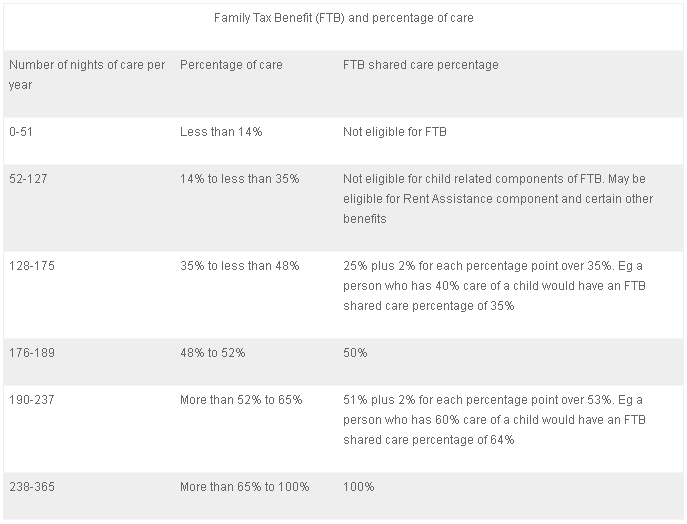
A care period of 12 months will generally be used when the arrangements are ongoing. Generally for a 12 month period, the 35% minimum care rule is satisfied where a person cares for the child for at least 128 days in that year.
Pattern of care

To work out how FTB is to be shared, a “pattern of care” must be established to work out what percentage of time each adult cares for the child. This percentage is then applied when calculating the rate of Family Tax Benefit A and B that each adult can receive. The table below summarises the percentage of FTB that will be paid. If “number of nights” is not an accurate reflection of the pattern of care, in some cases, care can be expressed in hours and converted into days to establish a pattern of care.
Shared-care-and-Family-Tax-Benefit

Who decides what the percentage of care is?

Centrelink’s Family Assistance Office or the Child Support Agency make a determination about the pattern of care that each relevant carer provides for a Family Tax Benefit child, and then informs the other agency automatically.

This pattern of care then gets converted into a percentage rate that decides how the FTB is split.

If both adults agree on the actual pattern of care for the child, the agreed pattern of care is used.

If both adults disagree, Centrelink must decide what the actual pattern of care is, on the basis of available evidence, even if a formal care arrangement exists according to court orders.

Each adult will be asked to provide additional evidence to support what they say in order for the Family Assistance Office to make a decision.

If you do not agree with the percentage of care that Centrelink or the Child Support Agency decide you have, you have the right to appeal.

An assessment by Centrelink or the Child Support Agency is binding for both agencies. If the decision is made by Centrelink, you can appeal to an Authorised Review Officer in Centrelink. If the decision is made by the Child Support Agency, you can lodge an appeal with the Child Support Agency or to an Authorised Review Officer in Centrelink.

If that doesn’t work, you have the right to appeal to the Social Security Appeals Tribunal.

How can I prove my percentage of care?

When there’s a disagreement between yourself and another carer as to percentage of care, each person has the opportunity to provide verification. You could try to get evidence which might support what you say, such as:

  • any records of agreement between you and the other carer (a written agreement, an email);
  • a family law order or parenting plan;
  • confirmation of play group, kindergarten or school enrolment;
  • proof of attendance or membership of local organisations or activities;
  • receipts for things you paid for while caring for the child;
  • statements of close family friends or relatives who can confirm your percentage of care;
  • confirmation from any professionals who know your situation (a doctor, a family law solicitor, a teacher, a police officer);
  • proof of travel arrangements at contact times (rail or airline tickets); or
  • records from a government agency (like the Child Support Agency) who might be able to confirm current or previous patterns of care.

A decision maker will usually speak to you, speak to the other carer, look at any evidence submitted, and then make up their own mind about what percentage of care to apply in your case.

Who can help me with this?

Welfare Rights Centres often can’t act for you against another carer. This is because we don’t want to be “conflicted out” of helping as many people as we can with their problems with Centrelink. You could contact your local Legal Aid Child Support specialist service to see if they could help you. Centrelink’s Family Assistance Office and the Child Support Agency can each make a determination about the pattern of car and this decision is then applicable to the other agency automatically. Legal Aid Child Support Service in NSW can be reached on 96339916 (Sydney) or 1800 451 784 (regional).

Shared care debts

Problems can arise when one person receives FTB by instalments based on a certain percentage, but then another person claims FTB later (eg at the end of the year) and claims to have a higher percentage of care than Centrelink had applied.

For example, Susie receives instalments of 100% of FTB through the financial year on the basis that she has care of her son Tom 70% of the time. However at the end of the financial year, her ex-partner Jason lodges a claim for FTB stating that he has 35% care of Tom.

If Centrelink assesses the care and decides Jason did have 35% of the care, Susie will incur a debt:

  • If Susie disagrees with Centrelink’s decision about the percentage of care, she may appeal to an Authorised Review Officer to argue the decision was wrong;
  • If she agrees with the decision, she might still have grounds to have the debt waived if it was caused by Centrelink error or if she has special circumstances.

If you disagree with a debt raised on the basis of the percentage of care you had of a child over a past period, you have the right to appeal. You can present your case to a decision maker and ask them to make a decision that you had a different percentage of care. The same sorts of evidence referred to under “how can I prove my percentage of care” on page 2 would be relevant to your appeal.

If you agree with the percentage of care basis for the debt, but would like the debt waived in view of your special circumstances and in view of the fact you did not realize you were being overpaid at the time, you have the right to ask that the debt be waived (meaning it does not have to be paid back). See our factsheet “Debts” for more information about this.

Shared care and other payments

Parenting Payment (for children under eight if you’re single) can’t be shared because it is paid to the principal carer, and only one person at a time can be the principal carer of a child. Where the care of a child is shared a decision has to be made as to who qualifies as principal carer. Where one person provides the majority of care they will generally be determined to be the principal carer, even if that person has not claimed Parenting Payment. Where the care is shared equally (eg, 50:50 or where there is less than a 10% difference in the level of care), Centrelink’s policy is to grant Parenting Payment to the parent who:

–     claimed Parenting Payment, if the other parent does not claim; or

–     is most in need of the payment.

In determining need, Centrelink looks at:

–     whether one of the parents already qualifies for Parenting Payment for another child;

–     any other income or assets of the parents; and

–     whether one parent has already been receiving Parenting Payment for the child.

Child Care Benefit and Rebate are paid to the person liable to pay the child care fees.

Appeal rights

If you think a Centrelink decision is wrong, you have the right to appeal. Appealing is easy and free. To appeal simply tell Centrelink that you are not happy with their decision and that you would like to appeal to an Authorised Review Officer (ARO).

You can appeal to an ARO at any time. However for an FTB past period decision, your appeal needs to be lodged within 52 weeks from the date of the decision, or by 30 June for the financial year after the one you are appealing about – whichever date is the later one. To claim FTB for a past period, you need to lodge your claim within 12 months of the relevant financial year you are claiming for. There is no time limit to ask to waive a family assistance payment debt. Different time limits may apply to appealing decisions through the Child Support Agency.

If you think the ARO decision is wrong you have further appeal rights, and time limits apply. For more information see our factsheet “Appeals – how to appeal against a Centrelink decision”.


De facto couples have differences to married counterparts, judge says

Close-up Of A Judge Hitting Mallet At Desk

Close-up Of A Judge Hitting Mallet At Desk

De facto couples – even those who have a child and live together – have significant social, financial and emotional “differences” to married couples, according to a Federal Circuit Court judge.

Judge Joe Harman has ruled a man and woman who had a child, bought a home together, and lived in it for 13 years were not in a de facto relationship and had had sex out of “need”, not love.

This meant the court had no jurisdiction to divide up their property under family law.

The woman, “Ms Benedict’’, argued the couple were in a relationship and lived together from 1992 to 2010.

Ms Benedict told the court they’d been sharing a bed and were in a marriage-like relationship, even though she had been claiming Centrelink benefits and filing her tax returns as a single parent.

However, her alleged partner, “Mr Peake”, said they’d never been in a de facto relationship and simply lived together with their daughter for convenience, in separate bedrooms.

Assessing whether they were in a relationship, Judge Joe Harman said Mr Peake mostly “attended to his own needs”.

“This included attending to his washing at laundromats or at other premises, making his own meals (or more often than not taking meals outside of the home or buying takeaway) and by and large living and maintaining his own life and lifestyle,” Judge Harman said.

He said the pair had not maintained a relationship that could be described “in normative terms” as marriage like.

“Indeed, a de facto relationship may be described as ‘marriage like’ but it is not a marriage and has significant differences socially, financially and emotionally,” he said.

But Forte Family Lawyers partner Jacky Campbell said many married couples stayed together for years for the same reasons Mr Peake and Ms Benedict lived under one roof: for financial reasons and the benefit of children.

“The Family Law Act has been changing over many years to give de facto couples the same rights and responsibilities with respect to parenting and financial matters as married couples,” she said.

Judge Joe Harman seems to be saying that de facto relationships are different. I don’t know what these differences are. His comments appear to be contrary to the law and the general views of society.”

The judge accepted Mr Peake’s evidence the pair had not held themselves out to others as being a couple and said their sexual relationship was “brief, sporadic and far from reflective of mutual commitment”.

“In all probability for these parties and especially Mr Peake, engaging in sex with each other has met a need and has not imported or implied anything else be it emotion or commitment,” he said.

The pair lived different hours: Mr Peake usually worked through the night and went to bed in the morning, and Ms Benedict woke usually in the morning and slept at night.

They were largely financially independent, but Mr Peake had taken care of the mortgage.

Ms Benedict paid some of the bills, helped to maintain and improve the home and had cared for their daughter.

They had also been involved in a business together and took overseas trips with their daughter.

However, Ms Benedict had failed to register Mr Peake’s name on her daughter’s birth certificate.

Ms Benedict argued this was an oversight that occurred while she was heavily sedated following her daughter’s caesarean delivery. However, the judge found this was “substantially and significantly inconsistent with Ms Benedict’s evidence and assertions as to the level of closeness, joint purpose and intent and mutual commitment to relationship”.

Legal Aid offices in WA may close due to budget pressures

simone-mcgurk-legal-aidBudget pressures have prompted Legal Aid to consider closing two of its metropolitan offices and centralise services at its Perth headquarters.

The service is jointly funded by the state and federal governments and provides free services to people who cannot afford to pay for a lawyer.

But the budget is under strain and the ABC has been told the service, which has an annual budget of about $65 million, will soon put a proposal to the Legal Aid Commission to close offices in Fremantle and Midland.

There are no plans to cut jobs and staff would be relocated to the May Holman centre in Perth’s CBD, in a bid to save $600,000 a year.

The Member for Fremantle Simone McGurk has described the proposal as a “tragedy”.

“Remember that this service is being cut for metropolitan centres because the Barnett government has prioritised vanity projects over people,” she said.

“The Government’s failed to manage their own budget and recipients of legal aid are paying the price. It’s a real tragedy.”

She is also suspicious of the claim that jobs would not be cut.

“Taking those Legal Aid offices out of the metropolitan areas will mean that some people are without proper legal advice,” she said.

“We still don’t know whether the actual staff numbers will be reduced as a result of this decision but we’ll be looking closely at the upcoming state budget to see if Legal Aid’s allocation has been cut.”

Attorney General Michael Mischin has blamed the previous Federal Government for cutting its part of the shared budget.

“Whereas once the Commonwealth was contributing something like 60 per cent of funding for Legal Aid in Western Australia, in 2011-12 it was down to 37 per cent,” Mr Mischin said.

“There are a number of pressures on Legal Aid but the assurance I’ve had is that the services won’t suffer.

“The Government’s failed to manage their own budget and recipients of legal aid are paying the price. It’s a real tragedy.”

“It was one of my concerns as to whether this would cause people to be disadvantaged, but as it was pointed out to me, there are duty lawyer services in Rockingham, in Mandurah, Armadale, they’re in Joondalup; all these are major areas which have their own significant problems.”

He says Legal Aid director George Turnbull had to work with the budget available.

“That is a matter for him as to how he handles the budget he has,” Mr Mischin said.

“It’s true to say that every government agency and department needs to achieve efficiencies and economies in order to stretch dollars further.”

The Opposition says the move will affect many vulnerable people, particularly with the busy Fremantle office also servicing the Rockingham and Mandurah courts.

The Legal Aid Commission will consider the proposal at the end of this month.

Property Settlement in Big Money Australian Divorces

big money divorce calculatorMost divorce cases of the mega-rich never reach court. The details are usually mediated by a retired judge.
Head of Mills Oakley family law team, special counsel Michael Paul said going to court could sometimes be like rolling a dice in divorce cases of the mega-rich: there’s an element of chance in how the court will allocate the assets.

Mediation is often the cheaper and usually safer option when it comes to deciding huge divorce settlements, Paul said. The mediator, in a position of authority, can evaluate the case and advise on what a court would be likely to do anyway.

“What we’re all on about is if you possibly can do a mediation, there’s a bunch of retired judges out there who for about $5,000 to $8,000 a day will do a mediation, plus they will need a fee for reading time before hand,” Paul said.

“Sometimes it is helpful to have senior counsel at a mediation and this adds to the expense.

“You can do neither [go to mediation or court] until there has been what’s called appropriate disclosure of all financial records.

“It becomes a pretty expensive process to get real estate valuations and forensic accountants to give an evaluation of companies and businesses, it’s very, very costly.”

But mediation can fail, and some big money cases do end up in the Family Court.

Paul said there were big unknowns in taking a big money divorce case to court.

“If you ask half a dozen lawyers, given a certain set of facts, what you see the results as being, you would probably get about three opinions across a bit of a range,” Paul said.

“The real concern is if you ask half a dozen judges you’ll get about the same range, and there are judges who have a predisposition one way, judges who are pretty straight down the middle, and judges who have predisposition the other way. They’re all known and I assume they know themselves.

“That’s why it’s a bit of a roll of the dice. The judge now gets allocated to you quite early so you know what could possibly happen so you plan and negotiate accordingly.

“But on the whole even when you go to court surprises do occur not withstanding discovery.”

What’s interesting is in many of the multi-million dollar divorce cases which have made it to court, the wife has received less than half of the assets.

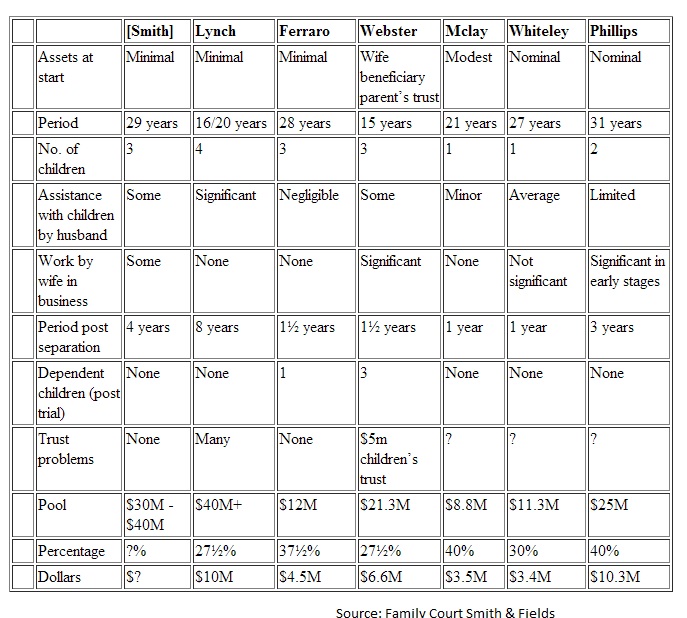
This table gives an indication of how assets have been split in divorce cases where tens of millions of dollars are at stake. It first appeared in a case over which Justice Peter Murphy presided over in 2012. Justice Peter Murphy awarded the entrepreneurial husband 60 per cent of the assets and the wife has since appealed, so “it’s not the last word,” Michael Paul said.

Family Court Smith & Fields

When these big cases with asset values between $8.8 million and above $40 million have been decided by a court, the wife has in some of the authoritative cases received less a lot less than half of the assets.

For example in the Lynch case, with an asset pool valued at over $40 million, the wife received 27.5 per cent or about $10 million.

In that same case the couple were together for 20 years; the judge deemed the husband’s assistance with the children was “significant” and the wife did not work in the business.

In the Ferraro case the court deemed the husband’s assistance with the children as negligible and the wife did not contribute to the business and she was awarded 37 per cent of the assets.

But in the Phillips case the court found the wife made “significant” contributions to the business in its early stages, the husband’s contribution with the children was found to be “limited” and the wife was awarded 40 per cent.

“If a wife has done significant work in the business then that should be looked at as a significant contribution on her part that cuts down on his,” Michael Paul said.

“It doesn’t seem to have mattered whether you’ve worked or not, we say as a general rule the income earning of the partner who goes out to work is the equivalent of what the partner who stays home looks after the house and children.”

What does matter, in terms of the multi-million dollar cases outlined in the table, and in Justice Peter Murphy’s arguments is the entrepreneurial skills of the husband.

“Usually luck is something that doesn’t attract that appellation [of entrepreneurial skills], something that’s the result of intelligence and an unusual set of skills leading to a result in terms of the asset created that is beyond the norm,” Michael Paul said.

In these cases the court found “special skills” of one party, in these cases the husband, have driven the wealth creation.

Going back to basics the legislation outlines a four step approach, including creating a balance sheet of all the assets and liabilities, evaluating both direct and indirect contributions of both parties, and making adjustments in favour of the weaker financial party.

Adjustments include if a person is caring for children, has a smaller income earning capacity or if one party has more property.

But Justice Peter Murphy looked at what are called “special contributions”, and in the case of the rich “entrepreneurial type contributions have been rewarded”, Michael Paul said.

“The argument about special contributions is a bit of a non-argument, it’s all about contributions in each particular case,” Michael Paul said.

“You have to go back to the legislation, there’s nothing about ‘special’ in the legislation, and they’re both direct and indirect, domestic and other.

“No one necessarily has a greater role.

“It’s the result of one person doing what they do in their sphere enabling the other to do what they do in their sphere.

“You’ve got to allow special contributions because to not do so you would be really ignoring something.”

Paul explained that what does happen in a lot of cases is that a judge will find that the contributions have been equal.

“That is the case absent either somebody starting with a lot more in assets then the other or somebody inheriting along the way,” he said.

“If you start with a lot of assets and it’s a short marriage you probably keep them.

“If it’s a long marriage after ten years or so there’s frequently little regard had for what you started with.

“Although there are exceptions to that for example if the asset is still in the same shape, is it a house, a business, the court should give a bit more to the one that brought it in.

“That’s one of the hardest things to work out.”

The other source of wealth some divorces squabble over is inheritance.

“People are always concerned about inheritances being gobbled up by the other party but it doesn’t happen that way because the court almost quarantines the inheritance if it was recently received on the side of the person who received it, it’s got to be more than five or six years ago I think before an inheritance starts to get divvied up,” Michael Paul said.

But it’s all considered on a case-by-case basis.

“Nobody is suggesting those cases [in the table] were wrongly decided, they’re all quoted as authorities for various propositions and I think an entrepreneur will still in an appropriate case, it’s almost back to the definition ‘what is special?’” Michael Paul said.

 
Related Family Law Brief

  • No items found in feed URL: http://www.familylawexpress.com.au/family-law-brief/category/divorce-2/financialdispute/marital-assets/feed/. You requested 15 items.
  • Father Wins Right To Vaccinate His Children

    boy-getting-vaccinationA Sydney father has won the right to vaccinate his children after a drawn-out legal battle with their mother, who is strongly opposed to immunisation.
    The children, a son born in 2002, and a daughter born in 2004, now live with the father and have both had whooping cough.

    The Family Court rejected the mother’s claims that the children, who will turn 14 and 12 this year, were at an increased risk of experiencing ”vaccine damage” due in part to various allergies she believes they suffer from.

    Sitting at Parramatta, Justice Garry Foster said the 42-year-old woman, given the pseudonym Ms Duke-Randall, had submitted hundreds of documents about the risks of vaccination, such as the link to autism.

    Justice Garry Foster said much of it ”is comments, submissions, irrelevancies” and Ms Duke-Randall had become ”narrowly focused on it, perhaps to the point where the best interests of her children have been subsumed”.

    The father, Mr Randall, 52, said during their marriage he agreed with Ms Duke-Randall’s anti-vaccination view ”for the sake of peace in the household” but since their divorce in August 2011, he had come to realise his son and daughter were missing out on extra-curricular activities because they were not immunised.

    Some of his relatives were unwilling to have their children socialise with his children and he was worried they would be excluded from school during an outbreak of an infectious disease.

    But he said he ”was simply unable to negotiate with [the mother] on the issue”.

    While the parents fought over other issues including custody and property, the court restrained both parents from vaccinating the boy and his younger sister until a three-day hearing into the immunisation issue could be held in January this year.

    But last month Justice Garry Foster discharged the order, finding the mother had been deliberately delaying proceedings and ignoring directions, which led to the ”strong inference that she has done so to suit her own end that the issue as to vaccination be delayed for as long as possible”.

    The mother claimed any delay in presenting her case was caused by the court not permitting her to use medical evidence regarding her children’s susceptibility to being adversely affected by vaccines.

    Justice Garry Foster accepted evidence from a senior consultant in immunology, given the pseudonym Professor K, that both children are healthy and do not have any allergies or any other contraindications to vaccination.

    Both children had been kept on a low-salicylate and low-amine diet but once the father gained primary custody, they had begun to eat a normal diet, Professor K said.

    She recommended the children be bought up to date with the routine childhood immunisations.

    The case is the latest in several court judgments that have found on the side of the parent wanting vaccination.

    A report by the National Health Performance Authority last week found childhood ­immunisation rates have ­improved over the past year.

    Domestic violence study suspended by UNSW for breach of ethics

    have breached the University’s code of ethics.An online ‘domestic violence study’ has been ordered offline by the University of NSW Human Research Ethics Committee.

    Flyers published by the survey organisers have been ordered destroyed.

    The study, being conducted by the Gendered Violence Research Network, White Ribbon Australia and Youth Action NSW, was found by the Ethics Committee to have breached the University’s code of ethics.

    The decision comes after a national coalition of men’s health advocates made a formal complaint to the University claiming the survey was gender-biased, poorly formulated and misleading. They argued it could not achieve its stated aims and any consequent findings would be unreliable and likely to mislead the public.

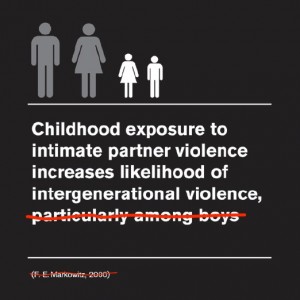
    Chair of the Ethics Committee, Professor Heather Worth, found that a quote on the original flyers claiming that “childhood exposure to intimate violence increased the likelihood of intergeneration violence particularly amongst boys” was incorrect. The ethics committee has ordered that the flyers be destroyed and replaced by a new flyer that has correct information, including any quotes.

    Professor Heather Worth also found that the participants’ information sheet referred to by the survey was not accessible as claimed. The Ethics Committee has instructed that the survey be suspended until the link is in place.

    Men’s Health Australia spokesman Greg Andresen said, “We congratulate the University for investigating our complaint so speedily and acting upon these ethical breaches. It is essential that domestic violence research, especially that involving young people, is conducted properly.”

    “The incorrect statement in question was lifted directly from current White Ribbon ‘Fact Sheets’ that haven’t been corrected. The University’s investigation determined that some of the methodological issues raised in our complaint would be dealt with in peer review of the findings when the authors submit publications for review.

    We trust that White Ribbon Australia plans to subject this study to the rigours of the peer review process prior to publishing any reports on its website. It is regretfully common that much gendered violence ‘research’ makes it into the public domain without going anywhere near peer review challenge,” said Mr Andresen.

    family-law-news-pluginPublish our content on your website for free. Choose to publish from family law news, expert family law briefs, Court & Tribunal decisions, sample legal documents, family law factsheets and much more.

    Family Assets & Divorce – Keep it in the Family

    dividing-gifts-after-divorceNO parent dreams their daughter or son’s relationship will end, but going in with a plan to protect assets is wise
    Family disputes over inheritances are nothing new. But parents planning their estates are becoming more wary about making sure inheritances stay with the sibling rather than potentially be hijacked by a partner.

    With one-in-three marriages in Australia ending in divorce, and defactos having the same rights as married couples, it’s important for parents to consider how estate plans are impacted if their child’s relationship ends.

    Both marriages and de facto relationships are subject to federal laws which govern the division of property and, without proper planning, it’s possible for beneficiaries to lose half of their inheritance in a future split.

    While we all hope it won’t come to that, when it concerns a legacy it’s best to play it safe, so here are three strategies to help keep your estate in the family.

    ESTATE PLANNING

    Every family is different and putting together a legally sound, tax-effective estate plan can be a big task.

    For families looking to protect their estate, RK Financial Planning’s Robert Reid says a practical option can be to set up a testamentary trust through their will instead of leaving assets directly to their chosen beneficiaries.

    Establishing a testamentary trust can protect assets from claims against beneficiaries, and can also be highly tax-effective compared with a direct transfer of ownership.

    As an example, say Scott has been married to Emily for five years and has recently received a $200,000 inheritance from his dad. Soon after the money arrives, Emily files for divorce.

    But if they’re held under a trust, Scott’s inheritance may be protected and considered separate from the matrimonial pool.

    If the assets are bequeathed directly in Scott’s name, they could easily be considered part of the matrimonial pool and be divided between the two parties. But if they’re held under a trust, Scott’s inheritance may be protected and considered separate from the matrimonial pool.

    That said, there are no hard and fast rules here, and it’s important to realise the Family Court has wide-ranging powers to decide which assets are included in any divorce property settlement.

    GIFTS AND LOANS

    Another common situation is when parents provide financial assistance to their kids, for example helping them out with a house deposit.

    This can be a dangerous game if their relationship is on the rocks and the money is simply gifted or lent under an informal loan agreement. If the relationship ends it could end up in their partner’s hands as part of the settlement.

    Say Louise is lent $80,000 by her parents to buy a house with her partner John, but no formal agreement is put in place.

    If the relationship ends, John may be entitled to his share of the equity in the house, including the loan amount, while Louise will still be liable for the informal loan from her parents, whose good deed has actually backfired and lost the family money.

    However, if Louise and her parents had organised a formal loan agreement complete with interest charges and set repayment dates, the loan would be much more likely to count as a personal liability for Louise and excluded from the division of property.

    Just don’t try and dress up a gift as a “loan” with some basic documentation. As Reid says, the more it looks and smells like a gift, the more likely it’ll be treated as such.

    BINDING FINANCIAL AGREEMENT (PRENUP)

    For people who have already received an inheritance and want to protect it from their partner should they separate, binding financial agreements (or prenups in Hollywood terms) are an option.

    These are signed by both parties before or during a relationship and govern how assets are distributed in the event of it ending. Although, again, the Family Law Courts can declare the agreement invalid if it’s challenged.

    While kicking off a relationship with one eye on the exit is never a good start, binding financial agreements can have their place.

    Whatever approach you take to protect assets, it’s best to get expert advice from a financial planner, as well as an estate planning lawyer, to ensure you’re covered.

    Family Law Courts launch new Youtube channels

    Family-Court-YouTubeThe Family Court of Australia and Federal Circuit Court of Australia have launched their official YouTube channels to provide informational videos aimed at helping self-represented litigants with court procedures relating to family law.

    Chief Executive Officer of the Family Court and Federal Circuit Court, Richard Foster said the courts received about 45,000 divorce applications a year and of those applications almost 70 per cent had no legal representation.

    Mr Foster said one aspect of the divorce process, serving documents, had been identified as an area which caused most confusion to some clients and was the subject of the first video.

    He said How to apply for a divorce: serving divorce papers was produced by the courts to help self-represented litigants understand and carry out the process of service in divorce applications.

    Mr Foster said this video was the first in a series of videos planned to provide court users with simple information in a digital format which differs from the usual printed fact sheet.

    “The courts aim to help clients through the legal system in what is often a difficult time in their lives,” he said.

    “The move from traditional to online media reflects the ways in which clients are searching for information and also reflects the changing ways in which people are consuming information.”

    Mr Foster said this was a further step in the use of technology and social media as a means to make the court process more accessible and to better communicate with court users.

    The Family Court has been using Twitter (@FamilyCourtAU) since October 2012 and both courts actively encourage the use of the Commonwealth Courts Portal as a way to file and manage documents.

    To view How to apply for a divorce: serving divorce papers visit the:

    1. Family Court of Australia’s YouTube channel,
    2. Federal Circuit Court of Australia’s YouTube channel.

    For the Family Courts Twitter page, go to the following link.

    For the Commonwealth Court Portal, go to this link.

    Roving family law courts will go to Aborigines

    family-court-of-australiaFAMILY law matters in indigenous communities will be heard outside courtrooms and a team established to help Aborigines under a plan being considered by the Federal Circuit Court.

    Chief Judge John Pascoe told The Australian he wants to devote part of the court to looking after Aboriginal families and their ­welfare under a reconciliation ­action plan launched yesterday by the Attorney-General, George Brandis.

    It is the first court in the country to have developed such a plan.

    “We wanted something that was concrete, something that you could measure,” Chief Judge Pascoe said.

    The Federal Circuit Court, which has jurisdiction over family, consumer and human rights law, was known as the Federal Magistrates Court until last April.

    The plan is to introduce hearings in informal settings for indigenous people by June next year where there are no dedicated court buildings, and the creation of a specific family law wing for Aborigines.

    The plan also includes indigenous mentoring and employment targets. “I would really like to see part of the court absolutely devoted to looking after Aboriginal people, their children and their welfare,” he said. “There are a lot of barriers to overcome but we should adapt the processes where a court can sit in an Aboriginal medical service or somewhere people feel comfortable.”

    He said he had become convinced change was needed in the court when he met a group of elders, many of them grandmothers, in Dubbo and heard stories about the Stolen Generations and wariness when it comes to accessing justice.

    “One grandmother I spoke to told me she would spend many days walking up and down outside her grandchildren’s school to make sure nobody took the children,” Chief Judge Pascoe said. “That was just so upsetting and I wanted to know what it was a court could actually do to make a real difference and not just make a token gesture.”

    He said children were being removed from their homes at a rate almost as high as during the Stolen Generations.

    Senator Brandis, launching the plan in Sydney’s Redfern yesterday, said it was “one building block in the national goal to which we all aspire”, reconciliation. He did not answer questions about the government’s exposure draft of revisions to the Racial Discrimination Act.

    Neither Male nor Female: High Court Recognises Gender-Neutral Category

    Norrie-non-specific-gender

    Norrie won High Court Appeal

    The androgynous person at the centre of a high court decision recognising those who do not identify as either male or female has described being “overjoyed” at the ruling and expressed the hope that it will encourage Australians to be more accepting.

    In a historic decision with far-reaching implications for institutions and individuals across the country, the court on Wednesday formally upheld the right of transgender person Norrie to be registered as neither a man nor a woman with the NSW Registry of Births, Deaths and Marriages.

    The decision is recognition by the highest court in the land that ”sex” is not binary – it is not only ”male” or ”female” -and that this should be recognised by the law and in basic legal documents.

    ”I jumped up and down a lot … I was getting ready for my shower and I saw it come up and I said, “hooray!” … I squealed,” Norrie said of the decision at a press conference hosted by the law firm DLA Piper, which took on the case pro bono.

    “It’s a very exciting victory. I’m overjoyed that it’s happened and happened so decisively. It’s been a long time from start to finish but it’s a great outcome, and it’s Australia-wide not just NSW.

    “Maybe people will now understand there’s more options than the binary, and even if a person is specifically male or female, their friends might not be – and hopefully people might be a little bit more accepting of that.”

    The case began in 2010 when Norrie, who identifies as neuter and uses only a first name, became the first person in NSW to be neither man nor woman in the eyes of the government with a formal “sex not specified” registration.

    But four months later the registry wrote to Norrie, who is from Redfern in Sydney, saying the change had been “issued in error” and was invalid.

    “It was completely unproblematic for a month – the world didn’t collapse, the sky didn’t fall in, human life continued,” Norrie told Fairfax late last year.

    “Then it was on the front page and they suddenly said: ‘Oh, no, we couldn’t possibly do that!”‘

    Norrie appealed the decision to the Administrative Appeals Tribunal, but the case was dismissed.

    Norrie then went to the NSW Court of Appeal, where the three-judge appeal panel unanimously declared that “as a matter of construction … the word sex does not bear a binary meaning of ‘male’ or ‘female’.”

    But the Registry of Births Deaths and Marriages did not accept the decision, appealing the matter to the High Court at great expense to NSW taxpayers.

    The High Court ordered that Norrie’s applications be sent back to the Registrar for determination in accordance with its reasons and otherwise dismissed the Registrar’s appeal.

    When the case was heard in the High Court last month, counsel for the Registrar had argued that the acceptance of more than two categories of sex would cause unacceptable confusion. But the judges rejected this argument.

    “For the most part, the sex of the individuals concerned is irrelevant to legal relations,” their judgment says.

    The judges said the Commonwealth Marriage Act was “the chief, perhaps the only, case where the sex of the parties to the relationship is legally significant”.

    The judges found there was ”evident force” in Norrie’s argument that to classify her as male or female while her sex remained ambiguous would be to record misinformation in the register.

    But the court found Norrie’s counsel went too far in arguing that Norrie should be assigned to a separate category of sex such as “intersex” or “transgender”.

    The court accepted the Registrar’s submission that male and female were the only “registrable classes” of sex.

    “But to accept that submission does not mean that the Act requires that this classification can apply, or is to be applied to everyone,” the judgment says. “And there is nothing in the Act which suggests that the Registrar is entitled, much less duty-bound, to register the classification of a person’s sex inaccurately as male or female having regard to the information which the Act requires to be provided by the applicant.”

    The court found that the provision of that Act, which recognises “ambiguities” in sex and a 1996 amendment which referred to persons of “indeterminate sex”, was a sufficient indication that the Act recognised that “the sex of a person is not … in every case unequivocally male or female.”

    “The Act does not require that people who, having undergone a sex affirmation procedure, remain of indeterminate sex – that is, neither male nor female – must be registered, inaccurately, as one or the other. The Act itself recognises that a person may be other than male or female and therefore may be taken to permit the registration sought, as ‘non-specific’,” the judges found.

    In the opening of their reasons for decision, the five-judge panel declared that “not all human beings can be classified by sex as either male or female”.

    “The Births, Deaths and Marriages Registration Act 1995(NSW) (“the Act”) expressly recognises that a person’s sex may be ambiguous. It also recognises that a person’s sex may be sufficiently important to the individual concerned to warrant that person undergoing a sex affirmation procedure to assist that person ‘to be considered to be a member of the opposite sex’.

    “When a person has undergone a sex affirmation procedure, s 32DC of the Act empowers the Registrar to register a change of sex of the person upon an application by that person.”

    Dr Tracie O’Keefe from Sex and Gender Education Australia said the High Court’s decision meant that “the law now recognises the physical reality”.

    “One in 100 people are either sex or gender diverse – that is one of life’s realities,” Dr O’Keefe said.

    “The law has now recognised that reality, the highest court in the land, through a decision that cannot be appealed.”

    Dr O’Keefe said she now expected others across the country who did not identify as male or female to seek to be recognised as such on their “cardinal documents” such as birth certificates and other documents held by their local registrars.

    “There are people out there who have been wanting to do this but have been unable to,” she said. “They now have that option.”

    Samuel Rutherford, the executive director of A Gender Agenda, a community organisation which advocates for transgender, gender-diverse and intersex people, said he was “delighted” with the decision.

    A Gender Agenda intervened in the case as amicus curiae, or a friend of the court.

    Mr Rutherford said he was especially pleased that the court had recognised “non-specific” as the most appropriate term for a person who is neither male nor female.

    He said while the decision would only be binding on NSW, it would be “highly influential” on other jurisdictions.

    The ACT last month became the first Australian jurisdiction to make provision for people to be recognised as neither male nor female. It also removed the requirement for surgery for people who wish to change their sex registration.

    Mr Rutherford added that Wednesday’s decision would be a powerful affirmation of the identity of many people for whom the decision was not personally relevant.

    ”It’s actually a really big thing to have a statement from the High Court saying that you exist and that the law should recognise you,” he said.

    Anna Brown, the Director of Advocacy & Strategic Litigation for the Human Rights Law Centre, which assisted A Gender Agenda with the case, said the judgment was a victory for the growing numbers of gender diverse people across Australia.

    “Sex and gender diverse people face problems every day accessing services and facilities that most Australians can use without thinking twice. It’s essential that our legal systems accurately reflect and accommodate the reality of sex and gender diversity that exists in our society, and the High Court has taken an enormous leap today in achieving that goal,” said Ms Brown.