Family Court Seeks Whereabouts of Layla Leisha

Layla-LeishaA father who has refused to comply with a court order to return his seven-year-old daughter to Queensland is believed to be living with her in northern NSW.

A lawyer representing schoolgirl Layla Leisha has obtained a Family Court order allowing a public appeal for information about her whereabouts.

It comes after a Family Court ordered missing persons’ report for Townsville twins Isabella and Bronte Watter, who were snatched by their mother Catherine “Cassie’’ Watter in April.

Layla’s mother Deborah Neilsen, 37, and her maternal grandmother have not seen her since late last year.

The schoolgirl, who has lived most of her life with her mother, was supposed to live with her maternal grandmother near Gympie, after a Family Court order in December.

Australian Federal Police believe Layla is still with her father Shahrainier Eric Shem Leisha, 42, known as “Shem’’ Leisha, in the Lismore or Goonellabah areas of NSW.

“Layla is a well behaved, bubbly little girl,’’ independent children’s lawyer Trent Waller said.

“The maternal grandmother is feeling upset, she is feeling anxious, not knowing the whereabouts of her granddaughter.

“We don’t know where the child is, whether she is attending school, we don’t know her accommodation details or her current emotional state.’’

A court order for the recovery of Layla was made on March 6.

Before that Layla had spent time with her paternal aunt, Jennifer Jean Leisha, around Inala, Mr Waller said.

Until late last year Layla was a student at Calliope State School and lived in the Central Queensland area with her mother.

Mr Waller said the indigenous father, 42, had lived in different places in Queensland and NSW and did not have a permanent place of abode.

Mr Waller said since March 6 Australian Federal Police had spoken to Mr Leisha, who told them he did not intend to comply with the court order to hand over Layla.

Mr Leisha failed to deliver Layla to the Commonwealth Courts complex in Brisbane on June 23, as ordered.

Layla has dark brown hair and brown eyes and is about 1.4 metres tall.

Anyone with information about the whereabouts of Layla Leisha or Shem Leisha should phone Crime Stoppers on 1800 333 00 or Australian Federal Police on 02 61267926.

Divorce often opens a can of worms for SMSFs

smsf-in-divorceWHAT happens to your super when you get divorced?

In theory the super assets are included in a couple’s total balance sheet and split just like any other asset. The couple can do this by mutual agreement or the Family Court can enforce its decision on the couple.

What value is ascribed on your Self Managed Super Fund if it’s a mess and its value might be significantly eroded due to ATO penalties and fines?

This very situation was before the Family Court late last year. Mr and Mrs Linder were married for more than 30 years. He was a solicitor and Mrs Linder ran the house and raised their three children. Their youngest child, while still a minor, was ill for several years with a variety of serious medical conditions. While she was in hospital her mother provided her with a high level of care and the husband worked and looked after their home and other children.

Their financial affairs were quite complicated and there was some dispute between them about how their matrimonial assets should be split. Of major interest to us is their super fund.

The SMSF had been established in 1995. Its two members and individual trustees were Mr and Mrs Linder. The assets of the fund were cash in the bank and shares in Argo, a very good ASX-listed investment company, which had been purchased in a number of different transactions.

The husband told the court that “at no stage did my wife ever take an interest whatsoever in the assets or operations of the superannuation fund or make any contribution towards it (sic) administration and management”.

The court accepted this statement and said the husband was responsible for the SMSF.

There was dispute between the parties about the super fund’s ownership of more than 22,000 of the Argo shares, which are currently worth about $160,000. There was no evidence the super fund had purchased them and no proof it actually owned them.

Ultimately the Family Court decided that these shares weren’t assets of the super fund. As a result the super fund was deemed to have about $700,000 in assets.

Since 2007 no financial accounts for the super fund had been prepared and no ATO return had been submitted.

Clearly, the fund potentially had severe ATO compliance issues. One expert accountant said, in an affidavit, that in her view the fund had a “very high risk” of being in breach of a number of super law provisions and that the tax office might impose a penalty of $350,000. That is the ATO would make the fund non-compliant and impose the high tax rates applying to super funds that apply when this occurs. The expert recommended that the super law breaches should be rectified and the fund closed for a cost of about $63,000.

The husband and his advisers told the court that they were confident that they could fix the fund and not face the financial penalties imposed by a wrathful ATO.

Putting to one side the slackness in preparing annual accounts and regulatory returns, it appears from the court’s written judgment that the fund had been run appropriately. Assuming we have a complete picture of the fund’s activities, and based on my experience of fixing up SMSFs that have regulatory problems, the husband and his advisers seem to have come to a reasonable conclusion.

The court decided that as part of the property settlement all of Mrs Linder’s interest in the super fund would be transferred to her former husband. As part of this process the husband had “to indemnify the wife in respect of the financial consequences of her having been a member of the superannuation fund”.

The court granted the husband’s wish but as each trustee is liable for any ATO-imposed penalties the court made the husband liable for any punishment imposed on Mrs Linder. The court judgment said, “… failure to properly manage the superannuation fund … should not be visited on the wife”.

Separated Families: Get Free Help with your Taxes

free tax helpFinancial issues become even more complicated for separating families, and sometimes in the midst of separation, preparing properly during tax time can take a back-seat to all the other priorities one is faced with during these hectic times.

However, tax time waits for no-one, and taxation based errors during tax time can sometimes compound into greater issues later on, as evidenced by the ATO’s increase presence in family court matters in recent times.

Well, its Tax time again, and if you are having a bit of trouble preparing for your tax return because of your circumstances, just head to one of the many Tax Help centres across Australia who can help you for free.

As long as your tax affairs are considered simple, and you do not earn over $50,000 in one year, then you should be able to find assistance in the preparation of your taxes from over 180 community centres across NSW and others across Australia.

ATO assistant commissioner Karen Anstis said it was a free, confidential service provided by tax office-trained volunteers.

The service is available by appointment until the end of October.

For more information, see ato.gov.au/help. Alternatively, call the Marion Library Service on (02) 8375-6785.

Does a ‘Mistress’ have rights to maintenance and property settlement?

financial-abuseFor the purposes of this article we have referred to “mistresses”, however the same risks would apply to affairs had with men.

New de facto laws came into force on 1 March 2009. The new laws declare that de facto couples will be treated in the Family Court in the same way as married couples.

As a result of the changes to the law, there is a risk that cheating spouses may leave themselves and their partner vulnerable to claims by mistresses for income support and/or a share of the assets of the marriage/relationship. This is particularly so if a child is involved.

In order to make a claim the mistress must prove that a de facto relationship existed. A de facto relationship is defined under the new legislation as “A couple living together on a genuine domestic basis”. The definition has caused great deal of debate.

There is a real risk in circumstances where a cheating spouse has had a longstanding affair with someone other than their current spouse, during which they have supplied the mistress with financial support and/or accommodation without the knowledge of their spouse or had a child with their mistress, that the relationship with the mistress would be considered by the Court to be a de facto relationship within the meaning of the Family Law Act (1975). In these circumstances the mistress may be eligible to claim a de facto relationship existed and therefore claim property and/or maintenance.

The new laws not only make the cheating spouse vulnerable to these potential claims from their mistress but in the absence of a Binding Financial Agreement may also affect the current spouse.

A Binding Financial Agreement entered into at the commencement of a relationship can potentially protect the non cheating spouse from a claim if in the future a party has a long-standing affair as mentioned above and the mistress makes a claim for property and/or maintenance.

The main objective is to remove same-sex discrimination from the Family Court system, but they have left the door open for a raft of de facto relationship claims.

The laws declare that de facto couples who satisfy basic criteria – such as being in the relationship for at least two years – will be treated in the Family Court in the same way as a married couple. It also applies to same-sex couples.

The laws will change the way property is divided by enabling the court to consider the “future needs” of partners, as it does for married couples.

Men or women who have a second relationship outside a marriage are now liable to legal action in the Family Court should the second partner decide he or she deserves income support or a share of assets. This is particularly the case if a child is involved.

As a result A CHEATING husband has paid his ex-lover more than $100,000 under Australia’s new “mistress laws”.

In the first known case of its kind in Australia, the Melbourne businessman was sued under changes to the Family Law Act which give rights to people in de facto relationships and same-sex marriages.

Legal experts say the case, prompted by the end of an affair of more than 20 years, will strike fear into the hearts of philanderers nationwide.

The woman, who has not been named for legal reasons, said not only did she deserve the money, but others should follow her lead.
A mistress wanting maintenance or a payout had to prove they had a long-term relationship, a sexual relationship, financial dependency, a commitment and a public recognition of the relationship.

Divorce is costing the Australian economy $14 billion a year

cost-of-divorceDivorce and family breakdowns are costing the national economy more than $14 billion a year in government assistance payments and court costs, an exclusive News Corp analysis has found.

That figure has blown out by $2 billion in the last two years alone, with each Australian taxpayer now paying about $1100 a year to support families in crisis.

The financial sting is one of the reasons why Social Services Minister Kevin Andrews has confirmed he will overhaul early intervention strategies in a bid to strengthen Australian families.

Mr Andrews told News Corp that as early as this month he will act to establish an expert panel on early intervention, which will be made up of a mix of practitioners and academics.

It will examine strategies to lower the divorce rate and better identify and assist vulnerable children and young people, including looking at whether more psychologists need to be deployed in kindergartens and preschools across the country.

“The reality is that most programs are programs that try to ameliorate the impact of marriage and family relationship breakdowns,” he said.

“There is not enough that goes to early intervention.”

A News Corp analysis of information from the federal Attorney-General’s Department, the Department of Human Services and the Department of Social Services, shows that this financial year alone the government will spend $12.5 billion on support payments to single parents, including family tax benefits and rent assistance.

Another $1.5 billion will be spent on the administration of the child support system, while the cost to taxpayers from family disputes in Australian courts is $202 million.

Almost 50,000 people get divorced each year in Australia, and while the divorce rate declined between 2002 and 2008, it is now on the rise again.

Over the last two years, the cost of divorce to the national economy has increased by more than $2 billion, or 17 per cent.

Mr Andrews — who in May estimated that each divorce was costing taxpayers at least $100,000 — said understanding what divorce was costing the nation was important.

“Whatever the figure comes out as, it is still a significant amount of money and I do think it is worth knowing because we are more likely to do more in terms of prevention,” he said.

In addition to his trial offering of $200 relationship counselling vouchers to couples looking to wed, which has this week seen 250 couples register for the program in its first two days, Mr Andrews said the overhaul of early intervention programs will also examine whether current schemes, like the Communities for Children program, are operating as effectively as possible.

He will also demand government service providers be more outcome focused.

EARLY INTERVENTION KEY

Academic and relationship expert from the University of Queensland Matthew Bambling said he was not surprised the cost of divorce to the national economy had now toppled $14 billion.

“It is one of the key sources of transitory poverty among working people,” Dr Bambling said.

“People may be required to rely in greater part on the social welfare system, there is the potential for court costs borne through the government-funded system,” he said.

“If we are not thinking about this as a society, we are likely to pay the price with a lot more mopping up at the other end.”

Relationships Australia’s Grant Pearson has welcomed the government’s relationship counselling voucher system and its push to overhaul early intervention strategies.

He said more government resources for programs which deliver early intervention, like relationship counselling, would be beneficial both to couples and to the nation’s budget bottom line.

“For every program we have, we have waiting lists,” Mr Pearson said.

“There is often a wait to get into our main line services, and it can be up to two months — which is quite a while if a client is under pressure in the eleventh hour of their relationship,” he said.

RELATIONSHIP PRIORITIES

Like all besotted first time parents, Rebecca and Marcus Andreoli are quickly adjusting to the pressures that come with a having five month old baby.

But the Bondi couple, who have been together for seven years and married for half of that time, are conscious of the importance of taking time out to prioritise their relationship amid the whirlwind of parenthood.

“We definitely try to get out somewhere alone together, we try to do that once a fortnight,” Ms Andreoli says.

She said spending time together as a couple, as well as with their friends, helps keep their relationship strong.

Communicating well with each other about the demands of daily life is also a priority for the couple.

“We talk to each other about little things before they become big issue, we wait until we are both calm and then bring things up early, because it’s too easy for little resentments to build,” she said.

Tax Commissioner denied access to Family Court documents – this time

ato-access-to-family-court-documentsWith the ATO’s information-gathering powers seemingly ever-expanding, the “long arm of the law” is taking on a whole new meaning. But that long arm doesn’t always reach as far as the Commissioner might like.

For example, the Federal Court recently denied the Tax Commissioner’s request for access to documents that were part of Family Law proceedings. The Tax Commissioner wanted to use the documents in a tax case.

In the course of the proceeding, the Federal Court said the Commissioner sought leave to inspect all documents on a file provided to the court by the Family Court other than documents on that file relating to a child. The file in question was a Family Court file between a man and his former wife, apparently involving their dispute concerning property and in respect of a child of their marriage. The man’s former wife did not object to access being granted, but the husband opposed access.

The Court said the Commissioner sought to access the file in order to determine:

  • whether the applicant in the case, a company called International Litigation Partners, was an Australian resident for tax purposes because its central management and control was exercised in Australia by the man, or
  • if the company was not resident, whether, pursuant to the double taxation treaty between Singapore and Australia, the company derived profits in Australia from a litigation funding enterprise it carried on in Australia which were attributable to a permanent establishment maintained in Australia by the man, and thus taxable in Australia pursuant to the double tax treaty.

The Court said the Commissioner’s contention in the separate Federal Court proceedings as to residence, was that: (i) the litigation funding undertaken by the company in Australia was conducted in such a fashion as to amount to carrying on business in Australia, and (ii) the central management and control of the company was exercised by the man in Australia.

The Commissioner’s alternative contention as to permanent establishment was that the company derived profits in Australia from a litigation funding enterprise it carried on in Australia which were attributable to a permanent establishment maintained in Australia by the man, and thus taxable in Australia pursuant to the double tax treaty.

The Commissioner contended there was utility in him being able to inspect the Family Law file as it may shed light on the man’s activities. Specific information that would be relevant to the tax issues would include:

  • the man’s involvement or that of any entity related to him, in the company International Litigation Partners;
  • the man’s dealings or those of any entity related to him, with that company;
  • the relationship of any entity related to the man, with the company.

The Commissioner did not seek to inspect any documents relating to a child.

After considering the matter, the Federal Court said the exercise of discretion must involve weighing the likelihood of the Family Law file disclosing to the Commissioner anything of any real utility against the interest in preserving the confidential and personal nature of the documents contained in the file. The Court said it accepted the man’s submission that there was likely to be substantial practical difficulty in separating documents dealing with issues that might be of relevance to the Commissioner from those which disclose information touching upon the interests and concerns of the child.

The Court considered as important, and as a distinguishing factor from the circumstances in the April 2014 decision of the Full Family Court in FCT v Darling [2014] (where the Commissioner was granted access to documents, although the husband in that case is seeking to appeal to the High Court), the fact that the man was not a party to the current proceedings.

The Court concluded that the utility in the Commissioner gaining access to the documents was outweighed by the public interest in confidentiality of Family Law proceedings.

From time to time, material and information comes before courts in non-tax proceedings which the court may deem would be of interest to the Tax Commissioner, and the court may even decide to provide that information to the Commissioner. Family Court and social security matters come to mind.

It’s a timely reminder that the Tax Commissioner does have an interest in financial and tax matters revealed in non-tax court proceedings involving taxpayers he may be investigating or auditing. The fact that such information is revealed in cases to which the Commissioner is not a party does not necessarily mean he won’t be able to access that information. He may have lost the case in question above, but he has had success in other cases.

Separated parents: Children under four and overnight stays

4-year-old-sleepingThe idea that young children under four should not spend any nights away from their primary attachment figure usually the mother, is a hotly contested idea.

English parenting guru Penelope Leach has quoted Australian researchers in her new book about separated families, but the researchers say they are unhappy with her interpretation of their research.

What does this Australian research actually say and how is it being used in the Family Court?

transcript" class="ct-transcript">

Transcript

Damien Carrick: Hello, welcome to the Law Report, Damien Carrick with you. When families separate, should children under four have overnight stays with the non-resident parent? Social science research plays a big role in such family law disputes, and it also has a big influence in forming the public’s understanding. One of the most prominent voices in this space is English parenting guru Penelope Leach. In her new book, Family Breakdown, she spells out some forthright views, and she uses Australian research to back them up. Here’s the best-selling author and developmental psychologist spruiking her book.

Penelope Leach: Fathers really matter, but when you talk about shared parenting, there’s an horrible tendency to see children as…like dinner; I’m going to share it. So we get situations where children are spending a week in Mum’s house and a week in Dad’s house and all kinds of horrible arrangements. I call them horrible because we do know that they are desperately wrong for children who need the security of a place called home and who when very little shouldn’t be taken away overnight from what is usually the mother, the person they’re attached to.

Damien Carrick: Now, the idea that young children under four should not spend nights away from their primary attachment figure, usually their mum, is a hotly contested one, and Penelope Leach’s position has reverberated throughout the UK and around the world. To support her claim, Penelope Leach quotes 2010 Australian research. That report’s lead author is Jenni McIntosh, an adjunct professor at La Trobe University. She’s currently on leave. One of her co-authors is ANU Associate Professor Bruce Smyth. So, does Bruce Smyth think their work has been correctly represented in Penelope Leach’s book?

Bruce Smyth: No.

Damien Carrick: Is that a cause of concern for you?

Bruce Smyth: Very much so, and it’s a cause that I know Jen’s been in contact with Dr Leach, and we’re currently working through a process to make sure that the findings and research is being reported accurately in the book.

Damien Carrick: Can you clarify for me what you think the misquote is, or the misrepresentation is?

Bruce Smyth: I read the book last night, and one sentence that leapt out at me, which is, ‘Findings strongly suggest that shared care that includes spending nights or even a single night at a time away from home and mother is seldom in the best interests of children under four years of age.’ Our findings don’t show that, we never said that, so I’m not quite sure how you reach…for the Australian study to reach a conclusion like that.

Damien Carrick: More from co-author Bruce Smyth later. So, what does the McIntosh report really say about overnight stays for children under four? It’s a crucially important question in family law. Well, it seems that depends on who you talk to. Here in Australia two leading experts aren’t surprised that Penelope Leach got the wrong end of the stick. Patrick Parkinson is Professor of Family Law at Sydney University, and he’s also President of the International Society of Family Law. Judy Cashmore is a developmental psychologist and she’s an associate professor in socio-legal research and policy at The University of Sydney. Other social science experts have also raised red flags about the interpretation of research. Judy Cashmore is also one of 110 expert signatories to a document titled ‘Social science and parenting plans for young children: A consensus report’.

Judy Cashmore: It was written by Dr Richard Warshak, who’s a US academic at The University of Texas in the department of psychiatry. He’s a very well respected academic who’s been involved in the debates about early childhood development and particularly the debate about overnight stays with fathers since the early 2000s. Why was it written? Because there has been a great deal of concern, I think, about the way in which the research has been misinterpreted and used to support suggestions that it’s dangerous or harmful for children to stay overnights with their father before the age of three. And that conclusion is not well substantiated; it’s not supported by the research evidence.

Damien Carrick: So that’s the take-home message from this expert consensus report, that research which suggests that children should not have overnight care with the dad or the absent parent because it could be harmful…there’s not enough evidence to support that conclusion.

Judy Cashmore: Yes, that’s right.

Damien Carrick: What does the Richard Warshak consensus report have to say about research that currently is very influential here in Australia; it’s research by adjunct professor and clinical psychologist Jen McIntosh, and it’s on this issue of overnight stays for very young children.

Judy Cashmore: Yes, that research was an attorney general’s report based on the longitudinal study of Australian children, but only a small proportion of those children were actually in separated families, so it’s not the 10,000 children but a much smaller group of children comparing those who had different arrangements. Basically what it was suggesting, using some of the measures that were not necessarily designed for that purpose, is that children were more distressed or more irritable if they were in a shared or overnight stay arrangements with their fathers before the age of four, and that research has been challenged on the basis of the research design, the sampling and going beyond the conclusions or the data analysis.

Damien Carrick: Now, Patrick Parkinson, if I can bring you in here, I understand that Jennifer McIntosh has said in recent times that she never suggested that children under three should never stay overnight with the father. What’s your view of the research and how it’s been interpreted and repeated and sent out into the world?

Patrick Parkinson: The first question is what does the research itself say. I think the research is quite equivocal with regard to children under two, and I’m referring here to the McIntosh research in particular. Clearly there are some children who do not handle overnight stays with their fathers well, and there’s all sorts of reasons for that. If there’s high levels of conflict between the parents, if the child doesn’t know the father, they’ve never lived together, for example, then some children are going to have difficulty with overnight stays. So what the research does tell us is what a lot of other research tells us, that children sometimes do not manage transitions between their parents terribly well, but it is not the basis for any blanket rule about children spending overnights with their fathers.

Damien Carrick: What specifically do Warshak and the other 110 people who endorse the paper, specifically what conclusions do they reach about that McIntosh research?

Patrick Parkinson: Well, they don’t just focus on the McIntosh research; there’s other research by Tornello and colleagues in the States which has also looked at these issues. What the paper’s really saying is, ‘Look, there is a broad consensus from a large body of research that children need both parents, children do fine in childcare, for example, away from their primary carer, and there is this research which appears to say the opposite, but we need to understand its limitations and not to draw conclusions from it, which contradict the rest of the body of research out there.’ That’s essentially what Warshak and others are saying.

Damien Carrick: Now, if course, it’s important because it’s influential. This sort of material is used in decision-making and negotiations when it comes to the care and responsibility arrangements for children. Patrick Parkinson and Judy Cashmore, you are the joint authors of a just-published article in Psychology, Public Policy, and the Law titled, ‘The use and abuse of social science evidence in children’s cases’. What role does this social science research that we’ve just been talking about play in our family court system here in Australia?

Patrick Parkinson: Whatever Professor McIntosh has herself said, her work has been widely understood amongst family lawyers and their clients to represent a view that it is not wise to have young children spending overnight time with their fathers. So that’s been the take on it, but it’s important to emphasise that first of all Dr McIntosh herself hasn’t said that’s what her research shows, secondly the body of research doesn’t show that, and so there’s been a misunderstanding of what that research says and what all the other research on this area shows us.

Damien Carrick: Judy Cashmore?

Judy Cashmore: Yes, I think there’s an issue here. There’s a responsibility both on social scientists to communicate their research very clearly and to correct any misunderstanding, and secondly a responsibility on those who are the receivers and users of that research in courts and decision making, to make sure that they are intelligent consumers of that research.

Damien Carrick: And do you think she’s done everything she can to make sure that her research has been correctly understood and the context of the research has been correctly understood by people in the courts and professionals in the area?

Patrick Parkinson: Just in the last couple of months Dr McIntosh has published a joint article with two leading experts in the United States, Joan Kelly and Marsha Pruett, which is extremely helpful in clarifying not only what Dr McIntosh’s own position is but also what is a shared view amongst three leading experts. And what it says is that there is nothing inherently problematic about overnight stays with fathers. That’s a very important clarification. But it sensibly says, ‘We’ve got to look at each individual family.’

Damien Carrick: How well do you think lawyers and judges understand the research which underpins the conclusions reached by report writers, be it Warshak and the 110 experts or McIntosh and her collaborators?

Patrick Parkinson: I think it’s fair to say that Jen McIntosh’s own work has attracted very widespread attention in the family law community, certainly in Australia, but I think also beyond, because it’s fed into a narrative that mums should be the only ones looking after kids and mums should be the gatekeeper to spending any time with Dad. So, it’s attracted, I think, a lot of attention because it’s fed into a broader sort of point of view. I don’t think that it has been widely understood amongst judges and lawyers that that is just one view.

Damien Carrick: Is it also that perhaps we need to be looking not at just the experiences of children as reported by researchers when they’re having overnight care but the impact of that overnight care in the longer term in terms of strengthening relationships, investing in their children and having a deeper relationship with their children?

Judy Cashmore: I think that’s absolutely critical, and that’s why there is so much concern about this, that if you cut fathers out of the picture very early on then it’s more difficult to build up their relationship later. If they haven’t had that experience of looking after the child and don’t feel confident, then that needs to be built up over time. Like any of us, we need a scaffold to help our learning and our transitions, and so do the children, too.

Damien Carrick: These debates, as they swirl around the zeitgeist, do they become quite important in shaping the parameters of what people will ask for in negotiations, what people will ask for in court cases if they reach that point? Is that part of the issue here, that they really help determine the parameters of what becomes possible?

Patrick Parkinson: Yes, certainly, and there are many, many situations where Mum will come in and say, ‘No overnight time for Dad because we understand that children were being harmed by having overnight stays with Dad under three.’ You’ll have Dad saying, ‘But I want to have a relationship with my kids.’ And so, I think what we are experiencing now is unnecessary conflict in the courts and between lawyers based upon gross misunderstandings of the research. So let me be clear that neither I nor, much more importantly, the psychologists who are expert in this field are suggesting that equal time for one- or two-year-olds is remotely sensible; it’s not. Children need stability, they need routine, they need a primary care giver. So we’re not talking about equal time, we’re not talking about even nearly equal time; we’re talking about, say, one overnight a week, or if there’s a strong bond between father and child maybe, you know, two overnights, whatever. But we’re not talking about equal time or shared parenting here. We’re just talking about building or maintaining that bond between a non-resident dad and his child.

Damien Carrick: Patrick Parkinson, and before him Associate Professor Judy Cashmore. The pair also have concerns about how the McIntosh research has been adopted by bodies such as the Australian Association for Infant Mental Health, which cites the McIntosh report to support the general proposition that infants under the age of two should not be separated overnight from primary carers.

I’m Damien Carrick and you’re listening to the Law Report on ABC RN, ABC News Radio and Radio Australia. Well, how do the authors of the 2010 McIntosh report respond to the concerns that we’ve just been hearing? One of the authors is Associate Professor Bruce Smyth, ARC Future Fellow at the ANU College of Arts and Social Sciences.

Bruce Smyth: We’re surprised by the amount of attention our study’s received, and the extent to which the findings have been mangled and misinterpreted, and I think the findings have been interpreted in a very black and white manner; they’ve been boiled down to a crude, divisive gender message: any overnights damage children. The truth is, we’re puzzled by this; we’re not sure why they’ve been interpreted this way and why they’ve been boiled down that way. Those who’ve actually read the original government report will know that we’ve never said that, and we’re surprised that no one’s picked up on the glass-half-full message that once kids turn four they’re actually able to cope with a variety of parenting arrangements.

Damien Carrick: Some people would say, though, that the study also participates in the gender wars by maybe overreaching with the data and maybe seeing everything through the prism of attachment parenting, which is perceived by some people as being an argument or a theory put forward by mothers at the expense of fathers.

Bruce Smyth: Well, we’ve tried to get in the shoes of children and look for signs of stress, and we’ve tried to take a very dispassionate investigation into the issue. We know that science moves slowly, we know that some people have strong views and are tempted to over interpret the findings, but at the end of the day we’re trying to get into kids’ shoes and get a sense for what the experience of shared times like when you’re very young.

Damien Carrick: But there’s also the longer term issue of keeping fathers in the loop and keeping relationships with fathers alive, and that’s perhaps as important a consideration as the stress experienced in the moment.

Bruce Smyth: Very much so, and father absence is a real problem around the world. Many dads are no longer in children’s lives after a divorce for a whole host of reasons. You know, that’s a concern for us too, and this debate around the stability of relationships versus the stability of place is a really tricky debate, and it’s been raging conceptually for a long time now, and now we’ve injected some data into that debate.

Damien Carrick: There’ve been a number of new publications in 2013 and 2014. The latest one, the peer-reviewed version of the 2010 report, ‘Overnight care patterns following parental separation: Associations with emotion regulation in infants and young people’, what does that actually say on this issue of overnight care?

Bruce Smyth: It’s a much cleaner version of the 2010 report that’s been distilled and boiled down, basically. It’s the same finding; that is, when infants and young children under four spend a lot of time between two homes, they show signs of stress.

Damien Carrick: Even one night overnight care?

Bruce Smyth: Well, we were looking at the high frequency group, and a lot of people have jumped in and said our key finding is that any overnights, even one night, damages children, and that’s just not true.

Damien Carrick: That was never there in the 2010 report and not there in the 2013 report?

Bruce Smyth: That’s right.

Damien Carrick: What’s your view of the Richard Warshak ‘Social science and parenting plans for young children: A consensus report’, which was published in the journal Psychology, Public Policy and Law?

Bruce Smyth: I’m really surprised by the consensus report. In fact, all three of us are very surprised by that report, and I guess the key question for me is, why has the scientific method seemed to have failed in this particular instance? Why, when a piece of research comes out, rather than replicate or have a discussion with the authors or go and collect some data and see what the findings look like, do you actually write a lit review and then send it off to a whole bunch of people saying, ‘Do you agree with my lit review and my conclusions?’ It’s a very unusual way; it’s not the way science normally works. A petition approach isn’t science. I’m not quite sure why Dr Warshak didn’t just publish the review and let it stand on its own two feet. There are question marks about whether the piece was peer reviewed, which is of some concern, and we have no idea how many people Dr Warshak wrote to, exactly which version they saw, whether they agreed or not… And his qualification, and not everybody agrees with every detail, we wonder whether might no one have agreed on some of the points and whether it’s a true consensus. So, we’ve got a lot of concerns about that particular piece.

Damien Carrick: What’s your view of the just-published article in Psychology, Public Policy, and the Law titled, ‘The use and abuse of social science evidence in children’s cases’, by Judy Cashmore and Patrick Parkinson?

Bruce Smyth: Well, obviously I’m not going to get into a public slinging match with Australian colleagues here, but basically that piece really just comes to the conclusion that it’s not easy to come to some consensus, and to translate research findings into, call it outcomes and policy decisions.

Damien Carrick: It’s, and I think I’ve got the quote but I’m not exactly sure, but, ‘Poorly constructed research, research which is agenda-driven, research which is misrepresented and research that goes beyond the data fails to illuminate the pathway to a decision that will work best for the child; worse, it can lead to detrimental outcomes for children.’ Do you agree with that?

Bruce Smyth: There are several commonalities with people who’ve been critiquing the research. I’d have to say that if there’s innuendo that our research isn’t quality research we’d go back to the scientific method, which is basically why don’t people collect the data or replicate the data with the LSAC data that we used…

Damien Carrick: ‘Research that is misrepresented and research that goes beyond the data.’ I think that’s probably the key point. I don’t think anybody’s saying the research was dodgy.

Bruce Smyth: Well, the issue of researchers controlling how people use the data and what their findings are and what the implications of those are, alas, that’s something that researchers have very little control over, which is probably a good thing in the end.

Damien Carrick: Don’t the authors, yourself and Jennifer McIntosh have a responsibility when research gains a certain currency out in the world, and a certain widely understood meaning to make sure that that gels or is consistent with what you put out there?

Bruce Smyth: Well, the recent piece in the Journal of Family Studies attempts to clarify exactly what we’ve found. We’re also currently writing another piece that looks at ten falsehoods around the way in which the data have been interpreted and reported. So we’re kind of doing our bit to make sure, in terms of research translation, that the messages are very clear, but at the end of the day there are still limits as to whether you can stop people interpreting results a certain way or cherry-picking things to suit their own ideas.

Damien Carrick: There’s been the use of the research in the courts, and we might come to that in a moment, but do you think that the Penelope Leach use of your work goes to the wider issues, why Warshak and Cashmore and Parkinson feel a strong need to put out into the world what their views are of the 2010 report? Doesn’t it go to this issue, that the work has been, as you would see it, widely misrepresented?

Bruce Smyth: Yes, that’s true, but I mean, we’re very happy for people to challenge our methods, look at other explanations for the data, which is the way science moves forward. I guess our big concern is why simply rail against the findings because they don’t like the results, as if we had no right to ask the question. We think there are elements of that with our research and we firmly believe that that needs to be challenged and resisted; otherwise we’re just stuck in a position of where we have no data, wild anecdote flies around in family law frequently and we’re left in a position of ignorance.

Damien Carrick: I’ve been told by a lawyer who practises in the courts that the take-home message of the 2010 report is that it’s often used to argue against any overnight stays for children under four. Is that a concern for you?

Bruce Smyth: It is a concern insofar as this was a small study, there are a number of limitations that mean we are very keen for people to replicate. Bob Emery and Tornello in the US have replicated and come up with very similar findings, which is heartening, but there are very few studies in the world that look at this. There’s no doubt that parents and policy-makers and decision-makers need to resolve problems in front of them right now, and there is a temptation to over interpret and push these data too hard, which is certainly something that we’re mindful of.

Damien Carrick: So it’s a concern for you if people walk into courts and say there should not be overnight stays for children between zero and four?

Bruce Smyth: Absolutely.

Damien Carrick: Associate Professor Bruce Smyth, one of the co-authors of the 2010 McIntosh report. Sydney lawyer Tom Reeve is a partner in charge of family law and immigration at the Marsdens Law Group. He sees the 2010 McIntosh report in the wider context of the pendulum swings in family law.

Tom Reeve: Well, the earlier report was, I think, responding in part to the earlier 2006 reforms which introduced the equal Shared Parental Responsibility bill and changed the whole ball game in family law. So the social science that McIntosh authored was then, I think, seen and used as a way of preferencing and preferring attachment theory based social science, which, putting it bluntly, is putting the relationship between mother and child ahead of the need to build a bond between father and child.

Damien Carrick: Jen McIntosh is adamant that she has never, ever said never to overnight care. But why do you think there’s a perception that this is what the research says?

Tom Reeve: Because that’s how it’s used, and if you put your name to something and know that it’s being used in that way, then perhaps you have some responsibility for it.

Damien Carrick: How so?

Tom Reeve: Because at the coal face of family law we’re not about to analyse and involve ourselves in a detailed discussion of how the data has driven particular conclusions in the report. You’re lucky to have practitioners who are au fait with the headnote. It’s a bit like the Gonski Report, everybody knows about it, but nobody’s read it.

Damien Carrick: Do you think, though, this is a research translation issue, it’s not about the research itself, it’s about the way it’s being used or spread out into the world?

Tom Reeve: Maybe, and I mean, Warshak, when he analyses the data, goes through the process of saying, ‘Well, some of the conclusions don’t actually follow from the data.’ It could be a problem in translation, but I think it’s more fundamental than that, and it’s simply that at the busy end of practice we look for a quick, easy, readily usable pitch that comes from a report. And her report lent itself to that, and it pushed the pendulum in a particular direction.

Damien Carrick: It’s really interesting, because of course lawyers are hired guns, and they’ll use whatever weapons they have, and that can include putting forward arguments on behalf of one client one day in court and then the next day, in the next courtroom, arguing the exact opposite. So, don’t the lawyers need to take some responsibility for the arguments?

Tom Reeve: Yes, yes, of course, and my comments make it sound like I’m only acting for people who have got, you know, ‘Men have rights too’ on tee shirts when they come into my office. But of course the other half of the equation is that you’re very often going to be in a position where you want to use a social research of that sort to assist the interests of your client, and if your client is a client who has a particular attitude towards overnight time and doesn’t want it, then social science that McIntosh was the author of previously was useful.

Damien Carrick: Tactically, do you think that sometimes when overnights are being discussed, maybe in pre-trial negotiations for, say, interim orders, do you think sometimes there are tactical reasons for them not being granted at that early stage, or not being agreed to at that early stage?

Tom Reeve: Of course, that’s what you’re paid to do.

Damien Carrick: So, maybe you don’t play ball in terms of overnights because you want to use it, or any other kind of concession as leverage to secure a better overall outcome down the track for your client; you don’t want to give away too many concessions at an early point?

Tom Reeve: It’s in your mind. Your interest is in improving your client’s position, and of course what you haven’t ventured into is the whole ugly truth that the parenting arrangement will impact on child support and will also be highly relevant to the distribution of property. Now, very often you have all three of those things in the mix in a family law case, especially when expensive lawyers are at the party, and those tactical considerations are very much part of the agenda.

Damien Carrick: In terms of Family Court processes, you have family reports and they’re written by family consultants. Do you think that assumptions about research can be embedded, even subconsciously, even under the surface, into the way family consultants build their family reports and the conclusions they come to?

Tom Reeve: Absolutely, and I think the whole problem with this debate is that what is embedded is either embedded openly and explicitly, and therefore you’ve got a whole range of legal problems about whether it’s admissible or not, and is it actually evidence, or is it embedded implicitly simply in the choice of language we use? For example, referring to things like attachment theory, which has a particular meaning and significance and social science related to it, but nowhere appears in the Family Law Act.

Damien Carrick: Do you think that some lawyers and judges in the Family Court subscribe to attachment parenting more than others?

Tom Reeve: I do, and I think some consultants are more wedded to attachment theory than others. So, short answer, yes.

Damien Carrick: Does that mean that there will be inconsistent outcomes dependent on which judge you appear before, and maybe which lawyers are arguing your case or what have you?

Tom Reeve: Yes.

Damien Carrick: Tom Reeve, these issues around overnight care, they’re very much in the zeitgeist at the moment because UK developmental psychologist Penelope Leach’s new book Family Breakdown has just been released, and she’s said that even one night a week can lead to damage to a child. What’s your view of that kind of view being put out in these kinds of very well-selling books?

Tom Reeve: I think it’s really problematic.

Damien Carrick: Penelope Leach’s book quotes Jenni McIntosh and her co-authors, the 2010 research, but it’s difficult, because again McIntosh says she’s never said never. But the research is now being used to argue for a particular line on the other side of the world. What does that say to you?

Tom Reeve: Well, it says to me that the job just got a bit harder when you represent the next father in court who wants to have time with an 18-month-old child, because you’re going to turn up at an interim hearing and you’re not going to have a family report writer there that you can ask any questions of or cross-examine. You won’t have a choice; you’ll be met with a particular judge who may or may not be in favour of a certain view, and you’ll be confronted with the comment, ‘Well, doesn’t the social science say something about this, Mr Reeve?’ And to be able to then sort of combat the way the tide is flowing at that point is very difficult. So you have to have the tools at your disposal to effectively argue back. Yes, I think what the profession should be saying is, ‘Look, the social science shouldn’t be used in that way.’

Damien Carrick: Tom Reeve, partner with Marsdens solicitors in Sydney. That’s the program for this week, thanks to producer Anita Barraud and to audio engineer this week Brendan O’Neill. I’m Damien Carrick; talk to you next week with more law.

Guests

Professor Patrick Parkinson
Professor of Law, University of Sydney, specialist in family law, President, International Society of Family Law
joint recipient, the 2013 Stanley Cohen Distinguished Research Award by the Association of Family and Conciliation Courts (AFCC) for outstanding research and/or research achievements in the field of family and divorce.
Dr Judy Cashmore
AO, Associate Professor in Socio-Legal Studies Sydney University,joint recipient the 2013 Stanley Cohen Distinguished Research Award by the Association of Family and Conciliation Courts (AFCC) for outstanding research and/or research achievements in the field of family and divorce.
Associate Professor Bruce Smyth
ARC Future Fellow, ANU College of Arts and Social Sciences
Tom Reeve
Partner in Charge of Family Law and Immigration, Marsdens Law Group

Further Information

Statement of overnight care of infants in separated families: Dr Jennifer McIntosh

Social Science and Parenting Plans for Young Children: A Consensus report: R.A Warshak

The Use & Abuse of Social Science Research evidence in Children’s: Judith Cashmore; Patrick Parkinson

Article: Parental separation & overnight care of young children : Part 1 Consensus through theoretical & empirical integration: Jennifer E. McIntosh, Marsha Kline Pruett, and Joan B. Kelly

Parental separation & overnight care of young children Part II Putting theory into practice: Jennifer E. McIntosh, Marsha Kline Pruett, and Joan B. Kelly

Overnight care patterns following parental separation: Associations with emotion regulation in infants and young children: Jennifer E McIntosh, Bruce Smythe, Margaret Kelaher

Post-separation parenting arrangements and developmental outcomes for infants and children: Jennifer McIntosh, Bruce Smyth, Margaret Kelaher, Yvonne Wells, Caroline Long

Woozles: Their role in custody law reform, parenting plans, and family court: Linda Neilson

Empty Days Lonely Nights: Bettina Arndt

Related Family Brief Articles

  • No items found in feed URL: http://www.familylawexpress.com.au/family-law-brief/category/children/childcustody/sharedparenting/feed/. You requested 15 items.
  • Sorting the super split when couples part

    Divorce-Superannuation-Super-SplittingIf having a marriage or de facto partnership break-up isn’t stressful enough, it’s worth knowing there are some hurdles to deal with in terms of sorting out superannuation.

    But all is not lost. Super assets can be split between a couple formally separating, including for de facto couples in Australian territories and some states.

    You won’t be surprised to hear that the super laws surrounding divorce are complex, and self-managed super fund trustees are obliged to discharge their trustee duties impartially, as well as look after their own personal interests.

    There are two processes at play here.

    First, SMSF trustees must follow all relevant procedures the super and divorce rules impose upon a trustee or face penalties for noncompliance. Trustees should consider seeking professional assistance from those who specialise in the practical application of this area of the law.

    Additionally, they should get advice from someone experienced in dealing with the super divorce rules so they can properly consider their personal circumstances.

    Decisions about how benefits should be split can have long-term consequences for a super fund member. What are the implications of keeping most of your super if you have nothing to live on? There may also be estate planning or social security implications.

    The Australian legal system is adversarial and a lawyer’s job is to advance the client’s interests.

    Some individuals, and even their advisers, might agree to super-splitting arrangements that appear favourable, but aren’t as good as they seem.

    When a husband and wife who are in a two-member SMSF get divorced, one of them will probably move their super assets to another fund. This may entail moving the market value of the departing member’s balance as well as an agreed amount of their former spouse’s account balance.

    These are separate amounts and must be noted as such. They have different reporting requirements and probably give rise to different tax outcomes.

    It’s important to ensure that these tax issues are sorted out with 100 per cent accuracy, so that one member doesn’t unfairly pay proportionately more tax than the other.

    One complex tax issue to solve is capital gains tax when super fund assets are sold or are deemed to have been sold .

    CGT concessions can apply to any asset transfer after June 2007 when a couple divorce under the following rules:

    • If a small super fund transfers an asset to another super fund then CGT may not apply if a “waiver notice” has been issued under the super and divorce laws

    • If the party demanding the transfer of an asset wasn’t a member of the super fund that owns the asset

    • If, after the transfer of an asset, the person who requested the transfer ceases to be a member of the super fund and the transfer occurred because of a court-authorised award, order or agreement. This exemption may also be available to separating de facto couples.

    The tax laws assume that any asset transferred using the above rules is acquired on the day when the original fund purchased it. Obviously, there would need to be a transfer of relevant documentation.

    Special rules apply when assets are transferred as part of a divorce settlement.

    Ordinarily, the super laws prohibit the transfer of an asset from one small super fund to another where the members of the super funds are related parties, however, these rules, if implemented correctly, get around this problem.

    When the separating parties agree on how their collective assets should be split, the court will confirm this agreement. If agreement can’t be reached then the court can decide how assets should be split.

    One possible way to negate the need to use these splitting provisions is to create a binding financial agreement.

    These agreements, which must be in writing, can be made before, during and even after a marriage. They can be set aside by the court.

    Since March 2009, de facto couples in NSW, Victoria, Tasmania, Queensland, the ACT and the Northern Territory have been able to access similar rules.

    Women more Violent and Controlling than Men: Various Studies find

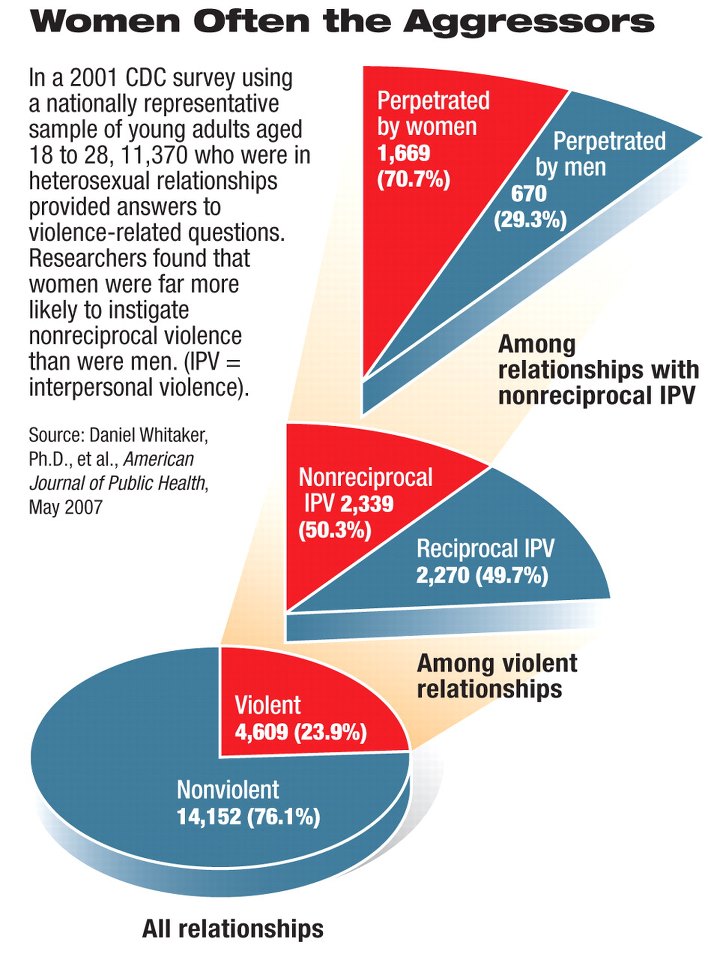
    women-the-aggressors-in-dvContrary to the overwhelming perception in society, numerous studies and statistics recently published from a variety of disparate sources have indicated that women are more likely to be verbally and physically aggressive to their partners than men, and are increasingly participating in serious acts of violence against other men, women, the elderly and children.

    The findings were presented to a symposium on “intimate partner violence” (IPV) at the British Psychological Society’s Division of Forensic Psychology annual conference in Glasgow.

    Dr Elizabeth Bates from the University of Cumbria and colleagues from the University of Central Lancashire gave 1104 students (706 women and 398 men) questionnaires about their physical aggression and controlling behaviour, towards partners and to same-sex others (including friends).

    Women were revealed to be more likely to be physically aggressive to their partners, and men were more likely to be physically aggressive to their same-sex partners.

    Women were also shown to engage in greater levels of controlling behavior, which is understood to be a predictor of physical aggression in both sexes.

    “This was an interesting finding,” Dr Bates says. “Previous studies have sought to explain male violence towards women as rising from patriarchal values, which motivate men to seek to control women’s behaviour, using violence if necessary.

    “This study found that women demonstrated a desire to control their partners and were more likely to use physical aggression than men.

    “It wasn’t just pushing and shoving,” Dr Bates said, of responses to the anonymous questionnaire. “Some people were circling the boxes for things like beating up, kicking, and threatening to use a weapon.

    “The feminist movement made violence towards women something we talk about. Now there is more support for men and more of them are coming forward.”

    In another finding in Australia, the number of men who report experiencing domestic violence from their current partner has almost doubled since 2005, according to a new survey released last week by the Australian Bureau of Statistics (ABS).

    The ABS Personal Safety Survey 2012 collected information from men and women aged 18 years and over about their experience of violence since the age of 15.

    Meanwhile, girls have been found to be more devious than boys in their torment of classmates, Australia’s biggest childhood study reveals.

    Kids who are poor, overweight, Aboriginal, disabled or living with a single mother are most likely to be picked on in the playground, the Australian Institute of Family Studies has found in a survey of more than 4000 children aged 10 and 11.

    Three in every five kids had been subjected to “unfriendly behaviour” in the past year, ranging from hitting to name-calling and being left out of social groups.

    And according to new national crime figures women are now outpacing men in the violence stakes, with the rate of women committing assaults jumping 49 per cent since the mid 1990s.

    Australian Institute of Criminology data shows the number of female assaults per 100,000 women increased from 125 to 186 between 1996 and 2010 compared to an increase of just 18 per cent for men, while other figures show that mother’s were by far the single biggest group responsible for child abuse and child murder in Australia.

    Griffith University’s Violence Research and Prevention Program director Professor Paul Mazerolle said there was “no question” young women were getting more involved in violence: “There’s been a moderate increase in [female] violence but we as a community are less tolerant of violence so we’re seeing more of a response from police.”

    Academic Calls for Taxpayer-Funded Child Support: Inquiry

    child-support-agencySeparated parents should not miss out on child support payments if the other parent fails to pay their way, a Tasmanian academic has urged the federal government’s child support Inquiry.

    Senior lecturer at the University of Tasmania’s school of social sciences, Dr Kristin Natalier has recommended taxpayers foot the bill of the amount owed so single parents and their children are not financially disadvantaged.

    In her submission to the inquiry into the child support program, Dr Natalier said there were high rates of non- payment, partial payment or late payment of child support.

    Figures obtained by the Department of Human Services showed Tasmanian single parents were owed $22 million as at August last year.

    Dr Natalier said the methods used by Child Support Agency to collect payments in arrears contributed to financial instability and poverty of the rightful recipients, the majority of whom are single mothers and their children.

    If CSA decided to write-off a debt, the amount owing should be “gifted” to the resident parent.

    “This recognises that a payee should not be financially disadvantaged as a result of CSA’s failure to successfully pursue a child support debt,” Dr Natalier said.

    The deadline for feedback to the inquiry has been extended until July 4.

    Bass Liberal MHR Andrew Nikolic encouraged anyone with experience of the child support program to have their say via a submission or completing an online survey.

    “A lot of Tasmanian parents who pay and receive child support are telling me about their problems with the child support system,” Mr Nikolic said.

    The National Council of Single Mothers and their Children Hobart branch’s submission recommended introducing tougher penalties for non-payments, including confiscating drivers licences or credit rating downgrades.

    The council also called for reform to the formula used to determine the amount of child support fees and re-opening of Child Support Agency shop-fronts to provide a point of contact for parents struggling with the system.

    Previously, Relationships Australia has told the government’s child support inquiry that some parents are insisting on shared custody just so they can pay less — or claim more — maintenance through the Child Support Agency.

    “The negotiation of three nights of care per week is a clear consideration for many of our ­clients as this is seen as the threshold used by Child Support,’’ it says in its submission to the parliamentary inquiry, which begins public hearings in Canberra today. “This means that the child support formula, rather than best interests of children, may drive the negotiation.”

    When custody is shared, maintenance payments are based on each parent’s income and their time with the children.

    Relationships Australia says parents often ask counsellors to “verify the custody arrangements and advise on the proportion of child support which each parent should pay’’.

    The counsellors refer parents to the Child Support Agency.

    Relationships Australia warns that children who prefer to live with one parent are being ignored because of the financial effect on the other parent.

    “A child may be interested in spending more time with one parent but the change in care ­arrangements may impact on the other parent immediately, which in some instances can be a disincentive for changes to care ­arrangements, even if this is what the children may want,’’ it says.