Dad wrongfully jailed on false child sexual abuse allegations seeks compensation

falsely-accused-fatherA father who was wrongfully jailed after his estranged partner accused him of sexually abusing his own son has vowed to turn “his worst nightmare” into a greater good and help iron out faults in WA’s justice system.

The father of one, who cannot be named for legal reasons, spent more than seven months in a WA jail for a child sex offence he was innocent of.

His lawyer said the case “demonstrated systemic failures at every level” and sparked an internal probe into the police investigation at the time.

The father, who is in his 40s, has spoken publicly about his ordeal to WAtoday for the first time, detailing his ongoing battle to obtain an ex-gratia payment over the botched police investigation and subsequent prosecution, which led to him being charged and jailed for three years.

He said the horrendous ordeal fuelled his wish to spark positive changes in WA’s justice system.

“I do not want a story that shows only how bad a system can be, I would truly like to work with the relevant departments and show the public that although mistakes happen, the people in charge are willing to implement the necessary safe guards to keep the trust of the people,” he said.

“Demonstrable failings are present at every decision point and giving the authorities an opportunity to correct their mistake and prevent anything like this occurring to another person is very important to me.”

‘Hell hath no fury like a woman scorned’

The State Government told WAtoday whilst it continued to seek advice on the man’s application for an ex-gratia payment, it was currently giving the case “significant consideration.”

The father’s nightmare started in 2013 when he was charged with three child sex related offences by WA detectives.

The complainant in the case was the man’s son.

The boy’s mother, and the man’s ex-wife, made the allegations to police in the midst of a Family Court battle about access to the boy.

The father always denied the allegations and the case went to trial.

But he was found guilty of one of the three charges – sexually penetrating a child who was a lineal relative – and jailed for more than three years.

He served seven and a half months in prison before the WA Court of Appeal overturned his conviction in July 2015.

The Court of Appeal judgement made note of the fact that during the Family Court proceedings, the man’s ex-wife said words to the effect: “You’ve got no idea the length a scorned woman will go to.”

Then WA Court of Appeal President Carmel McLure said she also had “doubts about the credibility” of the mother’s evidence and that there was a “real risk” the complainant’s evidence was “contaminated” by the mother.

“The fact that these deliberate perversions of justice occur (in WA) with alarming regularity, more so than in any other state in Australia is demonstrative of an inherent weakness in the justice system,” the father told WAtoday.

“Ignoring this fact and taking no action to correct it, is akin to promoting corruption within the justice system, allowing it to be manipulated.”

‘I want to move on with my life’

In January 2016, the man’s lawyer Neville Barber lodged an application to then WA Attorney General Michael Mischin for an ex-gratia payment, for the suffering he endured.

The application still hasn’t been approved – more than 18 months after it was first requested.

The new WA Attorney General John Quigley must now consider it.

A government spokesperson stressed Mr Quigley was giving “significant consideration” to the matter.

“As is appropriate given the complicated background to this matter, the Attorney General is giving significant consideration to this matter,” the spokesperson said.

“The (WA) Attorney General continues to obtain and consider advice and is consulting within government in relation to this matter.”

But the father said he was feeling frustrated by the lack of action on his ex-gratia application.

“I find this delay terribly disappointing,” the father said.

“Mr Quigley, has in the past been very outspoken about the lack of compensation paid to victims of state errors.

“I wish this application to be finalised, so I can move on with my life and the ongoing delay is having a real impact on me.”

Mr Barber said he was also “very concerned” about the delays in having all the matters resolved.

A botched police investigation

Meanwhile, an internal investigation into the original police inquiry which led to the father being charged in 2013 has been occurring behind the scenes.

It’s understood three officers who were involved in the original inquiry are in the process of being “sanctioned”.

However, it’s believed no final decision has been made on what sanctions they will face and WA Police maintain the matter is still not finalised.

Senior police took the case so seriously however that earlier this year Assistant Commissioner Michelle Fyfe and Commander Pryce Scanlan from the WA State Crime Division, held a meeting with the father in the eastern states where he now lives, to update him on the internal investigation.

The father said the meeting left him “encouraged” that from a WA Police perspective, steps were being taken to address shortcomings.

“I also greatly appreciated that they accepted responsibility on behalf of WA Police and offered an apology,” he said.

“Bad things happen, but if good can come out of them, we as a society will be better off for them.”

Related Family Law Judgments

The convenience of the Homemade Will – it’s cheap and easy to draw up

Sample Will FormatHalf of all Australians die without a will, according to the Australian Securities and Investments Commission, meaning the law decides where your assets go, potentially favouring relatives you resent.

Making a will is vital, but can cost from $150 to thousands of dollars, if you use professional channels. Here are some tips on how to do it yourself, with intense attention to detail.

  1. Harness online resources

Study sample wills on the internet to strengthen your grasp of how to structure yours. Find numerous examples on the Family Law Express Sample Legal Documents portal.

  1. Be picky about the key players

Find the most objective witnesses possible: those with the least to inherit, experts say. The executor – the person who carries out the terms of your will – should be someone set to outlive you: a much younger person.

  1. Sound out relatives

Discuss plans with your family – even seek their input, says estate planner Bruce Cameron. “It doesn’t hurt to know ahead of time which of your family members wants your collection of garden gnomes, grandma’s china, or the silver tea service,” Bruce Cameron says. Lack of discussion may spark entitlement feuding, he adds.

  1. Keep it explicit

Be exact, says Bruce Cameron. Instead of identifying heirs by name alone, include details such as their birth date, address and relationship to you.

Likewise, do not just denote your home by its street address – include its legal description on the deed. And, instead of just listing a charity by name, give detailed contact information.

  1. Insert stopgaps

State where your assets will go if heirs and beneficiaries prove unavailable, unable or unwilling to claim their inheritance, says Bruce Cameron. For instance, the beneficiary might “predecease” you. Or, if a beneficiary is a charity, it might have stopped operating.

  1. Don’t preach

Resist the urge to hit back from the grave. A clause saying that someone will only inherit if they quit gambling and drinking and wed someone at least 180cm tall and five years their senior may spark court battles rather than reform behaviour, says Bruce Cameron.

  1. Keep tweaking

Don’t think you can just write your will and relax, says Bruce Cameron. Regularly update and rewrite your will, reviewing it upon changes such as the birth or adoption of a child, divorce or retirement.

Revision may also be necessary when you open a new bank account, buy a car or move house, he says.

  1. Know the neighbourhood

Mug up on your state’s inheritance rules, because they vary depending on your location, warns lawyer Shane Fischer.

The Government’s “Wills and power of attorney” page offers state-specific information.

Remember that in Queensland, New South Wales and Tasmania, on the day someone divorces, any previous will is revoked, according to RP Emery and Associates.

  1. Exclude the estranged

Don’t bequeath peanuts to disenfranchised friends and family. For instance, forget leaving a dollar to the daughter you have not talked to in 10 years, because she could cause havoc with your estate by challenging your will, Fischer warns.

If you want to disinherit the person, write: “I do not leave anything for ‘X’, my daughter. This is intentional,” Fischer says.

  1. Pinpoint the paperwork

Tell a close contact the location of your will and final wishes statement, Fischer says. Otherwise, your heirs may pick your home apart in search of the information. If they fail, you may get cremated when you should be buried.

Reliability of Prenuptial Agreements questioned after High Court ruling


prenuptial-agreementThe High Court has this morning set aside their prenuptial agreement in a landmark ruling in Thorne v Kennedy, a decision that lawyers warn will open the doors to fresh legal challenges by other former spouses.
This High Court decision was pre-ceded by the original decision in the Federal Circuit Court, Thorne & Kennedy [2015] FCCA 484, and the following appeal in the Full Court of the Family Court, Kennedy & Thorne [2016] FamCAFC 189.

The couple met online in 2006 on a “website for potential brides” when the husband was 67 and she was 36.

“At the time, Ms Thorne, who was an eastern European woman, was living in the Middle East. She was 36 years old. She had no substantial assets,” five of the seven judges, including Chief Justice Susan Kiefel, said in a joint judgment.

The husband, known as Mr Kennedy, had assets of at least $18 million. He was divorced from his first wife and had three adult children.

Soon after he met the wife online, he told her that if they married, “you will have to sign paper. My money is for my children.”

However, this morning the High Court unanimously set aside the binding financial agreements they signed before and after the wedding because they were the result of “unconscionable conduct”. A majority of judges also said the wife, known as Ms Thorne, signed the agreements because of “undue influence”.

The judges agreed that she was “powerless” and had “no choice” to act in any way other than to sign the prenuptial agreement.

About 11 days before the wedding, Mr Kennedy told Ms Thorne if she did not sign a binding financial agreement the wedding was off. By that stage, her parents and sister had travelled to Australia for the wedding and were also staying at the husband’s home.

An independent lawyer advised Ms Thorne not to sign the agreement because it was drawn solely to protect his interests. She understood it was the worst agreement the solicitor had ever seen, but signed it anyway.

She told the court this was because she was dependent on Mr Kennedy and believed she had no choice. She signed it four days before the wedding.

The agreement said the wife was to receive a total payment of $50,000 adjusted for inflation in the event of separation after at least three years of marriage. It also provided for the wife to receive a penthouse worth up to $1.5m, a Mercedes and continuing income, in the event the husband died prior to either party signing a “separation declaration”.

The couple separated after living together for about four and a half years. They had no children.

The husband died in 2014 and was substituted in the litigation by the executers and trustees of his estate, who were two of his adult children.

The Federal Circuit Court set aside the agreements, finding that they were signed “under duress born of inequality of bargaining power where there was no outcome to her that was fair and reasonable”.

However, the Full Court of the Family Court of Australia ruled the agreements were binding, and said there had not been duress, undue influence or unconscionable conduct on the husband’s part.

The High Court this morning disagreed. It said the primary judge’s conclusion of undue influence was open on the evidence and it was unnecessary to decide whether the agreements could have also been set aside for duress.

The case will now be sent back for the Federal Circuit Court to decide how the property pool should be divided between the two.

She had sought orders for $1.1 million plus a lump sum spousal maintenance order of $104,000.

Prominent family lawyer Paul Doolan said the decision was likely to lead to further challenges to binding financial agreements by others.

“The decision of the High Court will likely open the door to many other applications being made in future to challenge prenups,” he said.

He said when looking at whether prenups and postnups could be set aside, the High Court had said that relevant factors may include whether the agreement was said to be non-negotiable, the emotional circumstances when it was made including any threats to ‘sign the prenup or the wedding’s off’, whether a party was given time for careful reflection before it was signed, and the independent legal advice received and how long they had to reflect on it.

Related Family Law Judgments

Tax Liabilities and Divorce

Tax liabilities may not rank highly in the heat of a divorce but when a couple splits assets – particularly property – there are tax hurdles that many people don’t expect but can still come back to bite.

For parting couples who own investment property, a practical and often easy solution is for one party to move out of the family home into the investment flat. It’s in a familiar location, it saves rent and is often already furnished with the owners’ furniture.

And if it’s no longer an investment but a residence, it’s no longer taxable, right?

Wrong. Even if such a property turns into a permanent residence, it can never shed the consequence of having been an investment in the past, says Les Stubbs, head of family law at commercial firm Harris Freidmann.

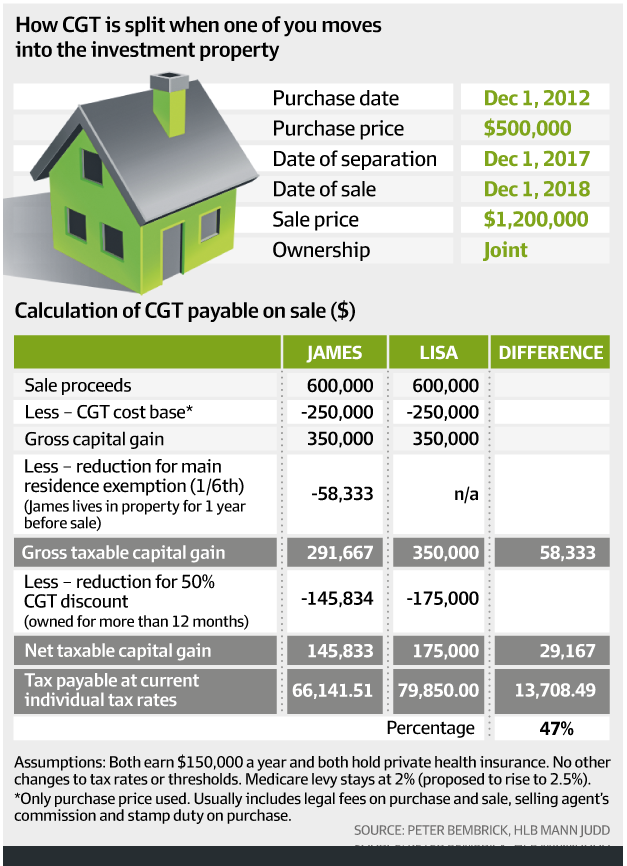
how-cgt-is-split-in-divorce

“If you own an investment property then on disposal you’re liable to pay capital gains tax on your property,” Stubbs says. “The fact that you move into and occupy an investment property doesn’t change it from being taxable to being non-taxable.”

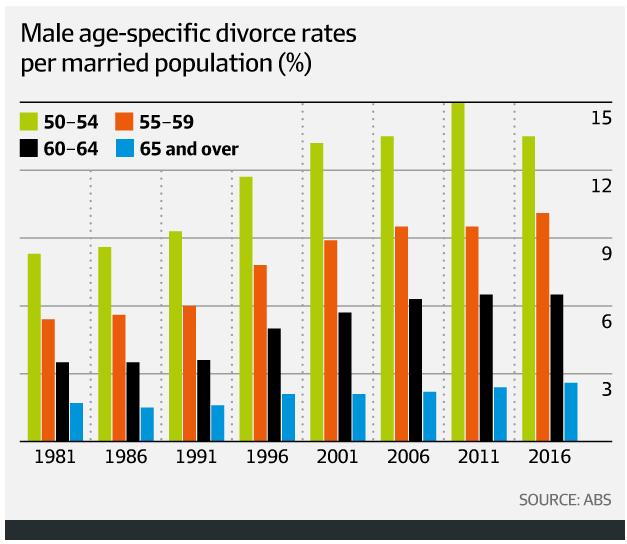
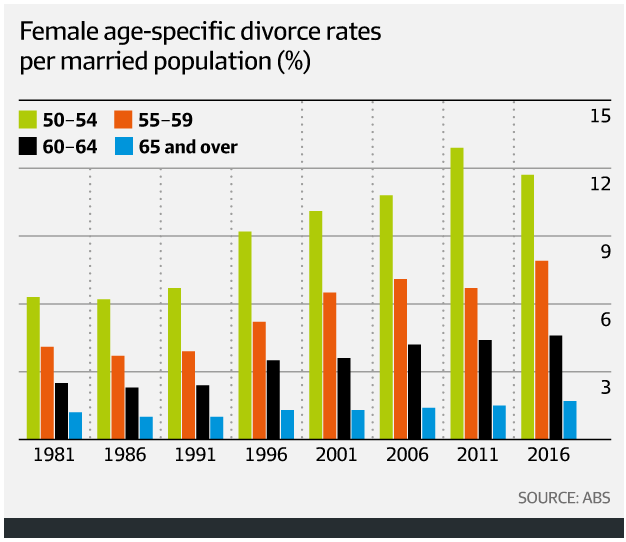
The rules have always been the same, but divorces between older and longer-married couples – the ones likely to have more assets – are growing. Breakups among older couples rose to their highest-ever level in 2016, having nearly doubled over the past 35 years, ABS figures last month showed.

Older couples splitting

The overall divorce rate slipped to 1.9 per cent of the married population last year, continuing a trend that has seen it fall from 2.9 per cent in 1996. While divorce rates have stabilised in the past 15 years among the 45-to-49 cohort and fallen in the younger age groups – possibly because fewer people are getting married at those ages – divorce has increased among women and men in the older age groups.

For men in the 55-59 age range, the divorce rate jumped to 10.1 per cent last year from 5.4 per cent in 1981. For women in the same age cohort, the rate also rose over that 35-year period from 4.1 per cent to 7.9 per cent.

male-age-specific-divorce-rates

“The median age for divorce continues to rise for both husband and wife,” says Lixia Qu, a demographer with the Australian Institute of Family Studies. “If you look at the durations, the divorces involving marriages of at least 20 years – especially those really longer, like 30 years of marriage – continue to rise.”

The trend of older divorces – when people are generally wealthier – coincides with a growing level of sophistication in investments since the 1980s economic reforms that turbocharged the Australian economy. Law firm Harris Friedman estimates there are around 2 million Australians who own one investment property.

“They’re really more ‘First World’ problems people didn’t have to deal with in the old days,” Stubbs says. “In our parents’ day, people had a house, a car, a joint bank account and probably didn’t have much else.

“As time’s gone by there have been new things like share portfolios and SMSFs that never existed. We didn’t have compulsory super until 1989. Then there’s the diversification of investments into investment properties, multiple investment properties – and the question of what you do with those investment properties.”

female-age-specific-divorce-rates

Tax liabilities

The liabilities between ex-partners can vary greatly. Consider this simplified example of a fictitious couple emerging as two singles from the rubble of a collapsed relationship.

James and Lisa purchased an investment flat in both their names five years before their relationship breakdown for $500,000. When they split, James moved into the unit and lived in it for a year before the former couple sold it for $1.2 million.Accountant

On the surface, each gets $600,000 back from the sale and has a CGT cost base of $250,000 (in this example we have used just the purchase price but usually legal fees on purchase and sale, selling agent’s commission and stamp duty on the purchase would be added to the cost base.). That gives both James and Lisa a gross capital gain of $350,000.

But at this point their tax liabilities part ways.

“If James never moved in and it was just an investment property and they had it as an investment and their separation or divorce went through and they sold it, then the calculation would be simple,” says Peter Bembrick, a tax partner at HLB Mann Judd.

James gets a reduction on his CGT liability that Lisa doesn’t because he lived in the property.

Less CGT

The value of his taxable capital gain is cut by one-sixth as the unit was his permanent residence for one out of the six years it was in their joint ownership. The tax liability on what was an investment property is never extinguished. It simply reduces over time the longer it is lived in.

“You’ll always have that period where it’s been an investment property therefore there will be some element of the gain which is taxed,” Bembrick says.

In our example, this cuts James’ capital gain by $58,333 to $291,667 while Lisa’s remains at $350,000.

The gap between the two is reduced, as this calculation happens before – not after – the 50 per cent CGT reduction on investment properties (if held for more than a year) is applied. This means James’s net taxable capital gain is $145,833 while Lisa’s is $175,000 – a difference of $29,167.

“The 50 per cent discount dilutes the benefit of the reduction,” Bembrick says.

But James still benefits. Assuming both of them earn $150,000 a year and have private health insurance, says Bembrick James pays CGT of $66,141.51 while Lisa pays $79,850. That’s a difference of $13.708.49. (These calculations include the 2 per cent Medicare levy.)

This example is necessarily simple. It doesn’t include other deductions or taxes that could apply such as land tax.

But unless these issues are thought through at the time, the implications for separating couples can be far-reaching.

Land tax

Stubbs tells of one client, previously part of a Victorian couple with children who moved overseas for his work. When they left Australia, the couple rented out the family home and three investment properties they owned.

After some years overseas, the couple separated. The wife returned to Australia with the children and they moved back into the family home. Some time later the husband was transferred back to Australia and he moved into one of the investment properties.

Then the Victorian State Revenue Office levied him for land tax on the house that the wife had moved back into with the children.

“Although he wasn’t living in the home, because they had rented it out while they were away, it stopped being their primary residence and became an investment property,” Stubbs says.

His client argued that it shouldn’t be the case. The revenue office was unmoved, stating that as the house was in his name, he got the land tax bills.

He kept paying the land tax on the house – which cost “some thousands” of dollars – for the next four years while his ex-wife stayed there with their children while they completed high school, Stubbs says.

“He said: ‘You’re living in the house so you should pay it and she said ‘Bugger off’. That happens.”

The house is due to be sold at the end of this year, at which point it will also incur a CGT liability.

Taxes on property for divorcing couples are fraught with difficulty and often the last thing they consider, especially when there are more pressing matters such as children and a roof overhead.

“A lot of people aren’t necessarily planning a year or a month in advance to separate. It can happen quickly,” Stubbs says.

But there is a lot to consider, he says. “If they don’t, those consequences could be hanging around their neck for a long time to come.”

Family Court judge blasts lawyers over outrageous fees

family-court-of-australia

A Family Court judge has delivered a blistering judgment on the “culture of bitter, adversarial and highly aggressive family law litigation” in Sydney and blasted two law firms for charging “outrageous” fees.

In a judgment published on Wednesday (Simic & Norton [2017] FamCA 1007), Justice Robert Benjamin said he regularly heard cases filed in the Sydney registry of the Family Court and was “increasingly concerned about the high levels of costs charged by the legal profession in property and parenting proceedings”.

He asked the Legal Services Commissioner to investigate whether the fees charged by the solicitors acting for a former couple fighting over parenting arrangements and property could constitute professional misconduct.

Justice Benjamin said the couple, given the pseudonyms Mr Simic and Ms Norton, had spent an “eye-watering” $860,000 in the proceedings and “these amounts are, on their face, outrageous levels of costs for ordinary people involved in family law proceedings”.

The Hobart-based judge took aim at the “win at all costs, concede little or nothing, chase every rabbit down every hole and hang the consequences approach to family law litigation” he had observed in Sydney and the culture of “bitter, adversarial and highly aggressive family law litigation”.

It was unclear whether this approach was “a reflection of a Sydney-based culture” or an approach by some lawyers or a combination of both, Justice Benjamin said.”Whichever is the cause, the consequences of obscenely high legal costs are destructive of the emotional, social and financial wellbeing of the parties and their children. It must stop,” he said.

The scathing comments come amid an Australian Law Reform Commission review of the Family Law Act, commissioned in September by Attorney-General George Brandis. The review will include a consideration of whether reforms are necessary to promote the “appropriate, early and cost-effective resolution” of family law disputes.Justice Benjamin asked the Legal Services Commissioner to investigate whether the fees charged in the case before him were fair and reasonable, as well as whether the legal work undertaken was necessary and performed in a “reasonable manner”, taking into account the proceedings were launched “on behalf of otherwise unsophisticated parties … and in highly emotional circumstances”.

Justice Benjamin said he had read “each and every one” of the letters sent by the parties’ lawyers and some of them were “inflammatory and reflected the anger of the parties or one or other of them”.” lare not employed to act as ‘postman’ to vent the anger and vitriol of their clients,” he said.Justice Benjamin said lawyers had “a duty to minimise costs and to reduce conflict” and “some of the communications appear to add ‘fuel to the fire’ of conflict rather than dampen it down”.”The children of these parties depend upon the income and assets of their parents to support them,” he said.”Yet, in this case, the costs of the proceedings have taken a terrible toll on the wealth of the parties and consequently their ability to support and provide for their children.

“He anonymised the names of the law firms on the basis the solicitors should not be punished by the negative publicity if the Legal Services Commissioner did not make a finding of misconduct.The parties’ barristers were not the subject of criticism and Justice Benjamin said he was not provided with details of their fees.

Related Family Law Judgments

Perth couple the first in Australia to file for same-sex divorce

farmer-and-louskas

Barrister Teresa Farmer and solicitor Maria Loukas were approached to investigate whether divorce was possible.

New same-sex marriage legislation came into effect on the weekend, prompting a rush of couples heading to registry offices around the country to file their intention to marry.

But in Perth, lawyers were lodging documents of a different kind, on behalf of a woman set to become the first in Australia to file for a same-sex divorce.

She married her long-term partner in 2015 at a consulate in Perth under the laws of a European country where same-sex marriage was already legal.

But things did not work out and the pair separated.

The woman quickly realised getting a divorce would be far more complicated for them than for a heterosexual couple.

She engaged solicitor Maria Loukas and barrister Teresa Farmer to investigate whether it was possible at all.

“The difficulty for this particular couple was having married under legislation of a European country, they couldn’t access the divorce system in that country because they weren’t residents in that country, neither of them were,” Ms Farmer said.

“They were very much caught with no other option.”

Ms Loukas said being stuck in a marriage she did not want to be in had caused her client a great deal of angst.

“For her it’s been about not being able to move on with her life,” Ms Loukas said.

“It’s been about not being able to tidy up the end of something to be able to start fresh somewhere else.

“She’s been held back in many ways.”

In August, the United Nations Human Rights Committee found that a couples’ inability to divorce in Australia violated international human rights obligations.

But the amendments to Australia’s marriage act, that passed through the Parliament last week, meant that the couple’s union was instantly recognised in their home country, and so was their eligibility to file for divorce.

“They’re no different to any other married couple and there will be a rate of failed marriages,” Ms Farmer said.

“But had Australia not changed the law, I don’t know what would have happened for this couple.

“It’s a shame it’s taken as long as it has but it provides an equality for all married couples on all bases, so it’s important.”

Lance Tapsell has been a marriage celebrant for 10 years and has officiated a number of same-sex civil unions in that time.

He is hopeful divorce rates between same-sex couples will be lower than their heterosexual counterparts.

“I’d like to hope there wouldn’t be a large take up of that but it’s like a lot of partnerships or relationships; something sours and people move on and that’s just part of life in the 21st century, I guess,” Mr Tapsell said.

“I think that gay couples would probably take their wedding or marriage a lot more seriously because they had to fight so hard to get it.”

New domestic violence laws to target men who unwittingly breach restraining orders

domestic-violenceMen who unwittingly breach personal protection injunctions, even if coerced or invited to by their spouses or ex-spouses, will face up to two years in jail, and no longer be able to rely on the defence that they were invited over, or on drunkenness.

Parents locked in bitter disputes about the custody of their children will also be able to access an out-of-court resolution scheme to be trialled in Parramatta from next year.

The changes introduced by the Turnbull government on Wednesday aim to reduce the number of families forced to straddle state and federal court systems to protect themselves from violence.

Family Court injunctions differ from apprehended violence orders, which are administered in the state courts. Currently, they can only be enforced if an ex-partner pursues potentially costly legal action.

Under the new laws, police will no longer need a warrant to arrest someone who breaches such an injunction, and offenders could be jailed for up to two years and fined up to $25,000.

“This sends a strong message to the Australian community – family violence is not a private matter, it is criminal behaviour,” Attorney-General George Brandis said.

Self-inflicted drunkenness, a common factor in domestic violence and breaches of restraining orders, will not be a defence to the new crime.

Victims of domestic violence will also not be held liable for actions they may have taken in encouraging or causing former partners to breach an injunction.

The changes were urged by the Australian Law Reform Commission and strongly supported on Wednesday by the Law Council of Australia.

“It’s a positive step. It’s about empowering police to step in,” LCA president Fiona McLeod said. The current system was so deficient that police were not necessarily even aware an injunction had been taken out, she said.

The change would especially benefit thousands of people currently appearing unrepresented in family courts, Ms McLeod said – for example, those seeking an urgent injunction to prevent a child being removed from school without their consent.

Separately, the government will legislate for a $12.7 million trial of Parental Management Hearings – an out-of-court mechanism to settle disputes over children.

Senator Brandis said the scheme would “take the lawyers out of the system” and will instead let parents put their case to a panel of social workers, family violence specialists and psychologists, who are empowered to make binding decisions about custody. The pilot will begin in Parramatta in mid-2018 and at another location later that year.

The notoriously overburdened Family Court system is in the government’s sights for reform. Senator Brandis has moved to turbocharge that process by appointing John Pascoe as chief justice, who will oversee reforms until his mandatory retirement in 12 months when he turns 70.

This week the Labor opposition announced it would legislate for 10 days’ paid domestic violence leave to be built into the mandatory national employment standards.

Brisbane man found not guilty of father’s assisted suicide

Australian man found not guilty of assisted suicideA Brisbane builder accused of helping his frail and elderly dad to kill himself has been acquitted by a jury.

Peter John Nixon, 59, from Petrie, stood trial for the past four days accused of assisting his retired firefighter father John Stephen Nixon, 88 to commit suicide in April 2015, telling him “Dad this will just help you go to sleep”.

The jury deliberated for one hour and 40 minutes and returned their verdict in the Supreme Court of Queensland in Brisbane just after 2.50pm today.

Prosecutor Danny Boyle alleged that Nixon Jnr dissolved the pain relief drug oxycodone and sedative diazepam into a bottle of soft drink in 2013 and kept it in the fridge, then gave the cocktail for his father to drink two years later.

Mr Boyle told the jury in his closing address on Monday that Nixon had lied to doctors after his father was admitted to hospital after drinking the cocktail on April 27.

Mr Boyle said Nixon Jnr told doctors he believed his father had consumed a tablet related to valium, and for three days didn’t disclose that he had also consumed oxycodone.

The forensic pathologist who carried the autopsy on Nixon Snr last week told the jury that he had “no doubt” that pain medication oxycodone “played a role” in inducing John Stephen Nixon’s “mixed drug toxicity”, which was the underlying cause of his death on May 9, 2015.

But Nixon Jnr’s defence barrister Dean Wells told the jury there was no way of proving beyond reasonable doubt the prosecution claim that oxycodone was to blame for Nixon Snr’s death.

He said the prosecutors “causal chain has a missing” link because they could not prove that Nixon Jnr’s actions in giving his father the soft drink laced with pills was a trigger for the mixed drug toxicity.

He said Nixon Snr died from aspiration pneumonia and not from a drug overdose, so Nixon jnr cant be to blame.

“Two doctors say he may have had the aspiration pneumonia before he went to hospital,” Mr Wells told the jury.

In his closing address Mr Boyle said Nixon Jnr had not “planned” to help his father kill himself that day, but he had a mental “shift” when seeing his father sitting in a taxi.

“Obviously it’s a sad case and you may have feelings of sympathy for him,” Mr Boyle said. “But his desire to give his father a dignified death is not a defence.”

Mr Wells told the jury in his closing address that his client must be acquitted because he never intended to help his father kill himself, he was only trying to get his father to sleep so he could have a valid reason to take him to Prince Charles Hospital in Chermside without upsetting nursing home staff.

“He would not have minded if he died, he wouldn’t have minded if he got sweet release, but he did not intend it,” Mr Wells said.

Mr Wells said statements Nixon Jnr made to the police on May 1, 2015, which prosecutors allege were confessions, were not because Nixon Jnr didn’t understand the law and mistakenly believed he was guilty during a police interview which was “sprung on him” by surprise.

 “It is what he has actually done that counts,” Mr Wells told the jury.

“You have to decide whether he has done it with the necessary intent,” he said.

“If there is going to be a life hereafter in that life John will embrace Peter as a most loyal and devoted son,” Mr Wells said.

“But … if the only life Peter is going to get is this one, and if the only justice he is going to receive is yours, then I suggest there is abundant evidence on which you can set him free, so he can go home to the loving arms of his family and let John Nixon rest in peace.”

Wife of ex-NRL player David Fifita jailed over Centrelink fraud

david-fifita-and-wifeThe wife of former NRL player David Fifita has been sentenced to jail for fraudulently claiming almost $50,000 in single-parent Centrelink payments but the magistrate has allowed her to be assessed for home detention.
Jade Robinson – also legally known as Jade Fifita – pleaded guilty in June to two counts of receiving financial advantage from a Commonwealth entity totalling $48,500 over almost five years from 2011.

In Gosford Local Court on Friday, magistrate Jennifer Price sentenced the 26-year-old mother-of-three to eight months’ imprisonment, with a three-month non-parole period, for misrepresenting her true circumstances.

However, she adjourned the matter until January so Robinson can be assessed for home detention, in which case she would avoid any jail time.

“To my mind, that would then cover the appropriate need for general deterrence,” the magistrate said.

Robinson sobbed as the sentence was read out and she was shielded by her husband, family and friends as she left court on Friday.

Court documents show she was in a relationship with Fifita before her first single-parent payment in September 2011 and married him in Thailand in October 2014, despite telling Centrelink their wedding was in April 2016.

The pair have three children, aged six, two and four months.

But Robinson claimed Centrelink benefits until May 2016, not including a period when she lived with Fifita in France while he played professional rugby league for Lezignan Football Club.

Her payments were reinstated in June 2013 when the pair returned to Australia and Fifita was signed to play for the Cronulla Sharks.

Fifita now plays for Wakefield Trinity in the English Super League.

His brother Andrew plays for the Sharks.

Ms Price said Robinson’s crime of non-disclosure was “consistent and persistent” and fuelled by her “desire to maintain an outward appearance of success”.

She noted Robinson felt competition to have well-dressed children, a new car and “keep up with others in social activities” and was not driven by narcissistic tendencies, rather “a dependency on the approval of others”.

The matter is due back in court on January 25.

Enduring power of attorney: your back-up plan if things go wrong

Enduring Power of AttorneyIt is generally when tragedy strikes that you wished you had taken the necessary precautions to protect yourself from financial disaster.

The appointment of someone you trust to make critical financial – and possibly life-changing – decisions on your behalf in the event that you can’t make those decisions for yourself is also time critical. Because once you lose capacity, you can no longer appoint that person.

An enduring power of attorney is the “insurance policy” that most people get wrong – it’s the document used to appoint someone else (called an attorney) to legally deal with your money, bank accounts and other assets if you become unable to manage your affairs by yourself.

It’s not just elderly people who need to think about this, it’s all of us.

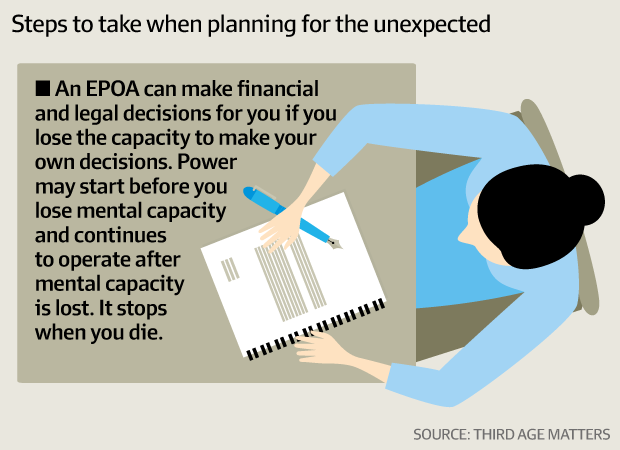
The power in the document in most cases starts when you lose  capacity – either temporarily or permanently. It ceases when you die. After that, your will kicks in.

With dementia rates on the rise, this condition gets maximum attention. But capacity can be lost through car accidents, workplace incidents, ill health, psychiatric illnesses, during medical operations, through strokes and being in a coma. Illness doesn’t discriminate between ages.

“It is just as easy for an old person and the young to lose capacity,” says Brian Hor, special counsel with Townsends Business & Corporate Lawyers. “No one knows when it might happen so it is better to be prepared.”

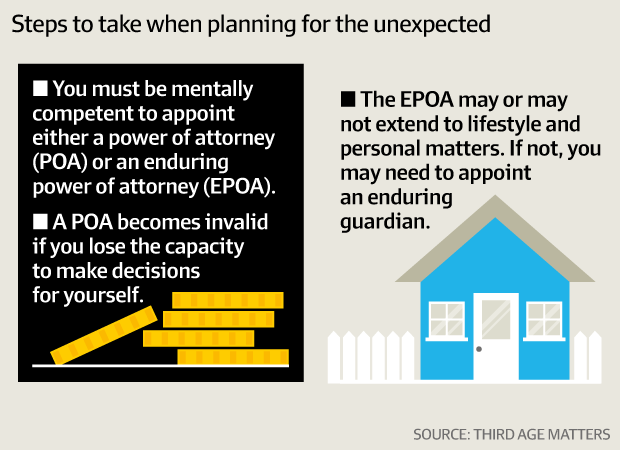
Being prepared is to understand what you are doing when you appoint an attorney, what the options are and that the person or persons chosen are the best possible, says Rod Cunich, consulting principal of KeyPoint Law.Enduring Power of Attorney - Steps to take

“People often make the mistake that abuse is limited to something that is intentional and underhanded,” he says. “There are [people appointed as] attorneys out there who abuse their power and rob their parents in full knowledge of what they are doing, but there are other cases where they are naïve and doing the wrong thing.”

The misuse of an enduring power of attorney can come in different forms. For example Jim (not his real name) who is 87 is finding it difficult to get to the bank to pay his bills and withdraw money. After a visit to his solicitor he appoints his daughter Jane as his enduring power of attorney with the powers to start immediately.

Using her powers, Jane is able to become a signatory to Jim’s accounts. She also has access to his internet banking. The arrangement is working well until Jane has some big bills of her own to pay and gets behind in her mortgage payments. At the same time she is paying Jim’s bills and doing his banking, she withdraws some cash and keeps it for herself.

Jim doesn’t check his bank statements and has no idea his cash reserves are running low until it comes time to move into residential care and there are insufficient funds to pay the costs.

Who to appointEnduring Power of Attorney - Who to appoint

So who can you trust? Spouses and partners generally appoint each other and, as a backup, one or more of their children. It can be set up so the attorneys can make decisions jointly or independent of each other.

Other options include the appointment of a professional such as a solicitor or accountant or a professional person jointly with a family member or friend.

It may be that two or more trusted and competent family or friends are appointed and required to make joint decisions which may reduce the risk of abuse.

There is no perfect solution and they all come with their pros and cons, says Cunich.

He says the safest way is to appoint a professional but that may come with costs, have an element of inconvenience or delay and if parties can’t agree there will be a deadlock which may be hard to resolve.

“The most efficient and cost-effective appointment is a sole person (family or friend) but this maximises exposure to risk/abuse,” he says.

“These people have your finances, and in some cases your very life, in their hands,” says Natalie Abela, a Partner at law firm Cowell Clarke. “It must be someone you trust implicitly and who knows you very well – preferably someone who is financially savvy and who is not in conflict with other family members.”

Natalie Abela a says the more instructions and clarification of your wishes you can provide to the designated person the better.

Telling the rest of the family about the appointee is also important so when the time comes, everyone is clear on who is responsible and has authority in making vital decisions, she says.

Forms to appoint an EPOA are readily available over the internet. But like a do-it-yourself will kit, most people “don’t know what they don’t know” and there are plenty of risks in appointing the wrong person or persons, says Rod Cunich. It is complicated by the law being different in each state and territory.

The powers of an attorney

In most states and territories, an attorney’s powers stop at financial and legal decisions – for example, spending money to pay medical and household bills.

When it comes to lifestyle and personal matters like whether to remain in your own home with help or move into residential care and which doctors to appoint or personal services to use, you may need to appoint what is calld an enduring guardian.

In some jurisdictions like Queensland, ACT and Victoria, an enduring power of attorney extends to decisions about lifestyle and personal matters and covers the role of enduring guardian.

However, a further thing to check is whether the document enables the attorney or guardian to direct how medical treatment is administered within, say, a hospital.

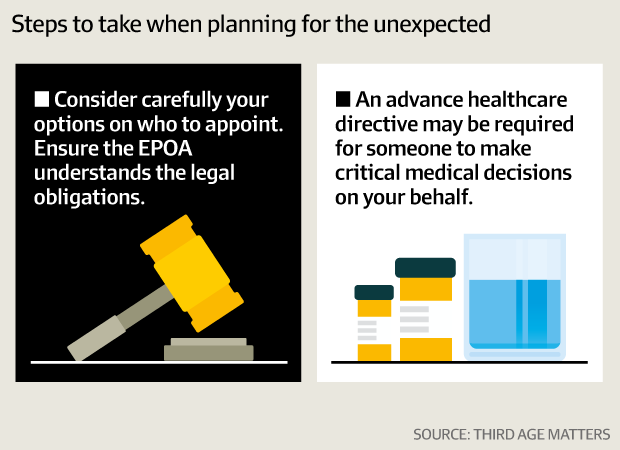
It may be that a further document such as an advance healthcare directive (also referred to as a living will) is required. This would include decisions around whether to attempt to resuscitate you in the event of cardiac arrest or turn off life-preserving machines.

Hor says it makes sense to appoint an enduring power of attorney at the same time as enduring guardian if necessary.

“Doctors may listen to family members about medical-related issues but there is now recognition that there is a formal role,” he says. “If there is an enduring guardian or an advance care directive in place and a person’s wishes are well-documented, then their views are likely to trump those of a family member who can make informal suggestions.

If you don’t choose

Where there are joint assets with a spouse or long-term partner, do not assume that they can make decisions on your behalf without being appointed your attorney and/or guardian, says Hor.

“Without an EPOA, there is no one who has the legal right to deal with your assets such as your bank account or selling your jointly-owned property. They cannot sign documents for you without it,” he says.

If someone has not appointed an EPOA and loses capacity and there are decisions to be made around their finances and their health, then an application has to be made to the relevant state tribunal to  appoint a guardian.

If there is a decision to be made, such as needing access to their money to pay for medical expenses or care, then family members may have to seek the permission of the appointed guardian.

Rod Cunich says in addition to this being a time-consuming and stressful exercise, financial guardians (even if they are a trusted family member) may have to pay a security bond as a condition of being appointed.

At worst, a tribunal may appoint a stranger as guardian or a trustee company where significant fees must be paid, he says.

Problem areas

The law states that the attorney must act in the best interest of the principal (ie, you) and avoid conflicts of interest.

Rod Cunich says common problem areas are when attorneys fail to keep accounts or they make unauthorised transactions – whether on purpose or inadvertently.

“There is no power or authority to give gifts to third parties unless expressly authorised by the document and there is no power or authority for attorney to benefit themselves, unless specifically authorised by the document,” he says.

By way of example, Rod Cunich says a child who is caring for their mother and is required to drive  her regularly to medical appointments and do  her shopping might feel their car is not up to the job, so they use her money to buy themselves a new one.

“They may genuinely believe they are doing nothing wrong even though it is absolutely wrong. It might be greed or naivety or a sense of entitlement and it may not be an evil motivation but it is a breach of the law,” says Rod Cunich.

Where someone believes an appointed attorney is not acting in someone’s best interests, they can apply to the relevant state or territory tribunal to have them removed. Elder abuse can be reported to relevant organisations in each state and territory.