
Notorious Australian Incest Clan to Stand Trial

Charlie Colt, Martha’s brother, was arrested with her at Griffith where they were living together in April this year

Charlie Colt, Martha’s brother, was arrested with her at Griffith where they were living together in April this year. Credit: NEWS.COM.AU

In the decades before they were found living in a squalid bush camp and accused of inbreeding and generations of incestuous sex, the Colt family moved freely from state to state, often earning money as travelling musicians.

But the law has finally caught up with them. Eight members of the alleged incest family are now preparing standing trial, starting in the NSW District Court.

Family patriarch Tim Colt (a court-appointed pseudonym to protect the identities of children) led a troupe of musicians made up of his children, including son Charlie and daughter Martha.

Tim and his wife June, who had emigrated from New Zealand, had seven children. Police allege four of whom would carry on the family tradition of interbreeding.

Tim is believed to have fathered several of his the 13 children of his daughter Betty, with whom he allegedly began to have sex after she turned 12.

June was the product of a sexual relationship back in New Zealand between a brother and sister.

Travelling from state to state, they had lived in remote parts of Western Australia, South Australia when, in Victoria in 2001, June died.

They moved back to South Australia, then Western Australia where Tim Colt died in 2009.
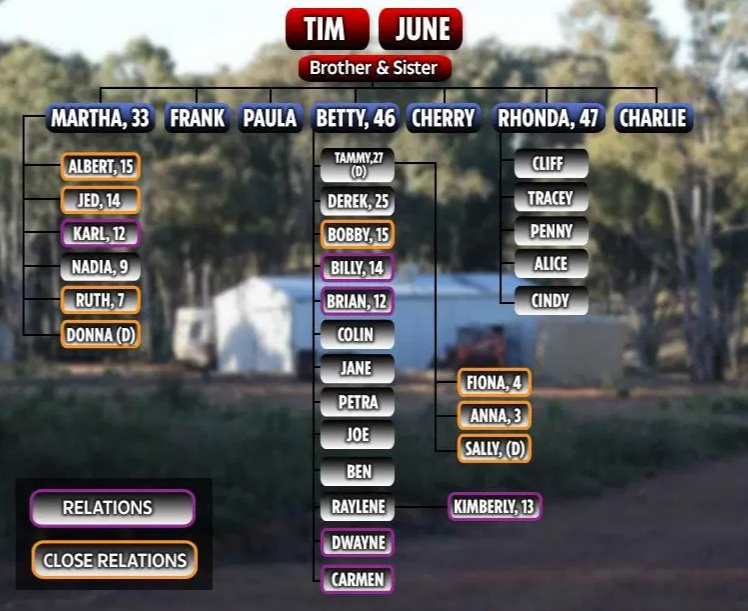
colts-incest-family-treeThe Colt clan’s world was torn apart on July 18, 2012 when a posse of police, and legal and welfare authorities arrived at the family farm and removed twelve of the Colt children.

By then, around 40 adult and child members of the family were living together on a remote and filthy plot in the hills behind the NSW rural town of Boorowa.

But it came to an end when one of the children attending the local school told classmates his sister was pregnant and they didn’t know which relative was the father.

Police and case workers visited the farm in NSW’s Hilltops region and were horrified by what they found.

The 40 Colts lived in putrid conditions in two caravans, a garden shed and a larger shed containing two tents on an un-sewered block without running water strewn with hazardous wiring.

The living quarters and cooking facilities were filthy and strewn with rubbish, and the children were dirty, wore grubby clothes, were unable to make eye contact and spoke unintelligibly.

They had fungal infections, rotten dental hygiene, and used the bush as their toilet.

Some had facial mis-alignments, impaired walking and had never used a toothbrush or toilet paper.

Taken into care, the children began telling stories of highly sexualised activity back at the farm or disclosing disturbing pastimes such as mutilating the genitals of pet animals.

Colt family members moved to parts of NSW, South Australia and Western Australia.

Almost six years after the family was split up, police arrested eight of them in a three-state swoop.

Betty Colt is facing five charges of making a false statement on oath amounting to perjury, which relate to her allegedly trying to conceal the paternity of her children.

Betty’s sister Martha is charged with six counts of perjury.

Betty’s sister Rhonda and daughter Raylene also face one charge each of perjury.

Brother Charlie Colt will go on trial at a later date on 27 charges, including six of sexual intercourse with a child under 10 years and 12 of inciting aggravated indecency of a person under 16 while in authority.

Three of Charlie’s male relatives, including two men believed to be his nephews, will face court as his co-accused.

Cliff Colt faces 21 charges and Roderick Colt 19 charges, both accused of 12 counts of inciting aggravated indecency of a person under 16 while in authority.

Another male Colt faces two charges of incest with a person around 16 years old under the authority of the alleged offender.

The trials of four of Tim Colt’s children and four grandchildren will hear testimony of family members, many of whom were children at the time of the allegations.

Also giving evidence will be a sister who allegedly had three children with her brother.

4 things you need to know about Child Custody disputes


1. You have to attempt to mediate with the other parent

Before you, or the other parent, can commence 4-things-you-need-to-know-now-about-Child-Custody-disputes Court proceedings about Child Custody, there is a legislative requirement that you attempt to participate in Family Dispute Resolution. This is a special type of mediation focused on helping separated parents reach agreement about future arrangements for the children.
If there has been family violence, you may not be able to participate in Family Dispute Resolution, or it may not be practicable. Also, if for some reason you need to urgently seek the Court’s assistance, or there is a child who is at risk of harm, there are exemptions to the requirement for Family Dispute Resolution.

In all other cases, you will need to obtain a certificate, known as a Section 60I Certificate, from a registered Family Dispute Resolution Practitioner confirming that you have participated in that process, prior to the Court accepting your Application.

Across Australia there are a number of private Family Dispute Resolution Practitioners who can assist.

2. You don’t have to be a parent to start Court proceedings in a Child Custody Dispute

The relevant legislation outlines exactly who may bring parenting proceedings in the Family Court of Australia or the Federal Circuit Court of Australia about Child Custody. Such people include:

  • either or both of the child’s parents;
  • the child;
  • a grandparent of the child; and
  • any other person concerned with the care, welfare or development of the child.

If you are a non-parent considering starting Court proceedings about a Child Custody dispute, it is recommended that you obtain expert advice from a family law lawyer about the specific matters the court will look at to determine whether you have standing to bring an Application.

3. Court is not your only option

If there is any possibility at all that you, and the other parent, can come to an agreement about future arrangements for your children, you should try to avoid Court proceedings at all costs.

Of course, in some situations, Court proceedings are unavoidable. However, it is important to understand that Child Custody disputes before a Court often becoming very costly, lengthy and messy. Parents rarely come out the other side with an improved co-parenting relationship. The other thing to remember is that you and the other parent are basically handing over the outcome of the dispute to a Judge. You both lose control of how things may go, and often people are not happy with the direction that the Court may take.

If you think that Court proceedings can be avoided, you and the other parent should keep control of the outcome, by doing your best to come to an agreement. You can attempt to reach agreement through informal negotiations, with or without the involvement of lawyers, and through mediation, either private mediation, or Family Dispute Resolution.

4. It’s all about the best interests of the children

In determining what arrangements to put in place in Child Custody disputes, the Court’s primary concern is that the children are being protected from physical or psychological harm, and that proposed arrangements are in the child’s best interests.

There are many factors that the Court will look at when determining what is in a child’s best interests, but it will always come back to a consideration of what is in the best interests of the child, not the parents.

A child’s best interests may not necessarily correlate with a child’s wishes. The Court may consider a child’s wishes, but it is in no way bound to uphold those wishes. The Court is also not bound to agree with either parent, and can only make Orders if it is satisfied that the child is not at risk of physical or psychological harm, and that the Order are in the child’s best interests.

Family Court report writer charged with sexually abusing three children

Family Court report writerAn accused paedophile has been used as an expert by the Family Court in custody disputes that involve allegations of child sexual abuse.

The psychologist, who has since been charged with sexually abusing three children, was appointed by the Family Court to make custody recommendations in cases where one parent had accused the other of sexual abuse.

One of Australia’s foremost family law experts said it could open the way for custody rulings involving the expert to be overturned.

One mother, who was sent to the psychologist in 2013 after alleging her three-year-old daughter was abused by her father, told the ABC the psychologist had made her feel extremely uncomfortable.

Greta* said he implied she may not be satisfying her husband sexually and even if he had abused their daughter it did not mean he couldn’t have a relationship with the child.

“He was kind of overly physical with me. He kept touching my arm and my leg. It made me feel creeped out. He said weird things. He kept telling me that he knew about real paedophiles and that they would show up on [psychometric] tests,” she said.

“My first impression was ‘this isn’t going to go well’.”

The psychologist’s family report was never provided to the court.

However, in another case the psychologist’s report recommended the child “continue to live with [the father]” after the mother raised allegations of sexual abuse, saying he “found no significant evidence” the abuse had occurred.

At the time of the family report interviews the psychologist had not been charged with any offences. It is alleged the offending occurred many decades ago.

University of Queensland professor Patrick Parkinson, said a child sex abuse conviction could “absolutely” give a parent grounds to seek to quash custody rulings linked to the psychologist.

“The fact that a [an expert] has been convicted would in my view amount to, in itself, sufficient changed circumstances for the court to look at the case again — in the light of the current circumstances of the child.”

Even the charges, coupled with other changes in circumstances could form grounds to challenge a custody ruling, he said.

The psychologist remains on bail and the matter has been adjourned to October.

The psychologist cannot be identified for legal reasons.

When asked what measures it had taken to ensure any expert charged with criminal offences was not used by the court, a spokeswoman said the court could not comment.

Sydney family sent to Melbourne for family report

The family law system has come under heavy scrutiny after recommendations from the Australian Law Reform Commission (ALRC) in March that included sweeping changes and a call to abolish the federal system altogether.

The ALRC recommended the Family Court introduce mandatory accreditation for family report writers, otherwise known as single expert witnesses, after concerns over the quality of their reports and qualifications.

In June, the ABC revealed a Sydney psychiatrist was the subject of numerous complaints to the Health Care Complaints Commission (HCCC), that would not be investigated after the HCCC stated it did “not have the power”.

The Family Court stated on April 1 that the psychiatrist was not among its in-house report writers and it did not keep track of private report writers used in cases.

However, the ABC has seen documents that show the psychiatrist was still being considered by parents as a report writer in May.

Lilly* was one of the parents who lodged an official complaint against the psychiatrist last year and said her ex-husband had requested a family report from the psychiatrist despite the many complaints made against him.

In response, the court ordered the Sydney-based family, including three children, travel to Melbourne to attend another report writer at the parents’ expense.

Lilly said she felt bullied into signing the consent orders that required her to attend a report writer in Victoria.

“I requested more time be made available to seek out a different report writer. I indicated I could not afford the airfare or the accommodation.”

The ALRC said a national training program for report writers is being worked on in consultation with the Association of Family and Conciliation Courts (AFCC) and the federal Attorney-General’s Department.

However, an influential AFCC member involved in representations to the Government was, just months ago, cautioned by the medical watchdog for breaching a parent’s privacy including by running therapy in a wine bar.

A spokesman for the Attorney-General said the department was not involved in the development of the training but was being kept informed by the AFCC.

He referred questions back to the AFCC and the Family Court.

The AFCC did not respond to specific questions about the training, which is not mandatory for court-appointed experts.

But AFCC board member and former Family Court chief justice Diana Bryant emailed the ABC a brochure of an AFCC advertisement promoting “Family Report Writer Training”.

On the AFCC website, the three introductory training modules are listed at $400 each.

The site promoted the 2020 “masterclasses” being held in Singapore, Hong Kong and Japan.

A Family Court spokeswoman said it was unable to comment on the training program.

*Names have been withheld for legal reasons.