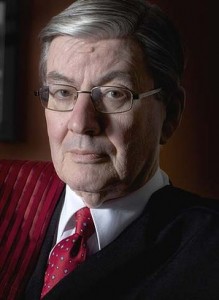
Two judges speak candidly about the many challenges that social media poses to our courts and the unprecedented opportunity it offers for a more transparent legal system.
Damien Carrick: Hello, welcome to the Law Report, good to be with you. First up, chances are you have a Facebook account. It’s quite possible that you also like to tweet. These days everyone was to tell the world and their friends what they do and what they think. But should judges jump on the social media bandwagon? Judith Gibson is a judge of the New South Wales District Court. She says that while there are potential pitfalls, provided judges use their common sense, social media can be a very useful tool.
Judith Gibson: I have found Twitter to be an amazing way to keep up with cases, judgement bulletins, summaries of arguments from all over the world. And I began a Twitter column essentially to provide links to all of these for people who are interested in defamation and media law.
Damien Carrick: What should courts and judges be able to say on social media as a general rule, do you think?
Judith Gibson: A lot of people wonder if judges should use social media at all, and of course it’s much too late to be asking that question. In America, for example, 46% of judges use Twitter and Facebook already. So judges are well and truly using it. The question is I suppose how you should deal with contact with litigants or lawyers, and what to do when judges express views which may indicate prejudice or a preconceived view.
Damien Carrick: So there’s a balance to be struck, there are danger zones that you should perhaps avoid. I understand that in a recent episode of The Good Wife, which is a US legal drama, the legal team were able to abort a trial when they discovered that the judge had become a Facebook friend of one of the jurors. Has that actually happened in real life?
Judith Gibson: Yes, there have been several cases in America where this has occurred. The best known is a case called Youkers and the State of Texas, and what happened was someone who entered into a plea bargain wanted to set it aside and he said, hang on, the victim’s father got in touch with the judge and sent him a communication on Facebook.
Damien Carrick: What did the court decide? Was this inappropriate?
Judith Gibson: No, for two reasons. The principal reason was that the trial judge very wisely put the Facebook communication onto the public record and warned the father of the victim not to do it again. He also stated that it hadn’t influenced his decision-making in any way. And finally, what the victim’s father had said was he hoped that the judge was going to be lenient and do the right thing.
Damien Carrick: And what did the court have to say more broadly about a judge’s right to be on social media?
Judith Gibson: What the court said was that allowing judges to use Facebook and other social media is consistent with the fact that judges can’t forfeit their right to be a member of society. You can’t have judges being like vestal virgins in an ivory tower, they have to be able to communicate with other people, whether it’s friends, family, they have to form part of the community, because an essential part of being a judge is the reflection of community values.
Damien Carrick: When you agree to have somebody as a Facebook friend, does that give them some kind of status which impacts on the way that a court might look at an interaction between a judge on Facebook and their friend?
Judith Gibson: Well, no, and in fact the American courts have considered this issue and they’ve noted that it’s basically something that’s done with the flick of a button. So it’s a completely novel form of communication that can’t be judged in the same way as going up to someone and shaking their hand and becoming their friend.
Damien Carrick: A lot of courts actually have Twitter accounts; the Victorian Supreme Court, the US Supreme Court, the UK Supreme Court. You’ve looked at what the Victorian Supreme Court does. What does it do? And you find it quite interesting.
Judith Gibson: The Victorian Supreme Court has some extremely interesting links which enable you to listen to the sentencing of a person who has been convicted of a crime. This is really something that I haven’t been able to find anywhere else.
Damien Carrick: They will also advise when a trial is starting or when a jury has come back and is about to return a verdict. It’s very practical…well, especially from the media’s point of view, it’s very practical information.
Judith Gibson: Yes, that’s right, but also of course it helps to bring courts more into the community. I think a vital part of courts communicating with and dispensing justice is interaction with the community, particularly with the shrinking role of the jury. The more communication you have between courts and the community, the more people understand and respect the justice system.
Damien Carrick: Moving away from courts back to individual judges, is it true that in the UK judges have been told that they can participate in social media—Twitter, Facebook et cetera—but they shouldn’t identify themselves as a judge when they do so?
Judith Gibson: Yes, that was originally the position that the English courts talk, but they’ve had to backtrack quite a lot because it’s become increasingly apparent that courts and sites such as BAILII, the English court reporting site, are using Twitter, and to exclude courts and judges would be ridiculous. So basically technology triumphed over conservatism.
Damien Carrick: Speaking of triumph over conservatism, I understand that there was a general principle out there that judges weren’t to participate in ‘inappropriate activities’, but there was recently a bit of a mass judicial revolt when it came to reality television. Can you tell me about that?
Judith Gibson: Yes, there was concern that judges needed to maintain their dignity and that this meant that they shouldn’t appear on reality programs. But there was a mass breakout by not only the judges from the Supreme Court, the appellate court and the Queen’s Bench, but also 26 QCs, they all did a mass appearance on Masterchef. And in fact Sir Stanley Burnton, who is a very respected member of the Court of Appeal, made an adverse credit finding against the mango passion desert. His honour held that he didn’t detect the mango and there was not enough passion.
Damien Carrick: What’s the harm in that? I mean, I can’t see any harm at all arising from judges and lawyers showing that they are human beings and being out there, but not in any way talking to a controversial issue. Do you have a view?
Judith Gibson: Well, I don’t think a judge should appear on Masterchef and less he or she can cook and s something about the topic. I don’t think you need to have judges expressing opinions on absolutely everything, the way some rock stars do. So I’d like to see judges participating in communities by a whole range of activities, but relevant I think to their role in the legal system.
Damien Carrick: Judge Judith Gibson of the New South Wales District Court. She was a speaker at a recent conference organised by the Australasian Institute of Judicial Administration. The conference explored the ever expanding world of social media and the courts. Her paper has also been published by the Gazette of Law and Journalism, and we have links to both organisations online.
[Audio: Masterchef ad]
Damien Carrick: A disaster? Well, that might be a slight exaggeration. But judges aren’t the only legal players who have to be careful about their presence both in the conventional media and on social media. John Faulks is the Deputy Chief Justice of the Family Court of Australia. He says Family Court litigants often trawl through Facebook to try and trip up or expose their courtroom adversaries.
John Faulks: It’s becoming increasingly common because virtually everyone does communicate in some way with emails, text or Facebook or Twitter, all of these things are coming about, and so people are saying things on these media which are then reflected in affidavits that appear in the court or in their evidence in the court, or sometimes these things are used to contradict positions that they’ve taken in their sworn evidence, which creates some interesting moments for those involved.
Damien Carrick: Can you give me some scenarios?
John Faulks: Situations where people have asserted one thing in there affidavits and then either boast about or communicate about with their friends something that’s completely different, so they don’t own something and yet they admit to someone else they do, which is always fertile ground for cross-examination. But in addition of course a lot of people will, as occurred in the recent case that was reported in the press of Lackey and Mae, people will use the social media to abuse the other party, to bully the other party, to be critical of the proceedings, to be critical of the court, of witnesses or any number of things, which of course is relatively easy to do in the middle of the night, sit down, open up your account, put the information on there. You don’t have to look at anyone when you’re doing it, you don’t have to feel any empathy for the person who is being affected by it, you can just spray.
Damien Carrick: Tell me about the facts in that case?
John Faulks: What had happened was that the father’s family in that case had proceeded to send a whole lot of material on Facebook which was critical of the judge, they disparaged the effectiveness and the role of the independent children’s lawyer, they criticised the court, they criticised the experts who provided the reports, they criticised DoCS, there was a whole range of things which were obviously designed to perhaps…well, it seems it was designed to overwhelm those who were associated with the case in some way.
Damien Carrick: The main target was the mother. The father’s Facebook page was full of unfounded accusations that mum was sexually and physically abusing her children. In his decision, Federal Magistrate Warwick Neville was scathing about these sorts of personal attacks online.
Warwick Neville [reading]: Often they are very cowardly, because those who post such derogatory, cruel and nasty comments, regularly peppered with disgusting language and equally vile photographs, appear to feel a degree of immunity. They think they are beyond the purview or accountability of the law.
John Faulks: Under the Family Law Act there is a prohibition in section 121 of the publication of any information that would identify someone involved in proceedings before the court. And these sorts of things could well…and I can’t speak about that one in particular because it may be the subject of some prosecution of course, but that may be an example of it. And if you want to consider, Damien, what it would be like if you were a kid at school and all your mates said, ‘Oh, we’ve been looking at Facebook and we’ve seen what your father says about your mother,’ or whatever it may be, it’s a pretty horrible situation, which is why section 121 was brought into effect in the first place, to stop that from happening.
Damien Carrick: And what did the judge in that case, Lackey and Mae, rule on these social media postings?
John Faulks: He ordered that the father immediately remove from Facebook all references to these proceedings, including but not limited to all references to the children, the mother’s name, the father’s name, and so on and so on.
Damien Carrick: You mentioned there’s this section 121 of the Family Court Act which prevents identification or broadcast of parties in family law disputes. There is actually a prosecution involving that section currently going through the courts in Queensland, it involves the Courier Mail and articles which identified four girls who were involved in a very high profile dispute over whether those four should return to Italy from where they had been illegally removed by their Australian mum. Do you know, what’s the court’s involvement with that matter? Do you get involved with these or do you just hand them on?
John Faulks: We hand them on. A breach of section 121 is in fact a criminal offence and is hence handled by the Commonwealth through the DPP, and prosecutions are undertaken essentially on the demand of the attorney general. So it’s not a matter the court can deal with at all. And that prosecution of course is still pending, so there’s a limit to what I can say about that.
Damien Carrick: I believe, and I don’t know how much you can comment about this, but there was also a 60 Minutes story around the time of the Courier Mail article that identified all the parties but made no reference to court proceedings. So we all knew what they were talking about, but because they didn’t refer to the court process they I understand haven’t been charged with contravening section 121.
John Faulks: That is also my understanding, and interestingly there was I think a follow-up session when the girls had gone back to Italy, and the argument at that point was; was a report of the proceedings then identifying the girls by name and whatever else, a report of their time in Italy, was that a breach of the act? And of course it may not have been because it didn’t deal with the proceedings.
Damien Carrick: Even though if you understood, as we all did, the context, then you could place them back in the context of those proceedings.
John Faulks: Exactly. It’s an interesting Act. To my knowledge it has been the subject of very few applications with prosecutions along the way, and to be honest the Commonwealth really needs to make up its mind; does it want to keep the section in the Act and prosecute breaches or apparent breaches of it, or does it simply abolish it?
Damien Carrick: Do you have a view?
John Faulks: I personally think that it is very important, particularly for children, that family law proceedings are not part of the salacious press, if I can put it that way.
Damien Carrick: I understand that in this notorious case out of Queensland there was also a social media dimension to the campaign being run by both sides.
Reading: This page was started by four courageous sisters who wanted to have a say in their future. We believe in kids’ voices.
Reading: I love you with all my heart. I can’t wait to come home. I wish I was home with you right now. I miss you so much.
Damien Carrick: Coming back to section 121, the focus I think should always be throughout the law, no matter where we are, the best interests of vulnerable people, the best interests of children, and that’s a fantastic central core principle at the foundation of the Family Law Act. But criticism of the courts, criticisms of lawyers, criticisms of the system, you could say, well, there’s a legitimate place for that kind of robust identification of people involved and their place in the system.
John Faulks: I don’t think there’s any problem with criticism of the courts and criticism of judges, if it comes to that. It would be nice if the criticisms were fair and it would be nice if they were based on information rather than innuendo or simply prejudice, which is why I’d normally say in relation to a number of these people; have you read the case? Look at the case first, look at the reasons before you come to a conclusion about what had happened.
Damien Carrick: We’ve been talking a lot about Facebook so far, but there’s also a lot of material on YouTube. Judge John Faulks, let’s have a listen to this piece of audio, it’s from a video clip, but we are in a car park and the father is upset as he hands his young daughter back to the mother at the end of an access visit.
[Audio: YouTube video]
Damien Carrick: Judge John Faulks, it’s very emotive audio, the child is crying, the dad is crying, the clip is clearly made by the dad as a way of eliciting sympathy for him from the viewer. What’s your view of this kind of broadcast?
John Faulks: It’s happening more often now in court, curiously, and there are some offences possibly being committed by people recording other people without their knowledge. What happens in some cases is that people, they say for their protection, use a recording device to monitor or record what happens in a child handover particularly, and it’s then…people try to use it in court to demonstrate how upset the children are. It’s not often a very useful piece of evidence because children are upset for a whole range of reasons, and obviously the recording that is put before the court wouldn’t be put before the court unless it was favourable to the person who was recording it. In many cases people who record things like that are saying more about themselves than they are about the situation itself.
Damien Carrick: I don’t know if this was used as evidence in court but it certainly…
John Faulks: I don’t know either.
Damien Carrick: It’s up there on YouTube, so again, do we come back to section 121 if there is litigation in this case?
John Faulks: Possibly you do, and I’m assuming…well, he identifies himself to begin with, so it’s quite clear that it relates to the proceedings, but it’s not an account of the proceedings unless it became part of the evidence.
Damien Carrick: I see, so it’s okay?
John Faulks: Well, ‘okay’ is an interesting term in this context.
Damien Carrick: John Faulks, the Deputy Chief Justice of the Family Court of Australia.
And speaking of social media, do drop me a line on Twitter, the show’s handle is @lawreportRN, or me, @damien_carrick. Also you can find tonight’s stories, transcripts and a heap of previous episodes online at abc.net.au/radionational, or you can catch up with our separate stories podcast on iTunes.
 Divorce can add a decade to your working life, according to a new study from an Australian super fund.
 Whether it’s tweet-happy judges or YouTube-wielding family law litigants, social media is dramatically reshaping our court system.
 LATELY, there have been all kinds of opinions swirling about on the subject of donor anonymity: whether or not to forcibly remove the anonymity of people who donated sperm and eggs before legislation was put in place in 1988.
 LIKE a red rag to a bull, the newly acquired puppy leaps playfully from the car and into the marital version of World War III in suburban Australia.