More parents defy law with overseas surrogacy

surrogacy-laws-indiaA sharp rise in Australian children born in India shows laws criminalising commercial surrogacy are doing nothing to stop parents going overseas to find birth mothers for their children, surrogacy advocates say.

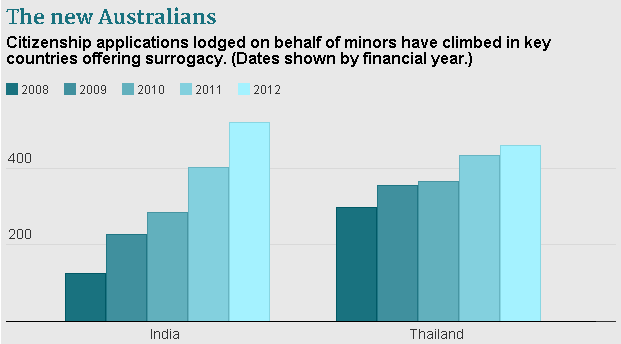
The number of citizenship requests for children born in India has risen by more than 300 per cent over the past five years, documents obtained under freedom of information show.

Surrogacy Australia founder Sam Everingham said Australians were fast becoming the highest per capita users of compensated, or commercial, surrogacy, despite laws in NSW and other states criminalising it, even if it occurs overseas.

“Australia, funnily enough, has become one of the largest surrogacy markets internationally because of the perfect storm created by the lack of access to international adoption, women leaving childbirth later on and the fact we are a wealthy country and women can afford it,” he said.

Mr Everingham estimated that about 100 NSW couples each year were engaging in compensated surrogacy overseas, and about 500 nationally.

Since March 2011 NSW parents who do so have risked two years’ imprisonment and fines of $275,000.

Nationally, the Family Law Council is reviewing how best to deal with the legal issues posed by increasing use of surrogacy, with a report due in December.

Department of Immigration and Citizenship show that there were 519 applications for citizenship for children lodged in India in the 2011-12 financial year.

University of Technology, Sydney professor Jenni Millbank said figures she obtained from the Department of Immigration and Citizenship show that there were 519 applications for citizenship for children lodged in India in the 2011-12 financial year. This compared with only 126 in 2007-08.

She said it had ”never been easier” to pay for surrogacy overseas but its legal status meant many IVF doctors were refusing to give any advice to couples considering it.

“Patients are going in blind, with no information from their doctors about how many embryos to transfer and the risks of those sorts of things,” she said. “People don’t want to go to a poor country and behave harmfully but they work with the information they have.”
Australians flock to India to find surrogate mothers

She said her discussions with Indian fertility providers indicated some had multiple pregnancy rates of between 25 and 40 per cent due to the common practice of transferring multiple embryos. Multiple transfers can put the mother and babies at risk, and in Australia IVF clinics have cracked down on the practice and have a multiple birth rate of only 8 per cent.

Professor Millbank said the steep rises in Australian children born in countries like India indicate more children are being born through compensated surrogacy, although the figures also include children who were not born through surrogacy but need to apply for citizenship overseas.

The rise is also evident in other countries commonly used for surrogacy, with Thailand increasing 54 per cent, from 297 to 459 applications, and Ukraine 122 per cent, from nine children to 20.

In a recent presentation at the Fertility Society of Australia conference, Professor Millbank argued that Australia should create an ethical framework for compensated surrogacy.

“That doesn’t mean a profit-driven system, or an incentive system, but one that doesn’t make it so hard to do it if people want to do it,” she said. “Parents say the idea that they would ask someone to do that for free is abhorrent.”

Related Family Law Judgments

Hundreds risk jail to import illegal drug promoted by euthanasia campaigners

dr-philip-nitschke-euthanasia

PHOTO: Dr Philip Nitschke tests imported nembutal for quality assurance.

A lethal drug promoted by euthanasia campaigners as a peaceful way to die is easily being illegally imported into Australia.

Known as the “peaceful pill”, barbiturate Nembutal is promoted by the euthanasia movement as the best and most peaceful way to end your life.

Most have bought the illicit drug online from China, a country that in the last two years has come to dominate the market.

The drug kills within an hour of being consumed.

“There are very few lethal drugs and the best lethal drug is Nembutal,” euthanasia advocate Dr Philip Nitschke told a recent workshop.

“I’ve been with a lot of people who have died using this drug, it just seemed to get into to a deeper and deeper sleep and then finally stop breathing.

“And for those watching they see this as the most peaceful of deaths, it certainly looks to be.

“Be careful, because it’s illegal.”

The penalty for importing or possessing Nembutal is a prison sentence or a fine of up to $825,000.

Dr Nitschke says hundreds of Australians have illegally brought the drug into the country over the past couple of years.

I sent an email requesting a sample, I received a reply asking me to forward $US360 and I duly arranged that, and two weeks later, my package arrived through the mail.

The Australian Federal Police have told the ABC’s Lateline program that they have seized almost 15 kilograms of the drug since 2007.

But so far, no one has been convicted.

Nembutal easily ordered by terminally ill online

Mexico used to dominate the market but now most Nembutal is bought over the internet from China.

Increasingly, there are reports of internet scams and Lateline has spoken to several people who have lost hundreds of dollars trying to buy Nembutal online.

Arriving in flat packed envelopes, Chinese Nembutal comes in the form of a white powder, and Dr Nitschke says people are worried about its quality.

“People obtain this white powder in envelopes from China and they’re concerned in a way that I never saw, the same concern with the South American product,” he said.

“They worry that maybe there’s someone selling them something that is contaminated or not pure or maybe cheating them completely and selling them castor sugar or something.”

To combat concerns, Dr Nitschke has set up a mobile testing laboratory, and he says there is a long queue of people across Australia waiting to use it.

“I think we can say the vast majority, all except one, have shown to be exactly what they’ve purported to be, so in other words high quality Nembutal,” he said.

Dr Nitschke has tested the Nembutal which terminal cancer patient David illegally imported earlier this year.

David says the drug was easy to obtain online and he was not fearful of any legal consequences.

Nembutal link to a Sydney woman’s suicide

David bought his Nembutal from a supplier listed in Dr Nitschke’s book The Peaceful Pill Handbook.

The book is also banned in Australia, but for $80 you can buy online access to the publication.

Dr Nitchske’s group also produces instructional videos for those considering euthanasia.

In one tragic case, a young Sydney woman who was not terminally ill but suffering from depression accessed this information.

She also attempted to buy Nembutal online, but lost her money.

In May, the 30-year-old committed suicide.

Her family told Lateline: “The internet is a tool and has many good uses, but when vulnerable people can so easily get hold of information and videos that can do a great deal of harm, it can be devastating.”

However, Dr Nitschke defended this advocacy, saying the dissemination of euthanasia material information should not be banned simply because it is used for purposes other than those he intended.

“It’s an age-old question about censorship,” he said.

“I can’t guarantee where the information is going to, but I don’t think that’s a good reason for stopping giving out information.”

But the chairman of the Federal Government’s advisory council on suicide prevention, Professor Ian Webster, disagrees.

“I don’t think that’s an acceptable risk,” he said.

There’s a very fundamental principle in medicine, primum non serum, a Latin statement for ‘above all do no harm’, so no action that a physician or a surgeon or a doctor should take, should increase the likelihood of harm.

“There’s a very fundamental principle in medicine, primum non serum, a Latin statement for ‘above all do no harm’, so no action that a physician or a surgeon or a doctor should take, should increase the likelihood of harm.

“It’s a very difficult balance to strike.

“Overwhelmingly I put my weight on preventing suicide and against promoting suicide methods to elements of the population which are at high risk.”

Dr Nitschke is currently facing two investigations by the Australian Health Practitioner Regulation Agency over claims he is not a fit and proper person to hold medical registration, but he says losing his licence will not stop his work.

“In a practical sense it would make very little difference, because of the growing demand if you like, of a growing or increasing number of elderly people who are demanding control over the end of their own life,” he said.

If you or someone you know requires help you can contact Lifeline on 13 11 14, visit Beyond Blue or young people can visit Headspace.

Abortion access threatened by new law: doctors

pregnancyLeading medical and legal groups have called on government MPs to abandon a proposed law that would for the first time define a 20-week-old foetus as a “person”.

The NSW Bar Association and the Australian Medical Association NSW have written to Liberal Party ministers to say the law is unnecessary and may impact on women’s access to late-term abortion.

Liberal MP Chris Spence has put up a private member’s bill called “Zoe’s Law” – initially proposed by MP Fred Nile – which holds people criminally liable for the death of a foetus. It is named for central coast woman Brodie Donegan’s unborn child, whom she lost at eight months when she was hit by a car.

The NSW Bar Association told Mr Spence the law’s definition of the foetus as a ”person” at above 20 weeks or 400 grams was “arbitrary” and set a risky principle.

“When can a medical procedure designed in the interests of the mother be permitted to harm, let alone result in the destruction of, another ‘person’?” the bar wrote. “Equally, can a mother consent to the destruction of the foetus where what is occurring involves the destruction of another ‘person’?”

On Tuesday the AMA wrote to Health Minister Jillian Skinner because it feared the laws could have unintended impacts on doctors in areas from genetics to obstetrics. The current legislation, covering harm to the foetus as grievous bodily harm to the mother, was sufficient, a spokesman said.

“Any further extension … would have unintended consequences and flow-on effects in other areas of medicine,” he said.

Women’s Electoral Lobby Australia chairwoman Melanie Fernandez said a coalition of women’s rights groups has repeatedly requested to be allowed to brief the Liberal Party, but this had not happened. “It would be really concerning,” she said, ”if this bill were to go to debate without consultation with experts in the community.

She said that after initially saying the bill would go ahead on Thursday, Mr Spence had agreed to delay it again. Fairfax Media was unable to reach his office for comment.

Mr Spence previously said the law was never intended to infringe on abortion, which is illegal in NSW but is protected under case law as being acceptable if a woman is facing “serious danger to her life or physical or mental health”.

A spokesman for Premier Barry O’Farrell said: “Liberal Party MPs will be given a conscience vote … for that reason it would not be appropriate for the Premier’s office to organise such a briefing.”

‘Divorced’ girl takes fight to Australian court

Divorce decreeAHMEDABAD: A 28-year-old girl from Ahmedabad has made her fight for justice cross the seven seas. She has approached the Federal Circuit Court of Australia which had allowed her husband to divorce her without hearing her side of the story. The court has taken cognizance of her email and will decide on Wednesday if her statement can be recorded through video-conferencing.

The couple got married on March 7, 2011, as per Hindu rituals. She was allegedly harassed by her in-laws and soon thrown out of her husband’s home. The two later patched up on the condition that she give up her job.

The girl quit the job but the harassment allegedly did not stop and was sent back to her parents when she fell ill. Here, she found out that her husband was planning to emigrate to Australia and confronted him. He promised to call her to New South Wales in Australia as soon as he settled down. He flew out on January 17 last year and snapped all communication with his wife.

On May 6 this year, Desai’s uncle approached her and allegedly obtained her signature forcibly on documents, which she suspected could be her consent for divorce.

On July 5, the girl received a letter from the Australian court, which stated that Desai had filed a divorce petition. She then approached the Vastrapur police station and registered an FIR against her in-laws for harassment and domestic violence. Four of the eight accused persons have moved the sessions court, which is scheduled to hear their anticipatory bail plea on Tuesday, said the girl’s lawyer Jayesh Kotecha.

Besides, she also dashed off an e-mail to the Australian court taking exception to the divorce decree on July 10. The court official even called her up on August 2 after receiving the email. The next day, the court intimated her that her protest petition against the divorce has been admitted.

Court allows teens to begin sex change

gender-dysphoriaA judge has allowed two teenagers to start gender reassignment surgery as the lesser of two evils.

The Family Court has granted two 16-year-olds permission to take gender reassignment hormones that will permanently transform their bodies and put them at high risk of serious health problems, finding that the dangers are outweighed by the crippling psychological trauma of living as the ”wrong gender”.

The teenagers, ”Terry” and ”Sam”, are suffering from the condition known as gender dysphoria – where a person identifies with a different gender to the one they were born with.

The proposed treatment is in their best interests.

The pair were formally represented and supported by their respective parents, and successfully applied to the court for permission to immediately undertake both stage one and stage two treatment of the condition.

Under the law, people cannot undertake such treatment until the age of 18 without a court order because it is considered that until they reach adulthood they cannot give informed consent for such a transformation.

For Terry – who was born as a female but identifies as a male – the injection of large doses of testosterone will be done with the aim of inducing male puberty, increasing muscle mass, facial hair, deepening of the voice and increased libido.

It is likely to render him at least temporarily infertile, and place him at a significantly increased risk of breast or uterine cancer and severe liver dysfunction.

Sam will undertake a course of large oestrogen injections to induce female puberty, including the development of breasts and loss of facial and body hair. Such treatment carries a major increased risk of blood clots – although this is treatable – gallstones, cardiovascular disease, type 2 diabetes and breast cancer.

In his judgment, Justice Peter Murphy acknowledged the potentially devastating health consequences for the teens, and their inability to give informed consent, but found that the severity of their dysphoria and the tragic consequences meant that treatment could not be postponed.

”Those risks and changes must be considered in the context of the risks of delaying treatment,” Justice Peter Murphy said in relation to Sam.

”The experts are agreed that delay in treatment carries the attendant risk of suicidal ideation and self-harm.”

The judgment sets out the heart-wrenching experiences of the two youths, much of it in their own words and those of their parents.

Terry described feeling “like a boy … for as long as I can remember”. He recounts attempting suicide when his periods began. ”Five days of torture every month … I hate who I am … I pray that it won’t happen, then I get depressed for five days … Nature playing a cruel joke every darn month.

”I’m here today, waiting for the treatment to be approved so I can go on and live my life like a normal teenage boy.”

Terry’s parents changed his school in late 2012 and since that time, Terry has been attending his new school as a male and “all his peers believe he is male”.

Sam’s parents first became aware of her gender dysphoria following a serious self-harm incident at school.

”In April 2012, Sam’s father received a phone call from Sam’s then-school to notify him that Sam was not at school,” Justice Murphy said.

”Sam’s father found Sam outside the school grounds. He arrived ‘as the ambulance and police were arriving’.”

Sam’s mother told the court that a month later, during their drive home from school, “[Sam] asked her ‘if I would help her if we had lots of money’. I said that ‘of course I would’. I recall [Sam] then saying ‘I feel like I am a girl’ and ‘I am a girl’.”

Two psychiatrists and a GP agreed that Terry and Sam should begin the hormone treatment as soon as possible as there was a serious risk of suicide.

”The nature and severity of the manifestations of the condition in each of Terry and Sam persuade me that there is urgency attaching to the administration of treatment and that postponing stage two treatment until either adulthood … is reached by either child would run contrary to the expert medical evidence before me,” the judge stated.

”The proposed treatment is in their best interests.”

Separating Families hit by cuts to mediation services

family-relationship-centresCUTS to the nation’s 65 Family Relationship Centres have prompted more than half to reduce staffing and put families at risk.

These are the findings of a recent survey of federally funded FRCs conducted by the peak body, Family & Relationship Services Australia.

The FRCs originally were established under the Howard government from 2006-08 to assist families who separate to sort out parenting arrangements without going to court and to help provide referral and support services. This included access to three free hours of mediation, or family dispute resolution.

Evidence from the Australian Institute of Family Studies Review and from the court system’s reports has shown that FRCs have been effective in the first five years of operation, with overall parenting applications to the courts dropping by about 32 per cent, and use of mediation and counselling services increasing.

In 2011-12 the Gillard government cut funding by more than $4 million and forced FRCs to impose a charge beyond the first hour of mediation to parents above a certain income.

As many disadvantaged families do not have the capacity to pay for these services, the FRSA survey reveals the cuts have reduced the ability of FRCs to provide services, resulting in more children and families being put at risk.

The survey of all 65 FRCs received a response rate of almost 80 per cent. FRSA executive director Steve Hackett said the survey found that 70 per cent of FRCs reported the funding cuts had had an impact on service delivery in their centre.

About 57 per cent had to reduce staffing by between one and five full-time equivalent and 42 per cent reported clients experienced longer waiting times.

Another 55 per cent have had to reduce the capacity of programs and 60 per cent of FRCs reported that fewer than 10 per cent of their clients had the capacity to pay for family dispute resolution.

“FRSA has called on whichever party forms government to guarantee funding to these and other vital family support services is increased to meet growing demand,” Mr Hackett said.

He said early settlement of parenting disputes in FRCs cost significantly less than family court processes.

“It reduces conflict earlier and provides other support options for families that facilitate decisions in the best interests of children,” he said. “Investing in family support services such as FRCs amounts to a long-term investment in our children, which has not only social but also economic benefits for Australia.”

FRC managers made a number of critical comments in the survey. “When FRCs were rolled out as part of the 2006 reforms, many were placed in disadvantaged locations,” one said. “Consequently, very few if any clients have the capacity to pay fees. The approach to charging (fees) was unwieldy, especially for families in conflict, and became a barrier to resolving their disputes.”

How the Federal Election will change Family Law in Australia

2013 australian federal electionWith the Federal Election looming, it is interesting to note the policies of each of the major political parties with respect to family law issues. Some may be sceptical about “election promises” and many Australians listen out during the election campaigns for matters that will affect the individual and his or her family. In this edition we take a look at some of the policies trending in the 2013 election campaign and how they affect family law.

Paid Parental Leave

The Policies: The Liberal Party has put a strong focus in this election campaign on family issues, promising to introduce a more lucrative paid parental leave scheme to that currently in place, with women to receive up to $75,000 within six months of giving birth. The Greens are mostly supporting this policy, however Labor has not made any promises of new policies having previously introduced a number of changes to work and family policies.

The Facts: Under the current Labor Government, the paid parental leave scheme involves payments to a parent at the minimum wage for 18 weeks following a child’s birth, and the other parent may receive payments at the minimum wage for 2 weeks after the child’s birth.

The Impact on Family Law:

Paid parental leave is important to families following the birth of a new baby. However, the impact of paid parental leave raises the question, how will taking maternity leave impact upon a property settlement?

When considering the relevant matters in a property settlement following the breakdown of a relationship, the income received by each parent goes towards their financial contributions to the relationship. The primary carer for the child may not receive any income after the conclusion of the parental leave scheme period for either a few months or a number of years, however they are still credited by their role as homemaker and carer.

Of course, the weight given to such contributions are entirely dependent upon a number of factors and differ case-by-case.

Same-Sex Marriage

The Policies: Although Tony Abbott and the Liberal Party will not make a decision on this topic until after the election, Prime Minister Kevin Rudd, on behalf of the Australian Labor party, has committed to holding a conscience vote in Parliament within 100 days if re-elected. Christine Milne and the Greens Party fully support same-sex marriage.

The Facts: Currently, same-sex marriage is not permitted in Australia. The law defines marriage as “the union of a man and a woman, to the exclusion of all others, voluntarily entered into for life”.

The Impact on Family Law:

Regardless of one’s views on whether same-sex marriage should be legalised, it is hard to disagree with the fact that in present society there is discrimination when it comes to persons who can and can’t be married.

In order to remove the inequality of the marriage laws, parliament has in the past decade allowed significant changes to legislation to recognise same-sex couples as de facto couples. A person is described as being in a de facto relationship with another person if they are not legally married or related by family, have a relationship as a couple and are living together on a genuine domestic basis. The change to the definition of a de facto relationship has streamed through to family law in terms of parenting arrangements, property settlements and child support as well as other areas of law such as superannuation.

Welfare: Centrelink Benefits and DisabilityCare Australia

The Policies: The Labor Party recently and infamously reduced the parenting payments that “single” parents were eligible to receive in recent years and has also introduced DisabilityCare Australia, being a government service available to assist persons with a disability and their carers. The Liberal Party supports (yes, agrees with!) the Labor Party’s disability program however true to politics do not agree with the name of this scheme and propose to change it should they be re-elected.

The Facts (on Centrelink benefits): In most cases the parenting payments received by the primary carer of a child are supplemented by child support paid either by private arrangement or with the assistance of the Child Support Agency.

The Impact on Family Law:

When considering whether an order should be made for one party to pay spouse maintenance to another, income received from Centrelink is not included in calculating the needs of the spouse receiving spouse maintenance.

The Facts (on DisabilityCare Australia): DisabilityCare Australia is an independent organisation created by the Government to facilitate the National Disability Insurance Scheme introduced by the Labor Government in 2012 which provides funding for people with disabilities, their carers and families. The organisation will also assist such people with locating various support services, goal-setting and possible referral to other government and community services available to assist with their needs. Being a very new organisation, branch offices are in the process of opening across Australia.

The Impact on Family Law:

Family Law does not extend to children over the age of 18 years, and so when reaching 18, parenting orders no longer apply. This can at times pose a hurdle for separated couples who are unable to agree to the ongoing financial arrangements for the child, financial assistance for the primary carer of the child, and/or arrangements for the child to spend time with both parents.

Family Law does however have the power to make orders for “adult child maintenance”, that is child support for a child over 18 years of age. Such financial support can be either a periodic or lump sum payment and can be ordered, or agreed upon, where financial assistance is required for a child to complete their education or where the child has a mental or physical disability.

It is recommended that parents who are unable to reach agreement as to ongoing parenting arrangements for a disabled child over the age of 18 years seek assistance via avenues outside of the field of family law, such as by lodging an application with the guardianship tribunal.

The content of this article is intended to provide a general guide to the subject matter. Specialist advice should be sought about your specific circumstances.

Children want greater say in Family Court cases

children's viewsChildren in court cases involving family disputes are in danger of going unheard because they are rarely given the chance to speak to judges directly, new research shows.

A survey of 44 Family Court judges showed only six had ever met with children face-to-face to hear their views.

University of South Australia law lecturer Michelle Fernando carried out the research and says it complements previous studies which show children are not satisfied with the standard Family Court procedures.

Dr Fernando has recommended changes to the way courts hear evidence from children, but says many judges feel they lack the expertise to interpret children’s statements.

She says face-to-face meetings between children and family court judges are common in New Zealand and Australia should consider adopting that approach.

“Judges definitely have discretion to speak with a child, and judges do do that from time to time, but it’s incredibly rare,” she said.

“The Family Court is compelled by the legislation to take children’s views into account, so there’s no doubt that children’s views are heard.

“But what we have is a lot on information from children who say that they’re unhappy with the way that their views are currently heard and they want to have more of a say in the decision that’s being made, which of course is going to affect their lives.

“Children feel that the way that their views are currently heard are not good enough, and that they feel their views are perhaps not being taken seriously, or they’re worried that they’re being filtered through a third person.”

Dr Fernando concedes some judges are reluctant to change.

“They felt they didn’t have the correct skills and training that were necessary to speak to a child and properly interpret the child’s views,” she said.

“Also, judicial officers were very worried that if they speak to children, the child’s parents might pressure them or manipulate the child and put the child in a very difficult position.

“The majority of judges who responded to my survey believed that guidelines might help – guidelines that explained the purpose of a meeting with a child and how they might conduct it.

“The vast majority were also in favour of training being provided to judges in order to get better understanding of how to meet with children and what children say.”

Dr Fernando says the fact that children feel detached from the decision making process means the system needs to change.

“The model that I encourage judges to adopt is to have a family consultant who’s a child welfare expert to be present during the meeting,” she said.

“That person can assist with the questioning but also discuss with the judge… if they believe that the child might be pressured.”

Dr Fernando says such meetings are not just symbolic.

“Children have said that they have a particular interest in speaking to the person who makes the decision,” she said.

“They want to be heard, but they understand that it is the judge who makes the decision and not the child.

“What they’re saying is they want to ensure that their views have been heard by the decision maker without filtering, and they think that this will result in better decisions being made.”

Family law courts chase $1.4m in fees

family-court-of-australiaThe family law courts are chasing more than $1.4 million in unpaid fees amid criticism that increases introduced by the federal government in January are putting pressure on families.

The administration cost of chasing the debt, which includes unpaid daily hearing fees of up to $765 a day after the first day, means some money is likely to be written off.

Richard Foster, chief executive of the Family Court and the Federal Circuit Court (formerly the Federal Magistrates Court), the latter of which hears most cases, said he had issued letters to people involved in more than 632 matters asking for about $380,000 in fees to be paid.

”Whilst at this stage the total amount of outstanding fees is still being investigated, initial estimates are in the vicinity of $1.4 million since changes to setting down and hearing fees were introduced in 2010. While the amount is not inconsiderable, it is only a small percentage of the $54 million in fees the Family Court and Federal Circuit collect annually,” he said.

Fees in the courts have increased considerably since 2010 and new fees were introduced in January this year, including $1205 for an application for leave to appeal and $350 for a conciliation conference.

Adoption law reforms desperately needed

Australian adoption lawsTHE revelation that federal Labor senator Jacinta Collins gave up her baby when she was 19 provided an insight into how adoption can be a positive fruit of an unplanned pregnancy.

That Jacinta’s 30-year-old son was able to attend her swearing-in as the Minister for Mental Health and Ageing last month, as outlined in the Weekend Australian, was particularly touching.

Nonetheless, the sad fact remains that in Australia today, our adoption laws have become among the worst in the developed world.

For Australian families wanting to adopt a child the road is incredibly long. In 2011-12 there were only 333 adoptions in Australia: 149 of these were overseas adoptions, 129 were “known’ adoptions (when the adoption formalises a pre-existing parental relationship) and only 55 were local adoptions. This number has fallen from 1494 in 1987, so there has been a 78 per cent drop in the numbers of adoptions in Australia over the past 25 years.

Even though adoption rates are at an all-time low, there are significant numbers of Australian families wishing to adopt.

The current waiting list for inter-country adoption can be anything between three to five years and costs may be as high as $30,000.

For local adoption, waiting times can be just as long and riddled with red tape.

Australia now has the second-lowest adoption rate in the developed world and, with an average five-year period for adoption approval, the waiting times are now the longest they have been in Australian history.

At the same time there are almost 40,000 children in out-of-home care. That’s almost 40,000 children who could benefit from a loving, secure and stable family situation with adoptive parents.

Making matters worse, last month 27 Australian families were heartbroken when they discovered their quest to adopt an Ethiopian child had been abruptly ended by the Federal Government’s decision to close the inter-country adoption program to Ethiopia.

But you won’t hear about Australia’s appallingly inefficient adoption laws from our politicians as they rush to outdo each other on policies to improve access to childcare and paid parental leave for middle-class Australia.

It may not be a hot election issue but Australia is in desperate need of adoption law reform.

Australia now has the second-lowest adoption rate in the developed world…

With infertility affecting one in six Australian women, and with IVF often a difficult, exhausting and ultimately unsuccessful process, a more streamlined and effective adoption process would provide an alternative for families desperate to raise children.

ANOTHER consequence of our adoption laws is that adoption is not currently a viable alternative to abortion.

Because the adoption process is so complex and time-consuming, a pregnant woman wishing to have the baby but unwilling to raise that child is often propelled to have an abortion. This compares with other countries where a woman wanting to adopt out her baby can easily do so.

Just like IVF should not be the only route for infertile women, abortion should not be the first, or only, option for Australian women facing a difficult or unplanned pregnancy.

That is why I am proud to be on the research committee of Women’s Forum Australia, which this month is launching its campaign to increase access to adoption in Australia.

It’s clear that further research is needed to identify the barriers towards adoption in Australia.

Women’s Forum Australia is beginning this work by conducting a research project and education campaign looking into this – the vital first step in lobbying for adoption law reform.

We can have an Australia where the adoption process is more efficient and readily available – we just need enough of us to care.

Dr Joanna Howe is a lecturer in law at the University of Adelaide, a former NSW Rhodes Scholar and on the research committee of Women’s Forum Australia.