Family Court stalwart who was dedicated to children’s welfare

Justice John Fogarty

Justice John Fogarty. Photo: Mark Wilson

John Francis Fogarty, who was an outstanding Family Court judge and a significant figure in child protection, has died aged 80. His compassion and humanity shone through all aspects of his life. He did not avoid the difficult issues in society and his life, thus making his contribution so noteworthy.

John Fogarty was born in Benalla, third son of Patrick and Nellie Fogarty, both originally from Koroit, but grew up in East St Kilda. He attended Christian Brothers’ College St Kilda but matriculated at St Kevin’s College because CBC St Kilda did not accommodate year 12 at the time. He was a good but not exceptional student, winning a Commonwealth Scholarship.

John’s father was a railway signalman and expected his son to take a secure job in a bank or the public service. Instead, John was determined to study law, despite family finances precluding full-time study. He enrolled at Melbourne University and undertook the articled clerks’ course, working full-time.

John Fogarty, AM
Judge, children’s rights advocate
9-6-1933 — 3-10-2013

John excelled in those studies, winning the Supreme Court prize for articled clerks in 1954. Rather prophetically, the next year, while still an articled clerk, he contributed the major case note in Res Judicatae (the journal of the Law Students’ Society) with august contributors such as Zelman Cowen and David Derham. The title of the article was ”Divorce – Constructive Desertion”.

He signed the bar roll in March 1956 and quickly developed a wide general practice with an emphasis on civil jury work, testator’s family maintenance and family law. Very much at home in the criminal jurisdiction, he defended the late detective sergeant ”Bluey” Adam, the only accused acquitted in the trials arising out of the Beach royal commission into police corruption.

More significantly, Fogarty was junior counsel to Edward Woodward, QC, in the first Aboriginal land rights case in Milirrpum v Nabalco Pty Ltd. This involved many trips to central and northern Australia and left a lasting impression on him. They did not win the day, but principles were established that led to the later High Court decision in the Mabo case.

In addition to his busy practice, John was editor of the Victorian Law Reports from 1969-1976, consulting editor of the Australian Argus Law Reports, author of Bourke & Fogarty’s Maintenance Custody and Adoption Law, and co-author of Bourke’s Police and Summary Offences.

There were many tragedies and hardships in these years. His eldest brother, Kevin, died in 1965 aged 40. John’s first wife, Noel, whom he had married in 1956, died in 1968 from encephalitis, leaving their three sons all aged under 10 years. He was assisted in the care of the children by Noel’s mother. His second marriage to Judy Henry in 1973 ended in 1980.

On February 2, 1976, Harry Emery and John Fogarty were the second and third appointees to the Family Court in Melbourne. John had been very active with Austin Asche, the first judge appointed in Victoria to educate the legal profession before the commencement of the Family Law Act. He sat from early days as an appeal judge in the full court and later as chief judge in appeals.

John Fogarty is generally regarded as the foremost jurist to sit in the Family Court. It was claimed at his farewell sittings that the Family Law Reports contain 280 of his judgments. He was involved in many major judgments in the early 1990s, particularly with the then chief justice, Alastair Nicholson, which defined major aspects of family law.

In 1983, John married Alicia Noonan and the next 30 years were likely his most contented. They established a superb garden at their home in Hampton. Alicia has been a wonderful hostess and Melbourne Cup day at the Fogartys was legendary.

As well as his duties as Family Court judge, John was chairman of the Family Law Council from 1983-86, and chairman of the Institute of Family Studies from 1986-90. As chairman of the Child Support Consultative Group from 1988-89 and chairman of the Child Support Evaluation Advisory Group in 1991, he was instrumental in the creation, establishment and implementation of child support in Australia.

John Fogarty’s interest in child welfare became a dominant theme in his life. He was chairman of the Victorian Family and Children’s Service Council from 1988-91. Due to his experience in the Family Court, he was acutely aware that children in vulnerable situations needed better protection.

In 1989 and 1993, he produced significant reports on child protective services in Victoria. The report on the notorious Daniel Valerio death led ultimately to mandatory reporting of child abuse in Victoria.

John’s interests were many. It is likely that his remarkable intellectual curiosity led him into the uncharted fields of family law and child protection. His love of literature and history, particularly Australian, was evident in his extensive private library.

He enjoyed sport. John’s first serious heart trouble occurred immediately after the siren when Melbourne stormed home to defeat Carlton in the 2000 preliminary final. He was in Epworth Hospital when Essendon thrashed the Demons in the grand final. In later years, John wryly remarked that the only illness likely to be induced by following Melbourne was depression.

He was a member of the Melbourne Racing Club and enjoyed a day at the races, particularly during the Caulfield carnival. He also followed cricket and tennis.

Recognition of the significant contribution made by John Fogarty to Australian society came in January 1992 when he was made a member of the Order of Australia. Other awards were the White Flame Award (Save the Children Fund) and the Community Services Appreciation Award. He was patron of the Centre for Excellence in Child Welfare, the Mirabel Foundation and Family Life, and director of the Trust for Young Australians and the Child Protection Society.

Despite his busy life, John found time for his friends. He enjoyed a weekly lunch when discussion rarely related to work but rather an analysis of the week’s footy, racing or cricket, plus a dose of current politics.

John is survived by his wife, Alicia, sons Peter, Mark and Matthew, and grandsons Balin and David.

Maurie Harold was a senior registrar of the Family Court in Melbourne and knew John Fogarty for 70 years.

Pregnancies earn woman better deal in defacto family law split

TWO short pregnancies were among the reasons a woman should get a larger property settlement from her millionaire former property settlement, a judge has found.

The first pregnancy ended in a heartbreaking miscarriage and the second was terminated on the insistence of her defacto partner, the Family Court heard.

The court found that the woman had made substantial contributions to the welfare of the family by virtue of the pregnancies.

In a recently published judgment, Justice Garry Watts said the woman had made contributions in the role of homemaker and loving partner during the relationship of almost two years, including by doing the dishes, cleaning and cooking, and walking the dog.

But her contributions extended to her participating in trying to enlarge their family by “committing to carry a child to term on two occasions; being involved in medical consultations; her physical discomfort during the two pregnancies; and the physical effects and emotional and psychological pain arising from the foetal demise and from the termination of the second pregnancy”.

The Family Court heard the man had a net wealth of up to $5 million.

Justice Watts said his declaration that the woman had made a substantial contribution meant “the result she will get in this court is significantly better”.

The man had argued that after the miscarriage he did not want to try for another child, but his partner had forced him to have sex with her.

But Justice Watts rejected the claim.

The woman gave evidence that one doctor refused to terminate the pregnancy after she confessed she was being forced to do so by her partner.

The man then took her to a second clinic, telling her not to “mess it up”, the court heard.

Justice Watts said the termination had been traumatic for the woman: “She cried for hours every night for many months following the termination.”

The woman is seeking $200,000.

The matter has been adjourned for further hearing.

Chinese Official Shamed Over Adulterous Love-Affair Contract

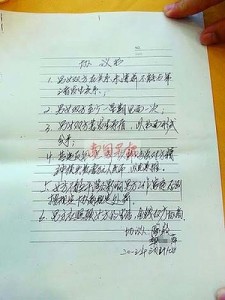
affair-contract-in-chineseA Chinese official has become an online laughing stock after the publication of a bizarre “love-affair contract” which he had obliged his mistress to sign.

The six-clause code of conduct, which was published by the Beijing News, set out the ground rules for a secretive affair between Tao Yi, a senior tax officer from Guangxi province, and a married woman who was named only as “Ms Fan”.

The six clauses – drawn up on a lined piece of A4 paper and dated March 2013 – stipulated:

1 No sex with third parties while the two sides are still in a relationship.

2 Meet at least once a week.

3 If the two come into conflict any break-up must be announced in written form.

“Surely, the official is aware that this love-affair contract is not protected by law,” wrote one.

4 If one party violates clause one, there will be a one-off compensation payment of 10,000 yuan [$1700] for mental damages to the other party.

5 The woman shall not interfere with the man’s work or family, or she will be punished accordingly.

6 The man shall take care of the woman’s living costs as per their agreement.

The contract was ridiculed by users of the Chinese microblogging site Weibo.

“Surely, the official is aware that this love-affair contract is not protected by law,” wrote one.

“With President Xi Jinping currently waging a high-profile war on corruption and debauchery, the leaked agreement represents a flagrant breach of Mr Tao’s contract with his Communist Party employers in the city of Guigang.”

A government spokesman told the Beijing News that Mr Tao had been relieved of his duties. The tax bureau and officials from the city’s disciplinary committee were investigating.

Mr Tao is the latest in a string of Communist Party officials to find his name caught up in a career-extinguishing sex scandal.

In August, state media called for officials to be banned from nightclubs after a group of Shanghai judges were caught cavorting with sex workers.

Earlier this month, officials in central China were accused of operating clandestine, whisky-fuelled karaoke sessions inside their local Party School, where Communist officials are supposed to learn about Mao Tse-tung.

Free family law advice available for Hervey Bay sittings

A FREE family law legal advice service is available for people who are scheduled to appear at the visiting Federal Circuit Court in Hervey Bay next week.

Run by Legal Aid Queensland, the Family Law Duty Lawyer Service will be available from 9am at the Hervey Bay Courthouse on the corner of Queens Rd and Freshwater St at Scarness.

Legal Aid Queensland Family Law principal lawyer Suellan Walker-Munro said the duty lawyer service provided a legal lifeline to people representing themselves in family law matters.

“Our duty lawyers provide free legal information and advice, help fill out some forms and documents needed for that day in court and will also talk about eligibility for ongoing support from Legal Aid,” she said.

“The service is aimed at people who turn up for court for a session that day without having received any information or advice from a lawyer.

“Our duty lawyers will try to help these people get through their day in court and give them the information they need to better prepare for later court dates.

“Duty lawyers can only provide a basic service to help people through that day in court.

“The duty lawyers are not going to be able take on case work or represent people in family law trials.

“Our duty lawyer service will go some of the way to helping people get through that first day before the court, but cannot replace the very important assistance a lawyer can provide in the days and weeks leading up to a court date.”

To access free legal information and advice from Legal Aid Queensland, phone 1300 651 188.

Too much medicine wasted on the dying, end-of-life care report says

advanced care directivesA QUARTER of the nation’s health budget is devoted to futile end-of-life care that strips patients of a dignified death and means healthier people have their surgery delayed.

In two major studies doctors are pleading for more people to sign advanced care directives that tell medicos not to revive them and not to provide care in certain circumstances.

A white paper on End of Life Care, the result of a collaboration of the Australian Centre for Health Research, Monash and Melbourne Universities, says junior doctors are often left in charge of end-of-life care.

The paper, to be released on November 21, said they don’t have the authority or confidence to make the tough decisions and instead very frail and elderly people are subjected to “conveyor belt” emergency care that “is reactive, unwanted and unnecessary”.

And a Medical Journal of Australia paper released today says Australians with advanced disease will average eight hospital admissions in their last year of life – and face a 60-70 per cent chance of dying in a ward.

This is even though 90 per cent say they would like to die at home.

Allison Sheather, 48, is dying of breast cancer and wants to spend as much time as possible at home with her two children as she nears the end of her battle.

With the help of her doctor Professor Richard Chye and nurses from the Sacred Heart palliative care service she is able to remain at home with her children, with brief visits to the hospital as her health deteriorates.

‘For me personally there is no going back,” she says.

“I’m only 48 and it’s a big decision. I’ve spoken to my doctors and my family and that’s how it’s come about listening to them. It’s hard as you can imagine,” she says.

“I think it is worth being able to make these choices,” she says.

“I want my family around me and today I’ve been out doing the groceries,” she says.

Allison says it is vital more people in her situation get the chance to consider their options and make choices about their care.

Melbourne anaesthetist Professor Paul Myles gave the example of a man in his 70s who was rushed to hospital for open heart surgery, even though his kidneys had stopped working, was in respiratory distress, had poor mobility and memory and required full time care.

The surgery took nine hours, 20 units of blood and caused three other heart surgeries to be cancelled.

The patient died in ICU 13 days later.

“I could not see how he would ever have an acceptable quality of life,” Professor Myles said.

Brisbane’s Princess Alexandra Hospital Professor Ian Scott wrote in the Medical Journal of Australia that 50 per cent of all deaths in Australia are clinically expected because of advanced disease.

“Almost a quarter of intensive care beds are occupied by patients receiving potentially inappropriate care,” he says.

“Regrettably considerable suffering as well as dissatisfaction with and overuse of health care result,” he says.

The white paper on End of Life Care found aged care homes often performed unnecessary, unwanted and unsuccessful resuscitation attempts with poor survival rates.

The report blames a medical culture that sees stopping treatment as a “failure” for the problem.

And it says too often even when patients have signed and advanced care directive refusing care it is ignored or not made available to hospital staff.

Doctors, nurses, specialists and other health system workers should offer all patients, not just those with a chronic illness patients, the chance to sign advanced care directives while they are healthy, the report says.

And it says there needs to be a better system for storing these living wills.

As the population ages more than 250,000 patients a year are expected to die from chronic disease in 2036.

Family law fact sheet – parenting orders and shared parental responsibility

parenting-orderA Parenting Order specifies where a child is to live, the time they are to spend with each parent and how they can communicate with their parents.

The Family Law Act 1975 (Cth) states that when making a Parenting Order, the Court must presume that it is in a child’s best interests for separated parents to have equal shared parental responsibility.

This means that parents must consult with each other and share responsibility for decisions about major long term issues in regard to the children.

Major Long Term Issues

Major long term issues are issues about the care, welfare and development of a child of a long-term nature such as:

  • The child’s education (both current and future);
  • The child’s religious and cultural upbringing;
  • The child’s health;
  • The child’s name;  and
  • Changes to the child’s living arrangements that make it significantly more difficult for the child to spend time with a parent.

The best interests of the child remain the paramount consideration, however, and the presumption of equal shared parental responsibility will not apply in situations of family violence or child abuse.

Where the presumption does apply, the Court must consider the appropriateness of the child spending equal time with both parents.  If equal time is not appropriate, the Court must consider whether it is in the best interests of the child to spend substantial and significant time with each parent.

Substantial and significant time requires some time on weekends, holidays and on other days.  It must include time in the child’s daily routine and allow the participation at events that are significant to the child and significant to the parent.

Substantial and Significant Time

In considering whether it is reasonably practicable for a child to spend equal time or substantial and significant time with a parent, the Court will have regard to:

  • How far apart the parents live from each other;
  • The parent’s current and future capacity to implement an arrangement for the child to spend equal time, or substantial and significant time, with each of the parents;
  • The parent’s current and future capacity to communicate with each other and resolve difficulties that might arise in implementing an arrangement of that kind;
  • The impact and arrangement of that kind that might have an impact on the child; and
  • Such other matters as the Court considers relevant.

The Child’s Best Interests

The primary considerations in determining what is in the child’s best interests are:

  • The benefit to the child of having a meaningful relationship with the parents;  and
  • The need to protect the child from psychological or physical harm from being subjected to, or exposed to, abuse, neglect or family violence.

In applying these two (2) primary considerations, the Court is to give greater weight to the need to protect the child from harm and from being subjected or exposed to abuse, neglect or family violence.

Additional Considerations

Additional considerations are as follows:

  1. Any views expressed by the child and any factors (such as the child’s maturity or level of understanding) that the court thinks are relevant to the weight it should give to the child’s views;
  2. The nature of the relationship of the child with:
  • Each of the child’s parents;  and
  • Other persons (including any grandparent or other relative of the child);
  1. The extent to which each of the child’s parents has taken, or failed to take, the opportunity:
  • To participate in making decisions about major long-term issues in relation to the child;
  • To spend time with the child; and
  • To communicate with the child;
  1. The extent to which each of the child’s parents has fulfilled, or failed to fulfil, the parent’s obligations to maintain the child;
  2. The likely effect of any changes in the child’s circumstances, including the likely effect on the child of any separation from:
  •  Either of his or her parents;  or
  • Any other child, or other person (including any grandparent or other relative of the child), with whom he or she has been living.
  1. The practical difficulty and expense of a child spending time with and communicating with a parent and whether that difficulty or expense will substantially affect the child’s right to maintain personal relations and direct contact with both parents on a regular basis;
  2. The capacity of:
  • Each of the child’s parents;  and
  • Any other person (including any grandparent or other relative of the child);

to provide for the needs of the child, including emotional and intellectual needs;

  1. The maturity, sex, lifestyle and background (including lifestyle, culture and traditions) of the child and of either of the child’s parents, and any other characteristics of the child that the court thinks are relevant;
  2. If the child is an Aboriginal child or a Torres Strait Islander child:
  • The child’s right to enjoy his or her Aboriginal or Torres Strait Islander culture (including the right to enjoy that culture with other people who share that culture);  and
  • The likely impact any proposed parenting order under this Part will have on that right;
  1. The attitude to the child, and to the responsibilities of parenthood, demonstrated by each of the child’s parents;
  2. If a family violence order applies, or has applied, to the child or a member of the child’s family, any relevant inferences that can be drawn from the order, taking into account the following:
  • The nature of the Order;
  • The circumstances in which the Order was made;
  • Any evidence admitted in proceedings for the Order;
  • Any findings made by the Court in, or in proceedings for, the Order; and
  • Any other relevant matter.
  1. Whether it would be preferable to make the order that would be least likely to lead to the institution of further proceedings in relation to the child;
  2. Any other fact or circumstance that the court thinks is relevant.

As practitioners and in accordance with our obligations under the Family Law Act 1975 (Cth), we encourage you to act on the basis that the child’s best interests are best met:

  • by the child having a meaningful relationship with both of the child’s parents; and
  • by the child being protected from psychological or physical harm and from being subjected to, or exposed to, abuse, neglect or family violence.

In applying these considerations, greater weight should be given by you to the need to protect the child from harm, abuse, neglect or family violence.

Mother charged over misleading Family Court in custody battle

hair-drug-test

The 47-year-old was sentenced today in the District Court after she was charged by the Corruption and Crime Commission with fabricating evidence with intent to mislead a court.

The woman’s 24-year-old daughter and a 37-year-old friend – who was a laboratory assistant at PathWest – were also charged by the CCC with the same offence and sentenced today.

The mother-of-three had to submit hair drug tests as part of a custody battle over her 10-year-old son.

Today, the District Court heard the woman was worried that a test of her own hair might show that she had used marijuana, which she felt might impact on her ability to retain custody of the boy.

As a result, she asked her adult daughter to provide a hair sample and requested that her friend to take it to her workplace at PathWest where an oblivious co-worker was asked to sign the specimen envelope.

The false test wasn sent off but the plan came unstuck when the woman’s former partner discovered PathWest did not carry out drug tests on hair samples and reported the matter.

In his sentencing remarks, Judge Michael Bowden said the offence struck “at the heart of the justice system” and must be regarded as serious.

Judge Bowden accepted that all three women acted out of genuine concern for the 10-year-old boy, were very remorseful and unlikely to offend again, but he said the offence was serious and could have seen them jailed for up to seven years.

The mother was jailed for 12 months.

Judge Bowden sentenced the former PathWest worker to 12 months jail, suspended for 18 months.

He said while her actions were a significant breach of trust by a public officer, the woman had already lost a much-loved job she held for 10 years and was the sole carer of an 11-year-old daughter.

Judge Bowden fined the the 24-year-old daughter $5000 because she initially declined to help her mother and to some extent had felt “compelled” to act even though she knew it was wrong.

It’s my business how I end my life: the former judge who flouts the law

Kep and Dot Enderby

The Enderby’s celebrate 50th wedding anniversary. Photo: Daniel Munoz

They keep it hidden, but close by. Two jars of Nembutal. One for him and one for her. When, and if, the time comes, they say they’ll swallow what some call the “peaceful pill”, drift off to sleep and die within an hour. Possession of the lethal drug is illegal; an ironic twist given that one of them is the former attorney general of Australia.

Kep Enderby sits with his wife Dot in a Sydney living room overlooking the sea. He fiddles with his walking stick and looks up. “I’ve thought about it a lot,” he says. “I’m suffering a lot. I’m not as active as I used to be – you can see this bloody stick. I’m a geriatric and I’m not enjoying life at all.”

Dot sits patiently.

“Euthanasia is a civil liberties issue,” Kep continues, “If I want to end my life, it’s my business.”

Does he not see the contradiction that a former first law officer of the crown, under the government of Gough Whitlam no less, is committing a criminal act?

Kep, 87, is fervent. “I think it’s a bad law, there’s no justification for it. But you’re quite right, we shouldn’t have it. That’s the truth of the matter. The law can often be unjust.”

He speaks for a while, drifting between case studies from his time as a supreme court judge in New South Wales which emphasise his libertarian point. Eventually Dot interjects.

A calmer voice: “The thing with Nembutal is, when you have access to it, you don’t sit down and make a plan … It’s something you have … something you know is there when you really need it.”

Procurement of the drug has been made more difficult in recent weeks since the closure of the black-market drug website Silk Road.

Dr Philip Nitschke, director of the euthanasia advocacy group Exit International – a group the Enderbys support – described the site’s closure as “devastating”. “Our elderly members appreciated the comfort that came from knowing that their transactions were private,” he said this month, warning: “The removal of the site will now mean that other less secure avenues will be pursued.”

The Enderbys won’t tell me where they got their two jars from.

Dot met Kep in 1960. He was a divorced 38-year-old law lecturer at the Australian National University in Canberra, drunk on the works of Marx and the anarcho-communist Peter Kropotkin. She was a 35-year-old college librarian raised in the traditions of the Labor party but without an active interest in politics.

Kep spotted Dot first. It was at morning tea in the common room.

“I confess all I saw in Dot at the beginning was a beautiful bloody woman,” he says. “I wanted to bed her.”

Dot laughs. “Well, I was otherwise taken at that stage,” she says. A courtship began, and within four years they were married. He moved into politics six years later. They celebrate their 50th wedding anniversary next year.

Dot and Kep concede they don’t know exactly how they’ll use the Nembutal. Perhaps, they say, it will be sipped simultaneously, then they will lie on the couch and drift off. But sometimes Kep has bad days and thinks about taking it alone.

“I’d get up out of bed in the night time, get the Nembutal from where I know it is, swallow it and Dot would find me on the couch or something.”

How would Dot feel to wake up and find him?

“Well it’s his right to do it if he wants to. If he feels he’s at that stage,” she says, unflinching.

The debate surrounding voluntary euthanasia has picked up once again in Australia. Only last week a legalisation bill narrowly failed in the Tasmanian parliament, voted down by 13-11. This despite polling suggesting 80% of people in the state supported it. In recent years state parliaments in New South Wales and Western Australia have rejected similar legislation, and at present it remains illegal throughout the country.

Kep describes a deep fear of going “demented”. He sees Whitlam every now and again; the last visit was four months ago. “I’m not even sure he recognises me,” Kep says.

It’s a far cry from their first encounter. Kep comes alive as he describes it; he was elected as the Labor member for Canberra in a 1970 byelection. “Whitlam was making a name for himself then, a great name, you couldn’t help but be hypnotised.”

After the 1972 election Enderby was fast-tracked to cabinet. In February 1975 Lionel Murphy moved to the high court, vacating the AG position. Kep says he knocked on Whitlam’s door, demanding the job he’d heard Whitlam was going to take for himself. “I said, ‘Oh come off it, I think I deserve it.’ He said, ‘All right, you bastard.’” Dot resigned her job at the library – such were the engagement demands of a senior cabinet minister’s wife at the time.

He pushed through progressive legislation – including the Family Law Act that introduced no-fault divorce. And then, on 11 November – Remembrance Day – the governor general, John Kerr, removed the prime minister, against attorney general Enderby’s advice.

Kep was representing Whitlam at a Remembrance Day event in Canberra. Kerr was at his side and Dot was in the audience. The event ended and Kep knew something was afoot.

“Kerr didn’t shake hands. He just left me, walked away. It was strange, I knew him quite well. He’d been in mine and Dorothy’s home for dinner. But Lady Kerr was terribly cold. She turned to me and said, “Goodbye, Mr Attorney.”’

Hours later the government was finished. Enderby was called to The Lodge by Whitlam. He recalls Gough opening the door, munching on a meat pie, and proclaiming, “The bastard’s done a Game on us” – a reference to the NSW premier Jack Lang’s overthrow in 1932 by governor Game.

Kep lost his seat at the following election. The radical reform of the Whitlam years was over, and the Enderbys moved to Sydney.

After his appointment as a justice in the NSW supreme court, Kep held other positions, including heading the Voluntary Euthanasia Society of NSW for six years. Dot retired from formal work shortly after the move but she says their relationship has “always been a partnership”.

You get the feeling that it’s the threat of this partnership breaking down, rather than a blinded commitment to political libertarianism, which really explains their decision to euthanise eventually.

He has arthritis and peripheral neuropathy. The doctors tell him it will only get worse. He doesn’t want her to hear, but says it anyway: “In recent times I have become more and more demanding of having Dot do things for me. I can’t even put these trousers on sometimes.

“I had this bout of diarrhoea, which lasted about four weeks. I couldn’t run to the toilet fast enough. It was shitting all over the floor and Dot would have to clean it up. This sounds like finding an excuse … to commit suicide, but the longer I live, the more of a burden I am to Dot.”

She frowns dismissively. “It’s bearable at the moment,” she says, but later she tells me the pain in her back is so crippling that sometimes that she considers taking the Nembutal out of the blue too.

They fondly recall their time in Balmain, sailing yachts together; flying light aircraft; they learned Esperanto – the global auxiliary language that Kep says embodies his beliefs as an internationalist. The most painful loss for him, the one he keeps coming back to in our conversation, is the fact that he can only read for an hour a day now. “I’ve been a great reader … But now my eyes get sore.”

It has been a charmed, full life – foiled, to an extent, by old age.

The ethical discussion of voluntary euthanasia is not likely to cease in the foreseeable future. The Enderbys’ case brings up many questions. Could people not as empowered as this couple come to a decision about euthanasia rationally? Would the legal proliferation of drugs such as Nembutal allow those without terminal illness easier access to suicide? Too easy, perhaps?

Stella Young, a disability advocate and editor of the ABC’s disability discussion site Ramp Up, is concerned that framing the euthanasia debate around issues of individual liberty undervalues the lives of those with disability and illness.

“As a disabled person, I’m concerned about giving even greater control of our lives to the medical profession,” she says. “The way we view disability as a society has a lot to do with the deficit approach taken by doctors.

“No matter how hard we dispute it, our lives are seen as less valuable than the lives of non-disabled people.

“I don’t want to see a situation where already vulnerable people who are living without the supports they need feel pressure to solve this problem by requesting death.”

As I leave I ask Dot what she’d do if Kep went first. They’re obviously still deeply in love, surely she’d be heartbroken?

“I’d cope. I did for the first 30 years of my life.” It’s a rational, lucid response based on mutual respect and understanding. It might also be seen as compelling argument.

Is faith above the law in family law proceedings? What is a court to do?

religion-and-the-courtsOn 27 August 2013, Judge Burchardt sitting in the Federal Circuit Court of Australia, Melbourne, handed down judgment following an extraordinary situation where a litigant in person refused to acknowledge the jurisdiction of the Court or to answer questions from the bench based on his religion.

Background

The case is Irvine & Irvine (No.2) [2013] FCCA 2076. His Honour was clearly exasperated by the behaviour in his court.

His Honour’s opening comments were “This is a wholly extraordinary case. I hope I never have another like it. For reasons which I hope will become apparent, it has been a proceeding almost impossible properly to control, essentially because of the position adopted by the respondent husband, a position unique in my experience on the Court.”

Mr Irvine had commenced living in Australiain 1989 and was an Australian citizen but had not lived in Australia for the last 12 months nor considered it his home. There were 4 children under 18 years and 4 older children.

This Application was for property settlement and children’s orders.  Mrs Irvine had already applied for a Divorce and sought an order dispensing service as she thought the husband was avoiding service on religious grounds. We do not know the religion.

Outline of Proceedings

Mr Irvine appeared on the first date (22 May 2013) for the property matters.  His attitude was that the court did not have jurisdiction as “his marriage was governed by a contract entered into pursuant to (religion omitted), and it was not open to this court to interfere with it.”  Mr Irvine refused to answer “very straightforward direct questions”. The 16 year old son had to be removed from the Court and affidavits of him and his younger brother were refused filing.

Mr Irvine was given opportunity to file an affidavit. That affidavit clearly told the Court that he considered the court did not have jurisdiction and that if the court proceeded it would be a “tort”.  Judge Burchardt sought to resolve the matter on 29 May 2013 by way of undefended hearing, following the difficulties that had arisen on 22 May 2013.

On 29 May 2013, Mr Irvine attended Court. When asked whether he was appearing for himself he said “I’m just – simply here regarding the matter”.  Again, the 16 year old son was ejected from court.  Mr Irvine is an apparently educated man with an “excellent command of English” yet he argued that he did not understand the proceedings.  Judge Burchardt observed that “everything Mr Irvine did and the way that he did it suggests to me that he is a highly intelligent man who is engaged in an extensive filibuster with a view to enforcing his basic position that the Court does not have jurisdiction.” Mr Irvine asked for a copy of the transcript and was allowed a copy and a further 2 weeks to co-operate. He was asked to make up his mind as to whether he was going to participate in the proceedings.

Mr Irvine had filed an affidavit on 29 May 2013 opening with the words “I, appearing as, Mr Irvine, by special invitation and not appearing generally before this honourable court…”  It didn’t advance his case any.

At 9.30am on 14 June 2013, Mr Irvine was not in court.  The matter proceeded undefended, however, at 10.00am Mr Irvine appeared.  He sought to file an affidavit which purported that the marriage contract was a binding financial agreement and thereby outside the court’s jurisdiction.

In light of the behaviour demonstrated by Mr Irvine and the parties’ child in court and the evidence before the Court of their behaviour away from court, equal shared parental responsibility was not granted.  Mr Irvine’s affidavit material indicated that Mrs Irvine had “no capacity or entitlement to make any decisions, although she is required to be consulted.” No evidence was put before the Court regarding the religion. On 14 June 2013, Mr Irvine had sought a 6 month adjournment. Judge Burchardt considered that the position taken by Mr Irvine was “designed to defeat the Court’s processes”.

His Honour found that Mr Irvine’s behaviour had “already succeeded in alienating the children in age order down to and including X and is no doubt actively seeking to suborn the rest.”

There were 8 children of the marriage.  Mr Irvine had transferred property and appeared to have 4 overseas properties. A taxi license and vehicle was ordered to be transferred to Mrs Irvine. It is clear from the judgment of Burchardt J that he was frustrated by Mr Irvine’s refusal to participate in the Court processes.

Conclusion

On 1 August 2013, the matter was listed for hearing. Mr Irvine failed to attend. On 6 August 2013, Mr Irvine contacted Mrs Irvine and advised he had just heard of the hearing date for 1 August 2013.  By 27 August 2013, the Court had not heard further from Mr Irvine despite indicating to the contrary.  Mrs Irvine had sought spousal maintenance. In the circumstances, it was apparent there would be no co-operation. Mrs Irvine sought the taxi license and vehicle and was granted this as the only real option available for property settlement.

So, what do we learn? Stay true to the path, dot the ‘I’, cross the ‘t’, be patient but firm with self-represented parties but take no nonsense from them.  The Court has jurisdiction, despite a determined attempt to thwart the Australian judicial system but it came at a significant cost to Mrs Irvine.

A Binding Child Support Agreement Can Be Set Aside

child-support-agencyA binding child support agreement can be set aside based on exceptional circumstances. An exceptional circumstance is when the agreement will cause hardship of a serious nature and inequity to the applicant. The father failed to prove the exceptional circumstance in his case.

Jessup and Jessup [2010] FMCAfam 124 (February 2010) involves the application of a father to set aside a child support agreement he entered into with the mother on May 12, 2006. He seeks to pay child support in accordance with the assessment of the Child Support Agency (CSA). The Agreement concerns their two children who were born on 1988 (X) and 1993 (Y). The father’s application was dismissed because he failed to prove that the Agreement will cause him hardship of a serious nature and inequity.

As of the time of the application, Y is still in school for which the mother is asking for support. The father already lives in Hong Kong and has a son (Z) born in 2007 of a subsequent relationship. He is also liable to the financial support of Z.

The applicable law in relation to child support agreement was amended by the Child Support Legislation Amendment (Reform of the Child Support Scheme – New Formula and Other Measures) Act 2006. The amendments to the law created two types of child support agreements: binding child support agreements and limited child support agreements. Due to the changes in the law, the Child Support Registrar is required to review all child support agreements that are in force before July 1, 2008. The Registrar found the Agreement of the parties to be a binding child support agreement and it would remain in force even after July 1, 2008.

The Court held that the burden is on the father to prove that there are exceptional circumstances that have arisen since May 2006 and that the change in his circumstances will cause him to suffer hardship if the Agreement is not set aside. The father contends that there has been a significant decline in his finances since his transfer to Hong Kong whereas the mother’s financial position has improved. On top of his child support payments for his two children with the mother he is also financially responsible for Z in Hong Kong.

In the Court’s decision, the definition of “exceptional circumstances” in Simpson and Hamlin (1984) FLC 91-576 was cited:

“… it was not sufficient that circumstances had arisen of an exceptional nature resulting in hardship to the applicant. The Court must consider in the exercise of its discretion whether that hardship is of such a serious nature and results in such inequity that it can only be rectified by the extreme step of setting aside or varying an existing order.”

The Court found that while there have been changes in each party’s circumstances these do not amount to “exceptional circumstances”. The Court further held that the evidence adduced by the father with respect to his income and assets were insufficient to support his position. Hence, the application of the father was dismissed.