
Grey Divorce Rates Soaring in Australia

divorce-in-waOlder Australians are divorcing more than ever before, with many struggling to get back on their feet financially after a split.

Grey divorce rates in particular are soaring, with big jumps in the number of men and women divorcing aged 50 and above.

Apart from coming to terms with the emotional pain, one of the biggest problems for older people after a divorce is figuring out how to rebuild their finances.

With the bulk of working years behind them and limited assets after the expensive child rearing years, it can be difficult to recover their married standard of living.

We have a number of friends in this situation so here are our observations on how to handle marital problems when you’re over 50, and where to turn if things are really going pear shaped.

WHY DOES GREY DIVORCE HAPPEN?

Your 50s is a decade of massive change. Kids leave the nest, work slows down and the body gently reminds you to take things a bit easier.

Some empty nesters, after the distractions of raising kids stops, realise that with so much else going on, their relationship has been left behind.

But before calling quits on any serious relationship, it’s in your financial and emotional interest to try to work it out with your partner first.

Lorraine Murphy, director of clinical services at Relationships Australia, says that it’s important for both partners to come together to focus on making things work.

If there hasn’t been a serious indiscretion to cause the relationship to fail and you’ve simply grown apart, then you could try counselling, being more open with each other or just spending more time together.

In your 50s, there’s a good chance you’ve spent some of the best years (or decades) of your life with each other and done some amazing things, so why not give it another shot?

GETTING A DIVORCE

If things have gone seriously downhill and the relationship can’t be salvaged, then be smart about how you handle the settlement.

Women have to be especially careful. The average Australian woman will live five years longer than a man but has a superannuation balance that’s 43 per cent lower. So dividing the family assets fairly in a split is important to maintaining quality of life.

Some women may not have a complete picture of the family finances, particularly if they’ve left the workforce to focus on raising children. Make sure you are fully informed about all aspects of your financial relationship – bank accounts, investments and insurance. Know where all the important documents are kept.

When the decision to split is made, protect your access to joint bank accounts, cancel joint credit cards and set up your own, change passwords and generally be on guard about any funds that may “walk”.

One of the most important considerations will be what to do with the family home and any investment properties. While it may seem like a great idea for one partner to keep the house, consider the ongoing maintenance fees and the fact it ties up money in an illiquid asset.

For a couple that is asset rich but cash poor, a good option can be to sell the house and split the proceeds.

Lastly, while your split may be amicable, it’s always wise to secure copies of all financial documentation and engage the services of a lawyer to organise the settlement.

Murphy recommends visiting your local Family Relationship Centre for information and confidential assistance. Otherwise, in the event things do get ugly, the Family Court may have to resolve the situation.

MOVING ON AFTER DIVORCE

Once the divorce has been finalised and you’re out on your own, it’s more important than ever to be smart about finances.

With one income and set of assets, you’ll need to put together a plan about how you’ll make things work and achieve your desired quality of life.

It’s a good idea to seek financial advice to ensure you’re on the right track.

And finally, don’t forget about estate planning. Update the will to reflect your new situation.

Bias Against the Gay Parent in Family Court Proceedings

gay-parentWhen it comes to child custody and same-sex parents, the Family Court has stated on numerous occasions that there is no presumption against the non-biological same-sex parent in the event of separation.

But what if both parents are the biological parents, and upon separation one declares themselves to be gay? Does a presumption exist against the gay parent in such circumstances?

New research suggests that despite a sea-change in attitudes over the past decade, some presumption may still exist, at least according to this research of some jurisdictions outside Australia.

Court decisions that favour a heterosexual parent over a gay or lesbian parent in a custody dispute often do not consider important social science research on parenting by gay and lesbian individuals, according to a new review from Drexel University.

Previous research shows that gay and lesbian individuals are as effective in parenting as heterosexuals, and that children raised by gay or lesbian parents are as well-adjusted as their peers raised by heterosexual parents. This research could greatly impact how legislatures and courts make decisions regarding custody for gay and lesbian parents. However, in many states, sexual orientation is still a deciding factor in custody decisions.

For a gay or lesbian individual, coming out as gay at the end of a heterosexual partnership can mean that he or she could be denied custody of the children from that partnership or face restrictions on visitation. For same-sex couples with children, the end of their relationship can mean difficulties in establishing parental rights for both parents when one partner is not recognized as a legal parent by the state and by the court, and therefore is not granted custody or visitation.

The Drexel researchers recommend that legislators and other policy makers take into account the research on gay parenting. They believe that this research should be used to help guide policy, which would have the potential to assist judges in complex decisions regarding custody and parental rights — and could help ensure that such legal decisions genuinely reflect the best interest of the child.

The review, entitled “Lesbian and Gay Parents and Determination of Child Custody: The Changing Legal Landscape and Implications for Policy and Practice,” was published in the first issue of the American Psychological Association’s (APA) new journal, Psychology of Sexual Orientation and Gender Diversity, which was released in March 2014. The full article is available here or by request.

The review was conducted by Emily Haney-Caron, a third-year JD/PhD candidate in Drexel’s joint program in psychology and law in the College of Arts and Sciences and School of Law, and Kirk Heilbrun, PhD, a professor of psychology in Drexel’s College of Arts and Sciences. They presented their research at the APA’s American Psychology-Law Society (APLS) conference in March.

“There’s been a sea-change within the past five to 10 years — several states are currently going through the process of legalizing same-sex marriage — and a by-product of that change is that there are more people in same-sex relationships that have been legitimized by society,” said Heilbrun. “This means that there are also more children involved in custody disputes where one parent is in a same-sex relationship. This has become an increasingly relevant issue and one that needs to be addressed.”

“As our views as a society change, we want our courts to reflect that,” said Haney-Caron. “Our legal system should reflect the values and the realities that we hold.”

Haney-Caron and Heilbrun reviewed the current law relating to gay and lesbian parents and child custody decisions as well as the research on gay and lesbian parenting.

Based on this review, the authors offer several recommendations for stakeholders:

  • For psychologists conducting evaluations for custody disputes involving a gay or lesbian parent, it is important to understand the relevant law and research, ensure that personal biases do not influence the evaluation or conclusions, and consider how the nature of these cases may influence both the evaluation and the information provided to the judge in the case.
  • For judges presiding over custody matters, the relevant social science research should help to inform decisions involving families with a lesbian or gay parent.
  • For legislators, research should also help to inform lawmaking in this area. Examples might include legislation restricting judges from considering sexual orientation in child custody disputes, or legislation making it easier for same-sex couples to establish legal bonds with their children.

“By allowing the research to influence legal decision-making in this area, our society can help ensure that the best interest of the children whose custody is at issue will be served,” said Haney-Caron.

Haney-Caron first addressed this topic in a paper for Heilbrun’s course on forensic assessment in 2013. “A conversation in class first triggered my interest,” she said. “And then I saw that there was nothing else out there on this topic in psychology literature.”

“This is a prime example of the kind of work we do in the JD/PhD program,” said Haney-Caron. “It brings together two disciplines — law and psychology — and creates scholarship in the space between them.”

What is a Power of Attorney? Easy to Understand Guide

power-of-attorney-formA power of attorney (POA) can be an important, practical and useful legal solution that not only provides you with peace of mind but can also help you avoid costly and complex legal problems.

A POA is a legal document that allows a person to act on your behalf in areas such as financial property or medical matters.

The person delegating the power is known as the principal (also referred to as a donor or grantor) and the person receiving the power is known as the attorney (also known as the donee, grantee or agent). The relationship between the principal and attorney is that of principal and agent.

A general POA (see below) can be set up to give the attorney the authority to:

  • do just one thing;
  • do a restricted range of things; or
  • make any financial or legal decisions on the principal’s behalf.

A general POA with limited powers is usually granted to cover a specific event for a fixed period of time. This could include selling shares, buying property or signing a legal agreement.

If the grantor of the POA becomes mentally incapacitated and legally incompetent, the POA ceases to be active and no longer applies.

What are the attorney’s responsibilities?

An attorney must:

  • avoid conflicts between their interests and yours
  • maintain proper records of their dealings with your money and property
  • keep your money and property separate from theirs
  • act in your best interest at all times
  • not pay or give gifts or benefits to themselves or other people using your finances, unless you specifically say they can.

However, the attorney can claim out-of-pocket expenses directly connected with carrying out the power of attorney duties.

Who can make a power of attorney?

In general, a principal must be 18 years of age and legally competent. In other words, the principal should understand the nature and effect of the POA in terms of what he/she as an attorney can do, when the attorney can make decisions and what kind of decisions, and the impact of this decision making.

Who should be appointed as the attorney?

An attorney must be at least 18 years of age if they are required to sign contracts, for instance.

People often appoint relatives, close friends or an independent person such as an accountant, lawyer or doctor as their attorney. You can also appoint a trustee company, but there will invariably be fees associated with this.

An attorney should be a person whom you trust and who understands the decisions you would be likely to make in certain circumstances.

Types of POAs

Specific: Enables the person to act on your behalf for a specified purpose.

Limited: Enables the person to carry out a particular transaction on your behalf.

General: Enables the person to carry out any business for you or deal with your affairs and assets.

Enduring: While specific, limited and general POAs cover you while you are alive and of sound mind, an enduring POA will cover you up until your death, even if you become physically or mentally impaired and are unable to manage your affairs.

This person will be able to take care of your investments and other financial matters.

The powers that a POA may confer on another person may differ between the various states and territories of Australia. Therefore it would be wise to seek professional legal advice before making a POA.

Sample Legal Documents

Surrogate Father of Twins labels Australia’s Surrogacy laws A DISGRACE

surrogacy-father-jake-docker

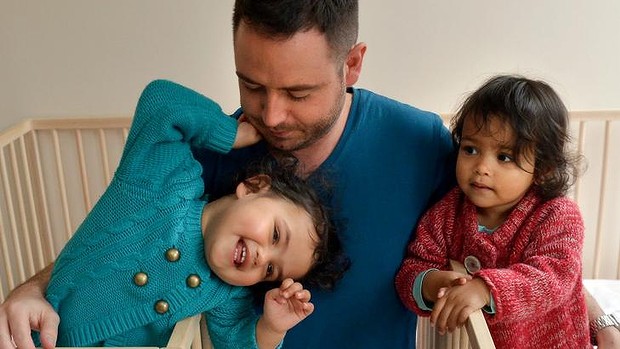
Jake Docker & twins surrogacy daughters

The commercial surrogacy laws in essentially all Australian states and territories have been criticised far and wide. Implemented to prevent the commercialisation and ultimately exploitation of people involved in the practice, all it seems to have achieved is drive people under-ground, and forced many Australians to seek overseas, that which they have been denied access to in Australia.

When Jake Docker discovered the NSW government was about to ban international commercial surrogacy in 2010, he immediately signed a contract with an agency in India to ensure he would be able to achieve his dream of fatherhood.

The father of twin daughters, Pippa and Millie, born to a surrogate in India in January last year, now questions why he rushed into it, saying hundreds of couples continue to skirt the law.

Since March 2011, NSW parents who engage in compensated surrogacy overseas have risked two years’ imprisonment and fines of $275,000, although those who signed contracts with agencies before that date are protected.

“I look back and think, ‘what was all that panic about?’ People are still doing it. Nobody has been prosecuted under that law,” he said.

“The laws banning commercial surrogacy are rubbish laws which haven’t had an effect on anybody.”

But Mr Docker, who is gay, is deeply worried that legal issues raised after baby Gammy might lead to a crackdown on overseas commercial surrogacy, which is only illegal in NSW, the ACT and Queensland.

“I am concerned there will be a federal legislation that bans international commercial surrogacy outright,” he said. “That’s punitive. It’s a real shame.”

The 28-year-old said further restrictions on surrogacy would create a black market for babies.

“Stamping out Australians doing commercial surrogacy anywhere in the world is not the answer,” he said. “It will only drive it underground, it will only marginalise people that are trying to access surrogacy. People who really want to have a baby will always find a way.”

He has nothing but praise for the Indian clinic which handled his surrogacy arrangement but he encountered problems with the Indian government when trying to take his babies home.

“I was put through the ringer by the [former] minister of home affairs in India,” he said. “I was interrogated by one of the senior officials there who told me I could be taking them to harvest their organs and all sorts of stuff.

“They do interrogate you and give you a hard time about taking the babies out of the country and that’s after you already have a birth certificate and an Australian passport for them.”

Mr Docker, who works in law enforcement, turned to surrogacy after exhausting other options in Australia, such as inter-country or local adoption.

‘‘I went on the adoption waiting list in NSW a couple of years ago and the response was: ‘When a child in need of adoption becomes available, we’ll get back to you’. I’ve never had an email and that was about four years ago,’’ he said. ‘‘I looked at inter-country adoption. If you say that you’re gay, don’t even bother.’’

Mr Docker, who moved from Sydney to Melbourne six weeks ago to find more family-friendly accommodation for his toddlers , still has 11 embryos in storage in India and hopes to have more children.

‘‘As a single parent, it’s only finances that are preventing me from having more, but I wouldn’t change my circumstances for the world. I love being a dad.’’

Baby Gammy and the long arm of the Family Court

David-John-FarnelThai authorities have ruled out taking legal action against the Australian biological parents of Gammy, the baby with Downs syndrome separated from his twin sister in Australia when allegedly abandoned in Thailand by his biological parents.

However, Australian authorities seem to be singing a different tune.

West Australian child protection services have been called in by police to investigate the “suitability” of the Australian biological father of baby Gammy following the public disclosure of sex offences against children.

Court documents have revealed that David John Farnell, the fifty-six-year-old Australian father at the centre of the international surrogacy controversy, has been convicted of more than 20 child sex offences.

It has now been revealed Mr Farnell has 22 child sex convictions, including unlawful and indecent dealing with girls when he was in his twenties. See 60 Minutes story.

Western Australia’s Department for Child Protection has launched an investigation into the safety of Gammy’s twin sister.

In a further development, WA’s Minister for Child Protection says she has asked her department to consider whether baby Gammy and his sister should be reunited.

Speaking to 720 ABC Perth, Minister Helen Morton said the department’s immediate concern was the safety of the baby girl living in Australia, but that she has asked staff to look at “whether there is a requirement for us to facilitate some bonding between Gammy and his sister.”

“We are interested in the fact that these two babies are twins,” she said.

“I’ve asked the department to give me an understanding of the impact of separation and needs for bonding for these two children, and what that may mean.”

Dr Alan Campbell is a research fellow in social work at Curtin University, and previously spent 10 years as a psychologist at the WA Family Court.

He said that while the case of Gammy and his sister is atypical, the trauma caused by splitting up siblings is well understood.

“There’s a lot of literature to suggest that twins and siblings, when they are separated from each other, experience a lot of ongoing trauma,” he said.

These concepts of separation anxiety are mostly heard within the context of family court proceedings, where one of the litigants, being either a parent or a child representative, argues for ongoing contact between siblings, despite the contact or residential outcome.

Some critics have argued that too much emphasis has been placed on contact between extremely young siblings, however these ideologies are so firmly entrenched within the psychological adjunct of family law, that it would be hard to resist these zealous demands lest it be claimed that it would further damage the children involved.

It seems the real battle for these children is soon to begin, and with all this publicity from around the globe, the Department for Child Protection will be under extreme pressure to not only act in the best interests of both children.

Let’s hope that unlike the Western Australian Family Court, it can achieve these goals without needing to immerse itself in some of the bizarre ideologies on child welfare that can ultimately forget that children are part of families as well.

Australian Taxation Office Just Made Divorce A Lot More Expensive

australian-taxation-office-and-divorceThe cost of divorce for many wealthy couples will rise under a Tax Office ruling that imposes much bigger bills on property settlements.

Tax and legal experts said the ruling reversed existing administrative practice and means the value of some settlements could be reduced by almost half. The ruling stops couples funding divorce settlements using income from private companies, which was taxed at the corporate rate.

Rich families often park their assets in private companies, trusts and partnerships. This allows them to pay the 30 per cent company tax rate instead of the 46.5 per cent marginal rate applied to the highest paid.

Payments made under a Family Court order were treated as tax free in the hands of a divorcing spouse. That changed when the Tax Office issued a final public ruling on July 30.

Payments made to spouses who are getting divorced from private ­companies will now be deemed ­dividends and subject to personal income tax.

Experts said the change in rules could make the cost of divorce a lot higher. In some cases it could reduce settlements by as much as 46.5 per cent, particularly where the primary part of the settlement was from a private company and there were no franking credits attached to the payment.

Gadens partner Peter Poulos said it meant people would no longer be able to use Family Court orders to pay corporate profits to divorcing spouses tax free. The need to fund the divorcing spouse’s tax bill would in many cases convert a 50-50 settlement into an effective 60-40 settlement or worse, which was inequitable, he said.

“It’s difficult enough for family companies to protect the business where the company is required to make a large payment to a divorcing spouse,” he said.

“Now the company will also have to fund the divorcing spouse’s new tax bill, and this could be the straw that breaks the family business’ back.”

A more commercial approach to dividing matrimonial property held in family companies would be via a Family Court direction ordering company payments to be made to the spouse’s own private company, Mr Poulos said.

“This will defer the potentially catastrophic cost of the top-up tax and put the divorcing spouses on a more ­equitable footing.”

Craig Henderson, co-head of Lander and Rogers’ family and relationship law group, said the ruling was contrary to many previous private rulings and arguably inconsistent with the Income Tax Assessment Act.

But the question was whether ­anyone was prepared to take on the Tax Office.

“The extra tax now payable will of course be taken into account as an additional liability to be apportioned between the separating parties,” Mr Henderson said.

“There will certainly be less to go round and getting money out of family structures will certainly be more expensive. A lot of careful tax planning may be undone.”

It will bring greater focus on the need for company restructures which had not previously been considered because of their comparative expense and complexity, he said.

The tax effect of shifting assets from private companies during matrimonial settlements would have to be taken into consideration during negotiations, particularly the effect of having to pay top-up tax for those on higher incomes, Pitcher Partners executive director Julie Strack said.

“In specie transfers of property, ­particularly where there has been a large increase in the value of the ­property over time and the company has substantial retained ­earnings, could result in large tax ­liabilities for the shareholder which they would have to fund ­themselves even though effectively the property has not been sold to anyone,” she said.

The Tax Office ruling, issued in draft form in November, makes clear that it reverses a “significant body” of earlier private rulings that amounted to a general administrative practice.

Those rulings suggested that a Family Court order for a private company to pay money to an associate of a shareholder would be exempt from the deemed dividend rules.

The ruling is likely to have significant taxation implications for property separations where a family company is involved, making tax-efficient separations more difficult to achieve.  It is likely that the taxation consequences will be of greater importance in negotiating settlements. 

The new public ruling will not apply to Family Court orders made before it was issued, to the extent the ruling is less favourable to the taxpayer.

Attempted Murderer Wife Scams Husband’s Property From Jail

vicky-soteriou-on-night-of-attempted-murder

Vicky Soteriou – scammed property from jail

A MAN who survived his ex-wife’s murder plot alleges she has transferred property to her family from prison to stop him collecting the money she owes as a result of suing his ex-wife for civil damages over the attack.

Chris Soteriou has launched County Court proceedings alleging his former partner, Vicky, gifted her share of a house in Reservoir to her parents and sister to keep it from him.

The mother of three is in jail after arranging for her lover, Ari Dimitrakis, to stab her then-husband Chris in 2010 near a Fitzroy restaurant.

Vicky Soteriou was jailed last year for nine years for conspiring to murder.

Fortunately, after being stabbed seven times, Chris survived but, as he claims, his psychological shock was so big that he did not manage to work again after this incident. He has lived off of his family’s money all this time.

Formerly a wealthy businessman, Mr Soteriou said he now has to borrow money from his own family after assets in his wife’s name were frozen following a court order.

He now claims the actions of his wife, Vicky, 45, have left him broke and forced to borrow money from his family.

“I have seriously suffered a diminution in my sense of self-worth, and everything I wish and wanted for my family must now be recast,” he says.

And he explains that, while he was for several days in the hospital recovering from the murder attempt, his wife’s family took items amounting to $100,000 out of his house including gold nuggets, watches, jewellery and vintage bottles of wine, and Vicky withdrew $200,000 from the bank. Court documents allege she also used $20,000 of her husband’s money to buy burial plots for herself and her lover.

“The police brought the transaction to my attention while I was in hospital,” he said. “I was aware she had significant savings but not to that magnitude.”

Now, he is asking for compensation in the vicnity of $1.3 million for pain and suffering, $1.5 million for loss of earnings, $190,000 for legal and medical expenses and $200,000 for his three children’s pain and suffering.

Chris added that he is not allowed to use any of the family assets because they were in his wife’s name and frozen under court order.

Before the attack, Chris, who had migrated from war-torn Cyprus with his family aged 12 and grew up in working-class Reservoir, was a high-flying engineering consultant on the National Broadband Network rollout, with an annual income of $600,000. For the 2000 Sydney Olympics, he had been head of infrastructure for the main stadium.

He is now a more hands-off director of five businesses, including a loans company and reception centre in Melbourne and a daiquiri machine-leasing business in Greece. But he sees himself mostly as a stay-at-home dad to the twins, whom he walks to and from school every day.

Mr Soteriou alleges in court documents that he and his ex-wife jointly held a 25 per cent share in a property in Plenty Rd, Reservoir, until June last year.

The writ alleges Vicky, her parents Dimitrios and Maria Skarlatos, and her sister ­Theodora Skarlatos – with the ­co-operation of Thornbury lawyer John Yianoulatos – contrived to improperly transfer her share.

The statement of claim says the gifted transfer was not done “with love and affection” as specified, and was “bogus and a sham”.

“The real motive for parties executing the transfer was to deprive the plaintiff of his legal entitlement to an interest in the land,” it says.

Documents also ­allege a copy of the visitors’ book at Dame Phyllis Frost Centre for June 14, 2012 – the date the transfer document was apparently signed and witnessed – shows no visitors for Vicky.

Lawyer Kurt Esser, acting for Mr Soteriou, is seeking an order declaring the property transfer void, and is seeking damages, costs and interest.

Dimitrios and Maria Skarlatos denied any wrongdoing by them or their daughters.

Mr Yianoulatos said claims against him were “vexatious and frivolous”.

“I sincerely protest my innocence in this. I will be strongly defending this.”

Vicky Soteriou, 44, was sentenced to 9 years in prison after being found guilty of trying to have her wealthy businessman husband killed.

After leaving his 44th birthday dinner in 2010, Mr Soteriou was stabbed six times and had his throat slashed.

A judge subsequently ­ordered her to pay her ex-husband $2.4 million in civil ­damages.

Related Videos

  • No items found in feed URL: https://www.familylawexpress.com.au/family-law-express-media/aiovg_categories/attempted-murder/feed/. You requested 15 items.
  • Storing and Locating Wills in South Australia: Call for Submissions

    south-australian-law-reform-losing-it-willsThe South Australian Law Reform Institute (SALRI) is calling for public submissions on whether there should be a state scheme for recording the location of, or securely storing, South Australians’ wills.

    The SALRI, located at the University of Adelaide, today issued a paper which examines what is currently available for those wanting to store their will in South Australia, and in other states and countries, and invites public to comment.

    SALRI Deputy Director, Helen Wighton, says the current court-based facility for the secure custody of wills is almost exclusively used for court-authorised wills and is not designed for accepting a large number of wills.

    “The only other options for secure storage of wills in South Australia are to make private arrangements (with a bank or solicitor, for example) or to appoint the Public Trustee as executor (who will store the will for you),” Ms Wighton says.

    “Also, there is no system for simply recording a will’s location with a public authority. In British Columbia you can electronically notify the equivalent of our Registry of Births Deaths and Marriages that you have made a will and where it’s kept.”

    Ms Wighton says the main purpose of any such scheme is to ensure that people’s property is distributed according to their wishes as expressed in their last will.

    “If your will cannot be found after you die, your estate will be distributed according to the rules of intestacy, and will not necessarily go to the people you wanted it to go to,” she says.

    “We’re looking for submissions from the legal profession, professionals involved in estate administration and the public.

    “The Institute will then report its findings and recommendations to the Attorney-General.”

    The review was initiated by the SA Attorney-General, the Hon. John Rau MP, as part of a wider review of succession laws in South Australia.

    The issues paper, Losing it: State schemes for storing and locating wills, and information about how to make a submission can be found on the SALRI web page: http://www.law.adelaide.edu.au/research/law-reform-institute/.The closing date for submissions is Friday 12 September 2014.

    The SALRI was established in December 2010 by agreement between the Attorney-General of South Australia, the University of Adelaide and the Law Society of South Australia. It is based at the University of Adelaide.

    Media Contact:

    Kate Bourne
    Media and Communications Officer
    The University of Adelaide
    Phone: +61 8 8313 3173
    Mobile: +61 (0)457 537 677
    kate.bourne@adelaide.edu.au

    Majority of Divorcing Couples Settle Without Lawyers: AIFS Study

    Family studies ConferenceAlthough we take it as a given that conflict and property dispute are part and parcel of divorce, this is not necessarily the case with the majority of divorcing Australians, at least as far as this very recent study from the Australian Institute of Family Studies.
    A recent large-scale AIFS study of post-separation property division in a decade — involving 9000 separated parents from around Australia — has found most divorcing couples manage to divide their assets themselves without lawyers.

    In a presentation to the 13th Australian Institute of Family Studies conference on Friday, researchers will report that separating couples generally do not have a lot of money to split and mostly sort things out themselves fairly quickly, avoiding long battles.

    AIFS senior research fellow Rae Kaspiew (nee Rae Aspire) said the findings were based on married and cohabiting parents who had been separated about five years, many with preschool or school children.

    “We found that close to half had finalised their property division within a year, although this took longer if couples had more assets to divide. For example, of those with more than $500,000, four in 10 took more than two years to finalise settlement,” Dr Kaspiew said.

    “By comparison, more than two-thirds of parents with under $40,000 in assets had resolved property division at the time of separation, but even many of those with considerably more property to divide had sorted things out in less than a year.

    “Of those parents with assets to divide, the average property pool was $261,000. Married couples had generally accumulated more assets, compared to those cohabiting. Just over a third of those separating after marriage had assets of more than $300,000.”

    Dr Kaspiew said separating parents had generally sorted out their own affairs. “The majority of separating parents had resolved property settlements without resorting to lawyers and courts, contrary to stereotypes about separation and painful fighting over assets,” she said.

    Research co-author and AIFS senior research fellow Lixia Qu said most men and women judged their settlements fair ­although between 30 and 40 per cent did not.

    The five-year study of 9000 separated parents found the average value of assets at separation is $202,900, including those who had no assets or debts.

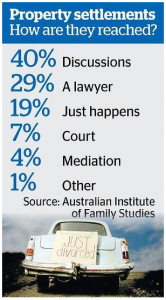
    Dr Kaspiew said parents across all income levels had generally sorted out their own affairs, with 39 per cent of settlements achieved through discussions and 18.8 per cent ‘just happening’ without specific action.

    A further 29.3 per cent were handled by a lawyer, 7.1 per cent went to court and 4.2 per cent went to mediation.

    AIFS-research

    AIFS Research Findings

    However, the involvement of lawyers rose as the assets in question rose in value.

    When assets were under $140,000, most cases were handled through discussion but once values rose above $140,000, more cases went to a lawyer.

    Dr Kaspiew said the study, the first large-scale, systematic analysis of property division in Australia for 13 years, had thrown up some interesting findings.

    Cohabiting or de facto couples were likely to have fewer assets than married couples, generally because de facto couples tended to be younger and have spent less time together and so had less time to accumulate assets.

    Dr Kaspiew said married couples’s higher wealth was also explained by their tending to come from higher socio-economic backgrounds.

    The report found mothers received substantially more assets in a settlement when they were caring for children most of the time and that the parent who left the family house tended to receive less.

    It also found fathers tended to over-estimate the share of property their ex-partner received, while both parents tended to underestimate their own share of a settlement.

     “Factors associated with reports of unfairness related to an individual’s eventual share of the settlement; who left the house; and whether they had experienced family violence,’’ Dr Qu said. “Debate about fairness also focused on people’s views of how much they had contributed to the relationship in financial terms, as well as the value placed on particular roles, such as the care of children.”

    The research surveyed parents of young children who were newly separated in 2008 and registered on a child support programs.

    It will be presented to the Australian Institute of Family Studies conference in Melbourne on Friday.

    The conference runs from July 30 to August 1.

    Couple Were Rorting Centrelink While Living in Lebanon

    centrelink-fraudIt seems that some people would go to any lengths to ensure they continue to receive the very generous social security benefits offered in Australia to young families.

    We have often heard the argument that many illegal immigrants are not fleeing against tyranny, but running towards a welfare system that is second to none in their eyes.

    Our welfare system seems to be leaving a long-lasting impression not only on illegal immigrants, but on those with Australian citizenship who have chosen to live abroad.

    In this case, we have a married couple who have chosen to live in Lebanon, but have frequented Australia for the birth of each of their children, solely it is claimed by the wife for the purpose of claiming a raft of family-based welfare payments.

    Two first cousins in an arranged­ marriage are being investigated for immigration and Centrelink fraud and rorting the baby bonus by returning to Australia from Lebanon for the births of some of their seven children.

    The woman, 33, told the Federal Circuit Court sitting in Parramatta her husband also had her return several times to Australia solely to update Centrelink­ details so she could continue to get social security.

    The family was receiving Family Tax benefits that in the last financial year totalled $25,265.74, despite three of their children having lived in Lebanon since 2009, Judge Joe Harman said.

    “On at least two occasions (the mother) returned to Australia for a brief period purely to allow the child then carried by (her) to be born in Australia and to then receive the baby bonus then operating,” the judge said.

    The case was before the court because the Australian-born mother is applying for the return of her three eldest children, aged 12, 10 and nine, from Lebanon and custody of all seven children.

    The others are aged seven, five, three and two. The eldest live with their father’s brother and paternal grandmother in a mountain village.

    The now-estranged couple wed in Lebanon in 2001 two weeks after meeting in an ­arranged marriage. They ­returned to Australia and lived for a time with their relatives — the woman’s sister is married to the man’s brother.

    The husband, 39, was ­granted citizenship in 2006 in circumstances which Judge Harman said troubled him since the couple had ­decided to live in Lebanon.

    “It is concerning (the man’s) evidence is his citizenship was granted in 2006 at the very time when, consistent with his evidence, he had formed the desire and intention to live permanently in Lebanon and to return to Australia … solely for the purpose of earning a greater income than was available to him in Lebanon, and returning the funds to Lebanon,” the judge said.

    “There would appear to be, at least potentially, some anomaly as regards the eligibility requirements for citizenship at the time the application was made … (and) whether it was obtained on the basis of full, frank and candid disclosure or otherwise.”

    He said he would refer the case to the Immigration and Human Services departments for investigation.

    The woman, who alleged her husband was violent ­toward her, was met at the airport by the Australian Federal Police when the pair returned to Australia in March.

    The judge refused the father permission to leave Australia and put him on the Airport Watch List until he has facilitated the return to Australia of the eldest children.

    The hearing resumes at the end of this month.

    In response to this case, some people have argued that our welfare system is an easy touch for scammers, even if they live far from Australia.

    This is a shocking demonstration of how low the bar is set for policing of our welfare system. It is fair to worry about the extent of welfare fraud when cases like this occur.