Sweeping changes to family court announced

family-courtThe Family Court and Federal Circuit Court will be combined as part of sweeping changes to the financially and emotionally crippling family law system, in an announcement by the Attorney-General Christian Porter today.

The decision comes before a broader review, which looks into the painstakingly slow way in which the nation’s strained family law system operates, delivers its findings next year.

The changes will come into effect from the beginning of 2019, in what the Federal Government is arguing will speed up the process of settling family disputes.

“We have two parallel courts, different rules, forms, procedures, individuals who are in the system get bounced around like Family Law footballs from one court to the other — terrible outcomes for them,” Mr Porter told the ABC’s AM program.

The Family Court currently hears family law cases involving complex financial arrangements, trusts, serious parenting arguments, allegations of child abuse in custody arrangements and protracted family disputes.

The Federal Circuit Court deals with the rest.

Appeals from the newly formed court, to be known as the Federal Circuit and Family Court of Australia (FCFCA), would also be heard by the Federal Court under the new arrangements.

Nearly a year-and-a-half wait to reach trial

Some 22,000 cases are filed across the two courts each year, and Mr Porter said delays in the family law system meant most cases were taking almost a year and a half just to reach trial.

He argued the merger was warranted given there is already significant crossover in jurisdiction and procedures of the two courts, and could result in an extra 8,000 cases being resolved each year.

“Twenty-two thousand matters are listed for final order in these courts every year, representing tens of thousands of Australians, and our priority is to get better outcomes for those Australians.”

Funding pressure, delays in appointing judges

It is unclear whether the changes will satisfy critics of the way the family law system, who argue funding pressures and delays in appointing judges to the bench are key reasons why the system is inefficient and struggling to cope with case loads.

Last year, the former Chief Justice of the Family Court demanded more funding.

The former attorney-general, George Brandis, announced a “long overdue” review of the family law system in September — the first since the dedicated court was established in the late 1970s.

The Australian Law Reform Commission is due to report back to the Government by March 2019.

Mr Porter defended making the announcement before those findings were delivered.

“It was a matter of such obviousness that the present structure was not working and was causing inefficiencies and duplications and delays that we considered that we could make the structural change,” he said.

Shadow attorney-general Mark Dreyfus cast doubt on the merit of the merger.

“We’ve got concerns about the near-complete lack of consultation that’s occurred here,” Mr Dreyfus told ABC Radio Melbourne.

“It appears that judges were not consulted, that family groups and the sector weren’t consulted, family lawyers were not consulted.

“And the Government has decided that this is somehow the result of inefficiencies in the court system.”

The current Chief Justice, John Pascoe, was appointed to the role last year after being the head of the Federal Circuit Court.

But he will be forced to retire by the end of the year, as he hits the statutory retirement age for judges.

One Nation leader Pauline Hanson has campaigned for changes to the family law system, including calling for the abolition of the Family Court altogether.

Can I See My Grandchildren if their Mother Says “No”?

grandparents-and-child-contactIt’s been 18 months since Anne last saw her grandchildren.

“They’re never far from my mind, in any situation,” she says.

The Brisbane woman had a falling out with their mother, her daughter, when the children were just a couple of years old.

Since then, Anne’s daughter has barred her from seeing the kids.

“My family was very important to me … and I spent a lot of my life as a lot of mums do making sure it went well for my children. And to find now that there’s disrespect and [a] break down in communication is difficult,” Anne said.

It’s a situation faced by many grandparents around Australia, who are cut off from their grandchildren through divorce of the parents, custody issues, or estrangements from their own adult child.

It can be a harrowing experience, but there are legal options available.

Anne’s story is all too familiar to family law specialist Sandra Kelly.

She hosts information sessions on the subject to grandparents at local libraries in the Moreton Bay region, north of Brisbane.

She said the Family Law Act acknowledges the importance of children having a relationship with their grandparents.

Ms Kelly said grandparents could use the act to apply to court for orders that their grandchildren live with or spend time with them.

It can be done whether the parents of the children are together or separated.

“Often that’s one of the things that’s said to me at my information sessions is, ‘I didn’t know I could do anything, I didn’t know it was my place’. And they absolutely can.”

Ms Kelly said the Family Law Act was very clear.

“The court recognises it’s vital for children to know where they come from.

“But pragmatically and practically it does require someone to take that quite aggressive step.”

Sandra said grandparents can make an application without having any prior contact [with the grandchild].

However, she said it could also be expensive and harrowing experience.

“I’ve had matters with grandparents that have gone to $90,000 to $100,000 in fees over five years where people have sold their boat … just everything,” she said.

Before a grandparent makes their own application to the court, they first must go through family dispute resolution conference or mediation.

“If you don’t get a resolution there, you can make an application to the court. Or you can try a couple of different attempts at family dispute resolution as well,” Ms Kelly said.

Ms Kelly said anyone needing legal advice could make an appointment with a family law solicitor, go to a legal community centre, or go to Legal Aid and see a solicitor.

What to do when mediation fails

Anne said she and her partner had tried mediation with their daughter through government-funded Relationships Australia, but it failed.

“We were given a certificate to say we’d tried for mediation, and that certificate was to last for 12 months as I recall if we wanted to go to court in that time,” she said.

After mediation failed, Anne said they chose not to go to court.

“We thought if we put our daughter through that process it’d be the last nail in the coffin if there was any hope of any reconciliation,” she said.

In addition to mediation they have written apologies, and sought out counselling for guidance on how to better relate to their daughter.

In this situation, Ms Kelly recommended trying again with a private mediator.

“It’s their training, it may be that it’s worth approaching a private mediator, asking them to send out an invitation. She may attend another interview and it could go differently for you.

“Private mediators … they’re not always lawyers but often they are and they’re family lawyers with lots of experience in that area.

“Solicitors engage private mediators all the time. You can also find them on online as well.

“There’s a lot of them around and they have very specific qualifications. And they’re very effective if you get a good one.”

She said it was worth seeking out a private mediator with a family dispute resolution practitioner qualification.

“They deal with children’s matters specifically … it’s an industry and university qualification.

“Some of them can be $1,000 a person, some are $6,000. Lots of barristers do it, it depends on what that particular mediator’s rates are.”

She said it was also possible to try again through Relationships Australia with another mediator.

Support important when fighting to see grandchildren

Another grandmother, Narelle, went through a similar situation to Anne.

But she’s come out the other end with a desirable outcome.

“My son separated from his partner [and] as a result of that the entire family was alienated. As a part of the court proceedings that my son was going through I put in a request for time and that was granted,” Narelle said.

“It was my son’s barrister that suggested that can be done. Otherwise I would’ve had no idea.”

Narelle said it was 18 months from when she last saw her grandchildren to when supervised visitations were granted.

“About eight months of that was being on a waiting list for supervised visitation during the court proceedings,” she said.

She said supervised contact at a supervision centre went well.

“It resulted in a much better outcome at the final court orders because I had reports done on how the children interacted with me,” she said.

These days Narelle enjoys unsupervised visits with her grandchildren.

Her advice for grandparents in similar situations? Get support.

“It’s a very difficult situation to be in and to follow through with the court. It’s definitely worth it,” she said.

“I had a lot of very good family support which was fantastic.”

Judge critical of barristers’ audacious ‘cancellation’ fees

barrister fees in family courtA family court judge has taken a swipe at barristers who charge cancellation fees after a case in which the mother clocked up almost $1 million in legal costs.

Justice Robert Benjamin said barristers should not claim “disappointment” fees because they have so much else to do.

“I have grave difficulty in endorsing, as fair and reasonable or proportionate, terms in fee agreements which provide for barristers to be paid for doing nothing,” he said in a recent judgment.

“Their work is not all appearance; it inevitably includes advising, conferences, preparation and research. There is little or no reason why these busy barristers cannot apply the time lost on other matters.”

The husband’s barrister charged $7000 a day, or $850 per hour (plus GST), in a fee agreement that allowed him to charge cancellation fees if the case settled or was adjourned.

Justice Benjamin said cancellation fees were “a very common provision in barristers’ fee agreements in family law, and perhaps more broadly” and should be reviewed by bar associations. He noted High Court judge James Edelman had refused a cancellation fee when he served on the WA Supreme Court.

He added the fees could be contrary to public policy as a barrier to settlement. “If a party knows he or she can save many thousands of dollars by settling, that circumstance may lead to that negotiated outcome,” the judge said. “If, on the other hand, the party has or will be liable to pay the barrister irrespective of the settlement, the cost-saving inducement is lost.”

Justice Benjamin said the husband, Mr Foley (a pseudonym), had “inflicted serious family violence on the children and on the wife”. After the police took out an apprehended violence order, he ordered his counsel to aggressively cross-examine the wife in court. He then pursued parenting orders for his 17-year-old daughter when she wanted nothing to do with him.

Out of kilter

The father’s behaviour was so bad during a custody hearing that the judge ordered him to pay his wife $359,712. It was two thirds of the wife’s “party to party” legal costs of $539,568.26 and wiped out the $338,000 in cash he was awarded in the property settlement. He must now pay his wife the difference, more than $21,000.

Justice Benjamin said costs were sometimes “out of kilter with the reasonable expectations of parties and the community to enable accessible justice.”

He noted the wife’s legal bill was $930,648.46: “This amounts to approximately $600,000 in solicitor costs, around $200,000 in barristers’ costs and the balance in joint expert fees, single expert fees, shadow expert fees, transcript fees, a proportion of the Independent Children’s Lawyer’s fees, a fee for bill of costs in relation to interim orders, searches and other disbursements.” The husband’s costs were much lower at $385,000, including $140,000 for his barrister.

However, the judge said the wife’s lawyers had helped track down funds.

“One example of this was the expenditure of money in Country U, which although a small sum was telling. The second was the purchase of a second boat without notice to the wife. The third was the extensive time the husband was absent from the business which, to some extent, explained the significant downturn in the business and enabled the husband to assert that the business’ value was far less than that asserted by the wife.”

He said the wife’s spousal maintenance application was “wholly unsuccessful”, as was the husband’s parenting application. It was a 65-35 property split in favour of the wife, with the husband keeping his business, superannuation, and $338,381.

She married me for a Visa – can you declare a marriage null & void in Australia?

Can a marriage be legal if your new wife or husband refuses to have sex with you – not just on the wedding night, but ever? Well, according to a number of recent cases, the answer is “No!”.

Disappointed husband tries to have marriage declared void on basis of fraud

The question arose in a Family Court case when a 68-year-old Tasmanian man described his new 31-year-old Filipina wife as a “classic mail-order bride” who refused to have sex with him. As soon as she got her marriage visa, she left him.

The man wanted the marriage declared void, as he believed the marriage was a scam to get her a residency visa as his wife. He argued that a section of the Marriage Act 1961 says a marriage is void when the consent of either party was obtained by fraud.

Judge finds that marriage was not invalid

Marriage AnnulmentHowever, the judge declared that fraud in the Act ­referred to things such as impersonation, where there is the ­appearance of consent, which in reality hasn’t been given

The fact that no sex occurred in the marriage was irrelevant, as Australian law does not require a marriage to be consummated to be valid. The judge ruled the marriage was not invalid, it was simply that the man’s expectations of the marriage had not been met.

Until the Family Law Act 1975, marriages could be voided if either party at the time of the marriage was of “unsound mind” or a “mental defective”, if one of them had venereal disease, or if the bride was pregnant by a man other than the husband.

Requirements for a man and a woman to be legally married

The Family Law Act ended all that. Under the law, to be legally married in Australia, you must:

  • not be married to someone else
  • not be marrying a parent, grandparent, child, grandchild, brother or sister
  • be at least 18 years old, unless a court has approved a marriage where one party is aged between 16 and 18 years old
  • understand what marriage means and freely consent to becoming husband and wife
  • use specific words during the ceremony
  • give written notice of their intention to marry to their authorised celebrant, within the required time frame

No fault needs to be attributed for divorce to be granted

Under the Family Law Act, all that is required for divorce is 12 months’ separation. Nobody has to be proved to be at fault for the marriage breakdown. It put many private detectives who used to tail suspect spouses for photographic evidence of extramarital dalliances out of business. They were probably the only ones who were sorry when the divorce laws changed.

However, some people from certain cultures or religions still feel that there is a stigma attached to divorce and may seek to have their marriage annulled or voided, so that in the eyes of the law it was invalid and never took place.

Decree of nullity can be granted by Family Court in certain circumstances

The Family Court can find grounds for a decree of nullity, which is an order saying there was no legal marriage between the parties even if a marriage ceremony took place, on the following grounds:

  • At the time the parties were married, one of them was married to someone else
  • The parties are in a prohibited relationship
  • The parties did not comply with the laws in relation to the marriage in the place they were married
  • Either party was not of a legal age to marry
  • Either of the parties did not give their real consent to the marriage because consent was obtained by duress or fraud, or one party was mistaken as to the identity of who they were marrying or the nature of the ceremony, or one party was mentally incapable of understanding the nature and the effect of the marriage ceremony

Insufficient reasons for declaring a marriage invalid

The Family Court says it will not declare a marriage invalid merely because it was not consummated, because the couple never lived together or because there was family violence or incompatibility.

In another case involving a claim for nullity of marriage, Hosking v Hosking, the husband claimed he was the victim of fraud after marrying a Chinese woman who really only wanted a residency visa.

The man claimed that he believed the woman would live with him as his wife, but the marriage was never consummated and she left him soon after getting her visa. Again, the application was dismissed, as the judge found that the bride had not committed fraud under the law in this case.

Decree of nullity not the same as divorce

It is important to know that a decree of nullity does not dissolve a marriage like a divorce. Nullity decrees are relatively rare. Between 2009 and 2012 there were 76 applications for nullity of marriage. Just 33 were granted, 22 were dismissed, eight withdrawn, 11 discontinued, and two were settled.

In other words, a same-sex marriage conducted overseas where it is legal is not recognised as legal in Australia. The same goes for all the other requirements relating to age, relatives and consent.

Evil ex-wife seeks to inherit deceased ex-husband’s fortune, despite years of false allegations

The Facts

They met in 1984, when he was a doctor and she was his patient. They had a daughter in 1986 and married in 1988, but the marriage lasted only 19 months.

Separation, divorce, property settlement and appeal

someone-who-hasnt-written-a-will-intestateThe couple officially divorced in 1995 and the Family Court made orders awarding the former wife $164,000, which equated to about 38% of the asset pool of the parties.

She appealed this decision, but the appeal was dismissed. She then phoned her former husband and threatened to “destroy his life” and “make his life a misery” if he did not pay her an additional sum.

Ex-wife proceeds to carry out threats

She carried out her threats in a campaign of what the court described as “relentless hostility” and “relentless persecution” of her ex-husband, taking professional disciplinary action against him, applying for reviews of child support, initiating legal action against him for damages and refusing to allow him to see his daughter.

In addition, she complained to police and sought an apprehended violence order against her ex-husband. Those proceedings were dismissed. The ex-wife also alleged that her husband had sexually abused their daughter. The husband was interviewed by police at that time and no further action was taken.

Man dies intestate

In 2014 he died intestate, that is, without a valid will. He had only been married once and their daughter was his only child. While the man had instructed his lawyers to draw up a will, he had never executed it.

The draft will set out his reasons for not leaving anything to his ex-wife, among them that she made “many and false allegations against me which were proved groundless and made a false complaint against me to the police alleging that I had sexually abused my daughter and these allegations have caused me great distress”.

Former spouse makes claim on late ex-husband’s estate 25 years after separation

Under the laws of intestacy, the deceased’s daughter was entitled to the whole of his estate, which was worth approximately $5 million. The daughter was estranged from her mother when her father died and her mother demanded that part of the estate be distributed to her. She claimed she required funds to purchase a property to live in and for future medical costs. At the time of trial she was unemployed and relied upon a disability support pension.

The case for the ex-wife

  • My ex-husband was able to accumulate the wealth he did precisely because I did all the caring for our daughter after our divorce. The breakup also had long lasting consequences for me that further reduced my ability to generate wealth.
  • My ex-husband understated his income in the Family Court proceedings, which amounts to fraud, suppression of evidence and/or non-disclosure. I would have received a much larger settlement if he had told the truth.
  • My ex-husband had an obligation to leave me a share of the estate to atone for his professional misconduct in engaging in an improper sexual relationship with me while he was my physician, causing me psychiatric injury.
  • I have significant health problems and substantial financial need. It’s unfair that my daughter should get everything when I was the one who raised her on my own.
  • For all these reasons my ex-husband had a moral obligation to provide for me. His estate is ample and warrants provision being made for me.

The case for the daughter as administratrix of the estate

  • Following separation and divorce, my parents never resumed their relationship and neither was dependent on the other.
  • My father was wealthy because of prudent decisions and many years of hard work, whereas my mother’s financial predicament is due to her spending vast sums on unsuccessful litigation and making poor lifestyle choices.
  • If my mother genuinely believed that my father had understated his income in the Family Court proceedings or that she had rights against him for psychiatric injury, there were legal avenues available to her that she could have taken while he was alive, but she did not do this.
  • My father had always complied meticulously with his obligations to provide financial support for me, despite my mother’s persecution of him by all imaginable means.
  • My father had no further obligation, moral or otherwise, to provide for his ex-wife after their divorce was finalised by the court.

So, which case won?

Well, initially, the ex-wife did in fact win, as unpalatable as that may sound. But on appeal?

First instance decision awards ex-wife 0,000 plus costs

At first instance, in the case Lodin v Lodin; Estate of Dr Mohammad Masoud Lodin [2017] NSWSC 10, the ex-wife was awarded $750,000 plus costs. Even though there had been a property settlement between the parties following their separation, the court found there were factors that warranted the making of the former spouse’s application.

The ex-wife had substantial financial need. Following the property settlement, the ex-wife had struggled, while the deceased had prospered. He had accumulated significant assets which greatly exceeded those at the time of the property settlement.

Ex-wife’s care of their child facilitated accumulation of wealth by deceased

The deceased’s ability to accumulate wealth was facilitated by his ex-wife’s assumption of responsibility for the care of their child (who was not quite six years of age at the time), until she became independent at the age of twenty-one.

The court also took into account the fact that the break-up of the marriage had unusual and long-lasting consequences for the ex-wife.

Noting that there was “something unbecoming” about an arrangement which would leave the ex-wife in financial need, reliant on a social security pension, while the daughter whom she raised would inherit in excess of $5 million, the court decided that the deceased’s estate was ample and this warranted provision being made for his ex-wife.

Court of Appeal overturns Supreme Court decision

In the case Lodin v Lodin [2017] NSWCA 327, the estate of Dr Lodin appealed the Supreme Court decision on several grounds, among them that the decision was “so divorced from reality, so unrepresentative of community standards or expectation, and so totally inconsistent with the objects and principles of family provision legislation as to be wrong and thus deserving of appellate correction.”

The court allowed the appeal and dismissed the proceedings by the ex-wife. An order was made for the former wife to pay her daughter’s costs.

Deceased had no moral obligation to leave anything to ex-wife in will

The court found the difficulty with the decision at first instance is that it presumed the deceased had a moral responsibility to make testamentary provision for his former wife because his estate was significant and the sole beneficiary of his estate, being his daughter, was a member of the deceased’s family for whom the former wife had had responsibility.

According to the Court of Appeal, the fact that the deceased’s former wife was responsible for raising their child did not create any social, domestic or moral obligation for the deceased to make testamentary provision for her.

Another factor which the court took into account was the fact that the ex-wife had made serious allegations against the deceased which were not upheld.

The financial position between the deceased and the former wife had been determined by Family Law Court orders made in 1992 and the deceased had always complied with his obligations to provide financial support for his daughter. The former wife’s financial need, medical problems, inability to support herself and poor relationships with others were not in any way related to the conduct of the deceased or her relationship with him.

Harry and Meghan: What are the chances this royal couple will one day divorce?

The royal wedding has already generated thousands of glowing media stories – but what are the chances that the fairytale romance between Meghan Markle and Prince Harry will end in a debacle or even just fizzle out.

Harry and MeghanRoyals

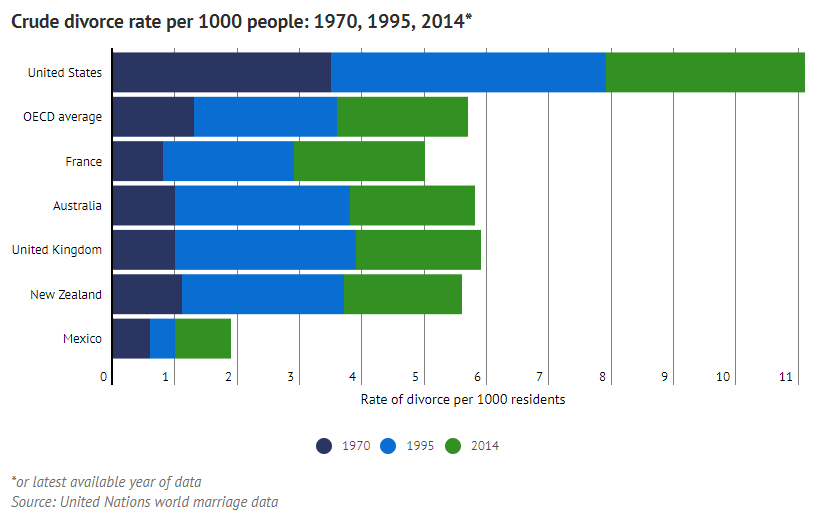
Ms Markle carries the burden of being American (divorce rates are higher in the US than Britain), a celebrity (record holders for divorce are famous) and it’s her second marriage (she was hitched to film producer Trevor Engelson) which are also more likely to end in divorce.

Other pointers against the happily ever after ending include research that shows people who spend $20,000 or more on a wedding triple their chances to end up divorced compared to those commoners who celebrate more modestly.

Crude divorce rate per 1000 people: 1970, 1995, 2014*

Prince Harry, 33 and Ms Markle 36, both children of divorced parents, are relatively young to be married in England where the average (mean) age for men to get married in 2015 is 37 and a half, while for women its 35.

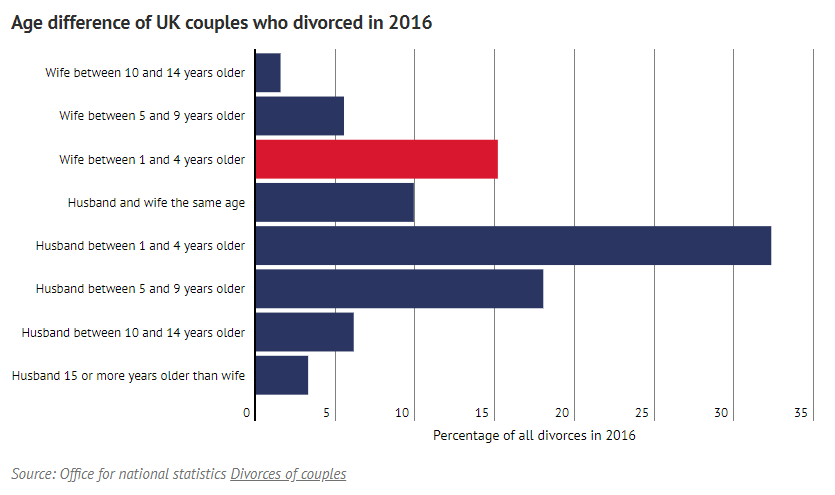
However, some research suggests that past the age of 32, the odds of divorce increase five per cent per year. And the age difference between the pair is a factor too.

Age difference of UK couples who divorced in 2016

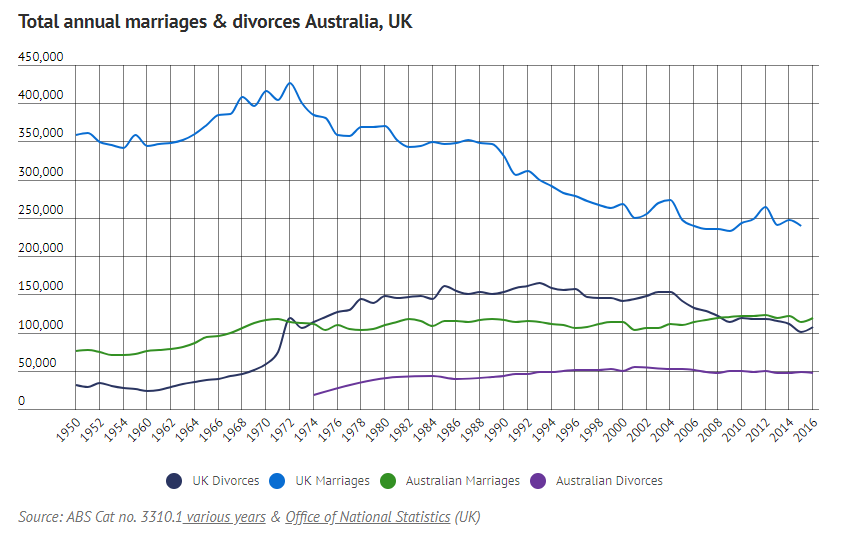
The rate of opposite-sex couples breaking up increased 4.7 per cent in Britain in 2016 with a total of 106,959 separations. However, that 2016 rate was more than 20 per cent lower than the peak in 2003. Unfortunately for Prince Harry, women in their thirties were the group most looking to get out of marriages while among men those aged 45 to 49 were leaving most.Total annual marriages & divorces Australia, UK

To balance this story with nice news from Australia, men and women are getting married later but staying married longer, as the number of divorces declines. Marriages that ended in 2015 lasted on average 12.1 years, compared with 11 years in 1995.

More hope comes from UK Office for National Statistics vital statistics outputs branch spokeswoman Nicola Haines who said despite the overall decline in people getting hitched, marriage at older ages was on the rise in 2016, so a second chance of marriage is increasingly on the cards.

The number of weddings increased for men aged 50 and over plus women aged 35 to 39 years or 45 and over were tying the knot more often, she said.

Important Financial Checklist for those about to Marry again

kylie parker

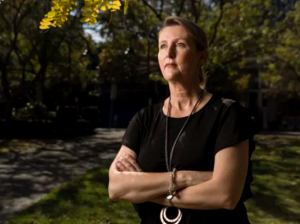
Kylie Parker and her intended husband will redraw their wills to protect their children from previous marriages.
Photo: Brook Mitchell

For chartered accountant Kylie Parker, who is about the embark on her third marriage, making sure there is a record of what is brought into the union is top-of-mind.

“We’ve both been through divorces, and we both know where we are at and we are hoping this takes us out to end of our lives,” says the 45-year-old Sydneysider.

She trusts her husband-to-be, who is also a trained accountant, also has two children and is tying the knot for the second time, but they are bringing significant assets in the marriage.

“We have started a spreadsheet listing the assets we are bringing into the marriage,” she says.

As they are in process of buying a house together, they will be taking out life insurance with each other as beneficiaries to cover the mortgage if the unthinkable should happen.

Kylie and her intended will redraw their wills to make sure their children are protected if either dies and the surviving partner enters into another relationship.

Kylie has written a book, Planning Plan B, which is a guide on how to deal with life’s most stressful events, of which divorce, as she can attest, is among the most stressful.

“It’s a practical guide to the big stressful events so that you can cope with the emotional side,” Kylie says.

A modern family relationship can be complex and if one of the partners was to die without a valid will, there’s good chance that your estate would not be divided up in the way you would have liked.

Experts say it is not only important for those, particularly those getting married for a second time, but also for those in de facto relationships, to make a will and estate plan that includes a power of attorney.

Emma Woolley, a lawyer and partner with Hall & Wilcox Private Clients, says it is hard enough for those with fairly straightforward affairs to contemplate their own death and to make plans, let alone for those who relationships are more complex.

However, there is much less likelihood of misunderstandings and disputes if you make those decisions at an early stage of the relationship so that if something happens, the respective children will be looked after, she says.

Emma Woolley recalls a case involving a terminally-ill man in a second relationship, with adult children from his first relationship.

Heads in the sand

“He had put his head in the sand and didn’t do anything in relation to his super and that resulted in a dispute between his children and his partner that ended-up costing both sides tens of thousands of dollars in legal fees,” Emma Woolley says.

“If he had taken the admittedly difficult step of trying to decide what to do about it, that could have been avoided,” she says.

Communication with family members about your intentions is key, Emma Woolley says. “You don’t have to talk numbers but you should be telling them what you are doing so that they know,” she says.

If you say what will happen when the person dies no one will be surprised about the contents of the will, she says.

It’s surprise plus grief that can lead to disputation and litigation, she says.

De facto relationships

It is generally believed that there is no differences in law between married and de facto couples. And that’s right, up to a point.

For example, under the law, a de facto couple who lives together for at least two years has the same rights as married couples with respect to property settlements.

However, those in de facto relationships who don’t have a will and estate plan can be treated differently, says Anna Hacker, national manager of estate planning at Australian Unity Trustees.

If there was to be a dispute about the care of one of the partners in a de facto relationship, it is not automatic under the law that the partner is considered next-of-kin and able to make decisions for the incapacitated partner or, if the partner was to die, that the surviving partner is next-of-kin.

Anna Hacker says it could be that friends of the de facto couple could be asked to sign affidavits stating the two really are a couple.

However, marriage automatically establishes these rights, she says.

Keep up to date

Kevin Smith, a financial planner at Ipac South Australia, says it is important to keep wills up to date as circumstances change.

Marriage generally revokes wills automatically, unless made in contemplation of the marriage.

“I had a client who had retired and left his partner 10 years earlier,” he says.

“The client was diagnosed with a brain tumour and had complications because of this,” Smith says.

“When he re-read his will, he was leaving a multimillion-dollar estate to his ex-partner who he had nothing to do with for more than 10 years,” he says.

Smith says it is also important to document as much a possible. And that includes any gifts or loans to adult children.

That is not only to make it clear to your partner what money is going to your kids but to make it clear what is the basis upon which the money was given and what would happen is your child’s relationship was to end.

“If your son or daughter moves in with someone and then they separate you can make sure that the money is not part of any division of assets,” Smith says.

Don’t forget super

Timothy Morton, an associate director of family and estate lawyers Farrar Gesini Dunn, says as superannuation is not part of the estate, sometimes it can be overlooked.

Some super funds revoke the binding death benefit nomination made by the fund member, the nomination that says who gets the money when the fund member marries.

The binding nominations of large funds lapse after three years.

However, some large super funds have recently introduced “non-lapsing” nominations, but there’s some doubt as to whether these would be legally binding on the super funds, Morton says.

Financial agreements

Lawyers agree that binding financial agreements can be a good tool, particularly for those entering another relationship, where they are bringing assets in the relationship.

Binding financial agreements, also known as prenuptial agreements, can be drawn up during the course of a relationship, not just as the start.

They can state what happens with the assets if the relationship ends.

They can be a good tool to give more clarity on where children from previous relationships stand. To be valid, each partner has to get independent legal advice.

Judge slams agency after ‘flimsy’ claims see child removed from carer

removal-of-children

A judge has slammed the actions of a government-contracted welfare agency as “shoddy” and “shameful” in removing a six-year-old girl from her foster carer on the flimsy claims of her mischievous older brothers.

In an extraordinary abuse of due process, the agency acting on behalf of the Department of Family and Community Services shunned the advice of the NSW Ombudsman in acting on a “deeply flawed” probe in which investigators cut corners to save money.

As a result of the children’s removal, the NSW Children’s Guardian cancelled the innocent woman’s working with children clearance.

Meanwhile, the embattled carer sold treasured belongings to fund an expensive, drawn-out legal quest to have the child returned.

The woman is an assistant nurse who has been the primary carer for the girl since she was 10 days old, and has cared for the boys for several years.

The agency – its name suppressed to protect the children’s identities – is a significant care provider in NSW.

Following a number of separate legal matters, the woman argued for the child’s return in Children’s Court proceedings, which were the subject of a successful appeal in December 2017.

She has spent more than $100,000 in legal fees to win back the child but was only able to recoup a meagre $23,000 in costs after winning the appeal.

In his scathing March 29 judgment awarding the carer costs, NSW District Court Judge Leonard Levy SC described her treatment as “unfair and unjust” and urged FaCS to pay her extra money in a show of good faith.

“The underlying investigation was flawed and unbalanced,” he said.

The removal of the children occurred against the backdrop of a 2013 claim of abuse made by at least one of the brothers, who was known to have behavioural difficulties and lie when in trouble.

It was investigated by the agency and found to be unproven.

On August 31, 2015, the two brothers made more claims of ill treatment, and all three children were removed from the woman’s care pending the outcome of the fresh probe.

The children were then permanently relocated “after more than six years of continuous care by the appellant, and as a consequence of what I have found on appeal to have been a deeply flawed care agency investigation report”, Judge Levy said.

The court heard the agency ignored a list of witnesses put forward by the woman because of the travel costs involved in interviewing them, producing a one-sided report that “amounted to little more than a list of concerns”.

“It is one thing for the care agency to have so glaringly abrogated its investigatory responsibilities by deciding not to take statements from witnesses who would have potentially exculpated the appellant.

“The investigator explained that circumstance on the shameful grounds that his manager had decided the cost of pursuing further investigations contradicted that course,” Judge Levy said.

When the Ombudsman raised concerns over the probe, the agency blatantly disregarded the advice of the independent arbiter.

In a shocking turnaround, FaCS eventually conceded the investigation report was “borderline worthless because of the fundamental failure to afford procedural fairness”.

The woman sold her car, jewellery, furniture, borrowed money from her son and moved into her daughter’s home to conserve her wages to fund the legal battle.

Her lawyers also greatly discounted their legal bills.

During the appeal lawyers for FaCS said the child was comfortable in her new home.

They also accused the woman of being difficult with professionals and claimed there were still question marks over the unproven abuse claims.

“The ‘question marks’ that arose were shown on appeal to be, if not baseless, then so unfair, as to be unreliable, due to the underlying shoddy nature of the care agency investigation,” Judge Levy said.

In his findings, he said many of the claims against the carer amounted to “unsubstantiated whispers” and described her as a “robust advocate for the child’s needs when dealing with teachers and health care workers”.

A new care plan reinstating the child with the carer was approved this year.

How to stop elder financial abuse in your family

the-rise-in-elder-abuseEWith the increasing proportion of people aged 65 and over, the problem of elder financial abuse is a growing concern.

While the full extent in Australia is unknown, conservative estimates suggest at least 10 per cent of older Australians suffer from financial abuse each year. The surprising factor is that their adult children are most likely the perpetrators.

If an older person needs some cash and can’t get out to a bank, why wouldn’t they just give their ATM card to their son or daughter and ask them to make a withdrawal on their behalf? Or if they need some shopping, they think it natural to give some money to a son or daughter and ask them to pick up a few extra groceries.

While most of us have the moral compass to know that  taking out extra cash or adding a few of our own groceries to the list without either asking or paying for it ourselves  is akin to stealing, there are many elder law specialists who know that these and other (much bolder) acts of elder financial abuse are  being carried out by some of the most trusted individuals and organisations.

Property is being transferred from a parent to a child on a promise that mum or dad will live in the house and be properly cared for. Bank accounts are being fleeced of thousands of dollars as trusted people with access – legally or otherwise – help themselves. Parents are being moved into aged care on the understanding that family will continue to care for them financially.

Because of the hidden nature of the problem, very few cases are reported. Often the truth is not revealed until relationships break down or death.

Briony Dow of the National Ageing Research Institute and the University of Melbourne says that when adult children abuse their parents, feelings of parental love and responsibility coupled with shame and guilt for having “failed” as a parent often stop the parent from seeking help and protecting themselves. Few parents would want to report their son or daughter to the police.

Power of attorney problem

Brian Herd, a Brisbane lawyer with CRH Law who specialises in elder abuse cases, believes the under-reporting of elder financial abuse is made worse (and even legitimised) through the appointment of the power of attorney.

By appointing an adult child as power of attorney (thereby giving them the authority to act for you in specified or all legal or financial matters), money withdrawals or property transfers by that person can be lawful.

People in these situations can be the victim of abuse, and they can also be the victim of undue influence where they end up making decisions to satisfy their children.

Enduring powers of attorney, which take effect once a person loses capacity, are the “wild west” says Herd.

An individual acting as the enduring power of attorney is under no obligation to report to anyone or tell anyone what he or she is up to.

Jessica Barker, a solicitor with Elringtons Lawyers says it is often where parents appoint their children to be their attorney and/or guardian that there is confusion around whether an attorney is acting in the parent’s best interest – despite there being clear guidelines available.

Barker was recently contacted by an adult child attorney saying: “I’ve got power of attorney for mum and my sisters are telling me I should put mum’s house into us kids’ name because she doesn’t need it anymore. Is that right?”

Unfortunately, the rise of the “inheritance impatience syndrome” seems to be increasing the confusion that some adult children are experiencing about how best to act as their parent’s attorney, she says.

A common situation for a solicitor is to be called into a hospital to see someone who is on their deathbed and asked to draw up a power of attorney document so their financial affairs can be managed while they are bedridden and beyond.

There is often some urgency in these situations and a whole lot of issues need addressing – such as whether an attorney has previously been appointed, whether the person has capacity and ability to understand the nature of the document, the person’s relationship with their chosen attorney(s), advising on the person’s rights and responsibilities and the risks involved in making the appointment.

Aged care rush

There is similar pressure when someone needs to go into residential aged care. Power of attorney documents are often downloaded hurriedly from the internet or arranged through solicitors, only to create further issues down the track.

At the very least, once it has your signature on it, this important document provides that nominated person with instant access to your bank accounts. The enduring power of attorney document also hands over the “power” for them to sell your house or shares or any other assets.

Of course, the widespread use of electronic banking means the signatures may never be seen.

Trusted professional third parties – including banks, financial institutions and real estate agents – may unwittingly assist a perpetrator of elder financial abuse.

It is in their best interest to establish clear guidelines around the detection of financial abuse and what to do about it – as many have already done.

The SMSF Association (with 47 per cent of its members aged 60 or older) supports a recommendation from the Australian Law Reform Commission to change the superannuation laws to ensure that trustees plan for the loss of capacity to an SMSF trustee as part of the fund’s investment strategy and that the Australian Tax Office is told when an individual becomes an SMSF trustee through an enduring power of attorney.

Herd says an increasing number of aged care facilities are presenting to a tribunal on behalf of residents to revoke a power of attorney following concerns about whose interests are being served through action taken by adult children.

What to do

The issue of where to report suspected abuse is another grey area.

If a person has lost capacity and you suspect abuse, then the relevant public guardian in your state or territory may be able to step in. You could go to the police but they could easily dismiss it as a family or civil matter.

A third option is to apply to the relevant tribunal in your jurisdiction to have an attorney sacked.

Jessica Latimer, a principal lawyer and elder law specialist with Slater and Gordon Lawyers, says that while criminalising an abuse offence through the introduction of an elder abuse act may make it easier to prosecute someone, currently the legal system is able to respond and help older people recover financial losses.

As well as mediation there are state and territory property laws, power of attorney acts, claims for breach of fiduciary duties and breach of contract claims, which can all help.

Obviously it is far better to protect someone at the front end than chase down the perpetrators at the back end through a court.

Which brings us back to relying on the good nature of human beings and trust. If it looks like a rat and smells like a rat – it probably is a rat!