A Guide to Child Support Non Agency Payments

FLWG Logo

In my blog site at the Family Law Web Guide  I wrote recently on the confusion surrounding what ‘other’ payments can be accepted by Child Support where a payer (usually a father) is paying child support to a payee (usually a mother) and where the payee does not agree that the payment made by the payer is for the support of the child(ren) or in other words…  is paid as child support.

Where parents agree there is no problem and anything is possible. HOWEVER in the main most people when it comes to money matters don’t agree. Certainly those that are separating and come to the Family Law Web Guide often never agree that the sun has risen on a  new day and so it is with Child Support.

Firstly some good news and some bad news.

The good news is that yes you can claim some types of expenses that are paid in lieu of child support and some of those are of a type that does not require the other parent to agree they were in lieu of Child Support.

The bad news is, that the payer has to have less than 14% care of all of the children and meet other requirements set out below.

The legislation also provides for prescribed payments under section 71C. If the payment was of a kind specified in regulation 5D (known as a ‘prescribed payment’) the Registrar can credit the payment up to a maximum amount that is equal to 30% of the amount payable under the payer’s liability for the period only if:

  • -the payer of an enforceable maintenance liability in relation to a payment period or initial period has made one or more payments to the payee of the liability, or to another person; and
  • -the payment is a payment of the kind specified in regulation 5D; and
  • -the sum of those payments exceeds the sum of all such payments previously credited under this section against the liability for all past periods; and
  • -at the time the payment was made the payer has less than 14% care of all of the children to whom the relevant administrative assessment relates; and
  • -at the time the payment was made the child support liability was not being fully or partially met by a lump sum credit (sections 69A, 71C(2) and 71C(5)(b)); and
  • -the liability is not a parentage overpayment order or spousal and de facto maintenance order (section 71C(5)(a)), or a registrable overseas maintenance liability (section 71C(6)).

We are seeing a number of things going on here.

Payees are running Change of Assessment applications and have been ensuring the Payer does not get 14%, but gets 15% time allocated.  One would be presumptuous to assume a payee is aware of the 14% rule.

The claims able to be made also include Mortgage Payments (See the drop down list in the on line Child Support payments gateway on MyGov )
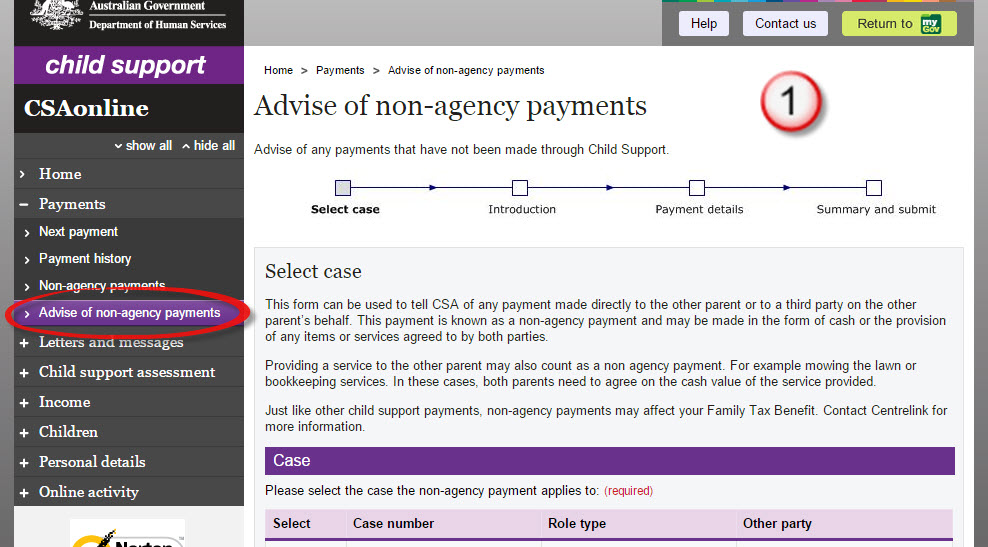
CSA Online, Child Support Agency

Prescribed non-agency payments

The Registrar can credit certain payments towards a payer’s child support liability regardless of the intention of the parents at the time the payment was made (section 71C), except if:

  • -the liability is an overseas maintenance liability (section 71C(6)); or
  • -the liability is a parentage overpayment order, or for spousal or de facto maintenance (section 71C(5)(a)); or
  • -at the time the payment was made the payer had at least regular care of any of the children to whom the relevant administrative assessment relates; or
  • -at the time the payment was made the child support liability was being fully or partially met by a lump sum credit (Refer to 5.3.3 Crediting Lump Sum Payments)

Credit can be given up to a maximum of 30% of the ongoing liability, provided:

  • -the balance of child support is paid as it becomes due and payable;
  • -the payer has less than 14% care of all of the children to whom the relevant administrative assessment relates at the time the credit is being applied (section 71C(1)(d); and
  • -the child support liability is not already being met by a lump sum credit.

The balance can be paid in cash or in the form of a non-agency payment credited under s71 or s71A, or from money credited from another source such as a tax refund or payment from a third party.

The Registrar can only credit amounts paid on or after 1 July 1999.

The types of payments that can be credited in this way are listed or ‘prescribed’ by regulation (regulation 5D). They are:

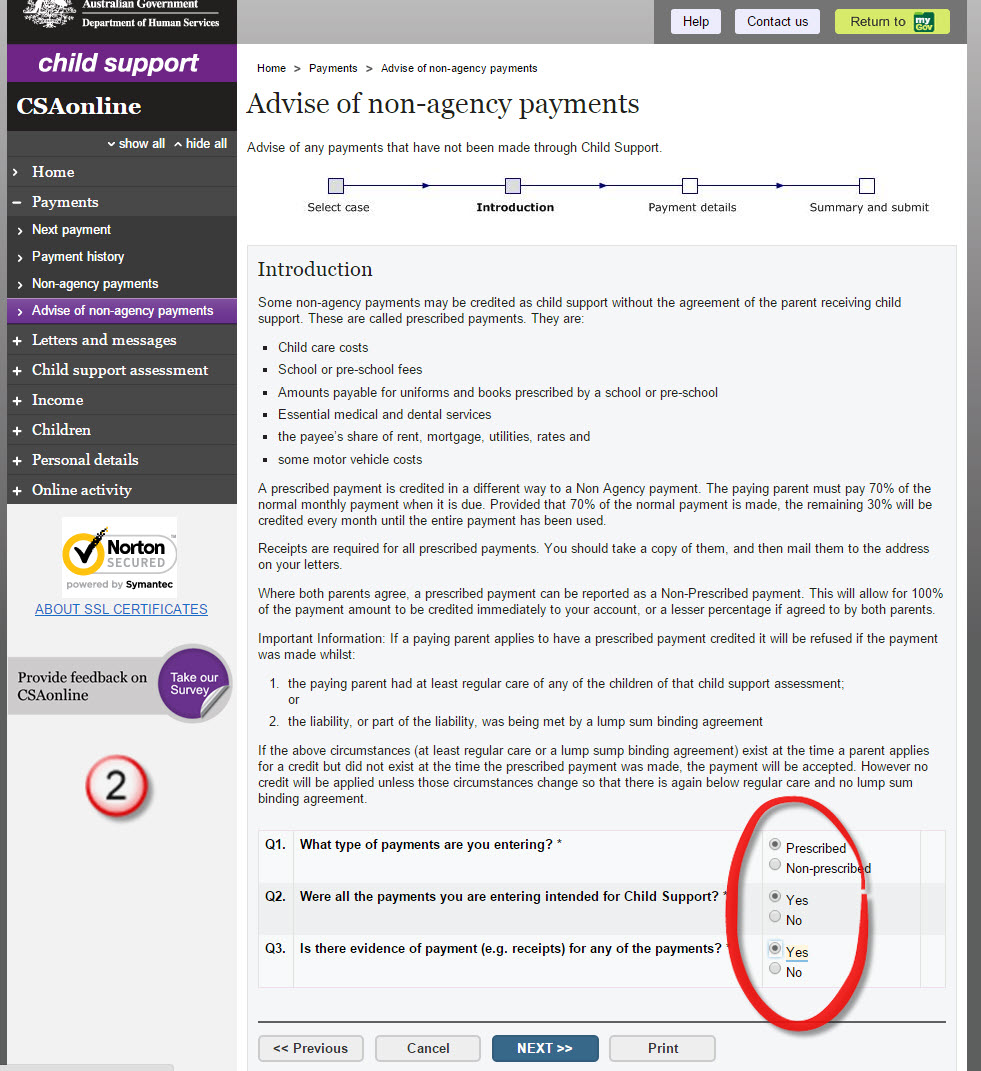
CSA Online screen 2

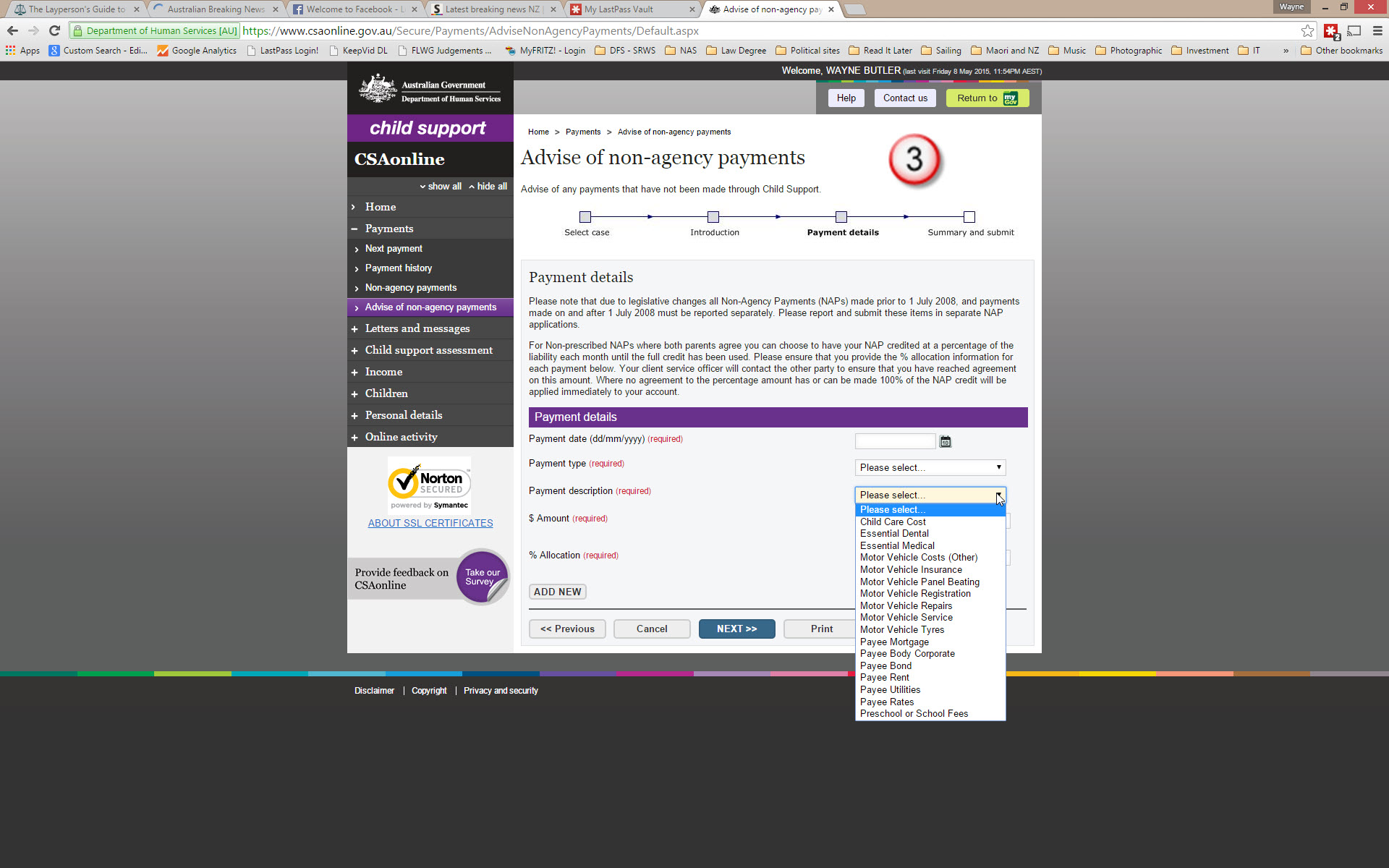
I note that the descriptions are much wider in the drop down lists than in the published material through the Guide. I can only assume that the list represents the sort of claims being made and those additional items that are not in the prescribed Non Agency Payments list are agreed Non Agency Payments. That is something we need to look further into.

For example:

  • -Child Care cost
  • -Essential dental
  • -Essential Medical
  • -Motor Vehicle Costs (Other)
  • -Motor Vehicle Insurance
  • -Motor Vehicle Panel Beating
  • -Motor Vehicle Registration
  • -Motor Vehicle Repairs
  • -Motor Vehicle Service
  • -Motor Vehicle Tyres
  • -Payee Mortgage
  • -Payee Body Corporate
  • -Payee Bond
  • -Payee Rent
  • -Payee Utilities
  • -Payee Rates.

My view has always been that these sorts of payments should be able to be credited as Prescribed Non Agency payments regardless of the level of care. That is, it does not matter if you have 10%, 14% or 40% care. If a payer wants to make a prescribed payment directly to an establishment for the purposes of Child Support then they should be able to do so. It is all about empowering parents to contribute to Child Support.

Those parents that pay for something that is tangible and can be seen as benefiting the child(ren) directly are empowered and far more engaged than those who pour money into a bottomless pit that is never accounted for, and where the other parent, in a number of cases has spent the child support money on other than the child(ren).

I will be writing further in my next blog about Superannuation and the trap for those between 60 and 65 who get excited about setting up a TAP. My hint until next time is that if you are in the Child Support system then avoid at any cost setting up a Transition to Retirement plan. As well we will address the issues of Redundancy and Self employed in the fullness of time. All of these subjects are dear to our heart and have many forum topics raised in our forums here.

Just to finish off here are some screen shots from the Prescribed non-agency payments to help navigate your way in making applications.

Key takeouts here are:

< 14% care (Less than 14% care)
Prescribed = where the other parent doesn’t agree

Non Agency Payments can be agreed or Prescribed Non Agency Payments NOT agreed between the parents.
CSA Online screen 3

CSA Online screen 3

Related Family Law Judgments

Divorce filing fees set for Significant Rise

family-court-of-australia

Divorce is not only messy for families, but it can also bankrupt them. Recent budget papers reveal that the government is planning massive hikes in Family Law fees, which would raise at least $90 million in revenues.

Unbeknown to many, the Federal Government has been preparing to jack up court fees from July 1, raising the cost of filing for divorce in the Federal Circuit Court of Australia from $845 to $1195.

Senior associate Amy Honan said some people were rushing to exit unhappy marriages before the price rose.

“When I’ve advised clients of the increase of the fee from 1 July 2015 they’ve taken that opportunity to instruct me to file their application urgently,” she said.

But Women’s Legal Service co-ordinator Rosslyn Monro said the increase was a “disincentive” to divorce for some and was especially concerning for women escaping family ­violence.

She said some victims had to save up in secret while planning their escape from an abusive relationship to make sure they could look after themselves and their children.

Increased court fees made it harder, especially for women who had to quit their jobs to flee to safety, she said.

“I think particularly for the kinds of clients we see, increasing filing fees are a disincentive,” Ms Monro said. She said being able to get a divorce and put parenting plans in place through the Family Court was often needed to help people move on with their lives.

As well as the divorce filing fee, an application for consent orders — used in parenting and property matters — rises from $155 to $235, and filing a subpoena to require someone to give evidence jumps from $55 to $120. People who can demonstrate hardship can be granted a reduced fee of $280 to file for divorce.

The fee rises will raise $87 million over the next four years, with $22.5 million of that to be injected back into the courts.

In addition, the Government has committed $30 million for maintenance work to court buildings.

A spokesman for the ­Attorney-General, George Brandis,  said fees only raised a third of the cost of running the courts, so taxpayers were still heavily subsidising services.

“The 2015 Budget included measures critical to ensuring that the courts are placed on a sustainable funding footing and to meeting the streamline savings election commitment.”

Mr McConnel, from the the Law Council of Australia, has said that the fee rises were a “heavy blow to access to justice” and called for the changes to be reversed.

“Many people on middle to low incomes may now find it simply too expensive to enforce their rights through the courts, which will undermine the rule of law and the proper administration of justice,” he said.

Fake Couples who Marry for Visa Targetted

fake-marriage-weddingNon-genuine couples who have orchestrated “fake marriages” to gain Australian visas and then claim separate welfare cheques will be stripped of entitlements as part of a nationwide crackdown to be announced by the Federal Government today.

Thousands of people have potentially declared sponsorship of a partner for immigration purposes but are then claiming single welfare payments because they are not together.

The Daily Telegraph has learned taxpayers were milked $132.7 million last year in welfare payments that were fraudulent.

Immigration Minister Peter Dutton and Human Services Minister Marise Payne will today announce a new data matching system which will find couples who claim to be either married or in a de facto relationship but are providing separate departments with different information.

Legitimate couples, who are happily married, but claim to have split so they can earn more money from separate payments will also be targeted.

Australia’s welfare bill is expected to balloon by close to $40 billion over the forward estimates, from $150 billion to almost $190 billion.

Mr Dutton confirmed “contrived marriages” were on the rise.

“Last year, my department identified an increase in the number of allegations relating to the facilitating of contrived marriages,” he said.

“This data-matching program is part of a whole-of-government approach to fraud detection and prevention. People who deliberately take advantage of Australia’s welfare and migration system will be caught.’’

Those found to have defrauded the system face losing their visa, being forced to pay back the money and criminal charges.

Mr Dutton said visas obtained through fraudulent relationships cost taxpayers significant amounts of money and blocked genuine people from being granted a spot in Australia.

Senator Payne said some legitimate couples had worked out they are financially better off to pretend they have split, yet remain a couple.

“People who receive a Centrelink payment and deliberately fail to declare their correct relationship status to the Department of Human Services are breaking the law,’’ she said.

“The Government is committed to protecting taxpayers’ money and the integrity of Australia’s social security system by ensuring people receive the right payment at the right time.’’

The announcement comes after the government yesterday confirmed yesterday a senior Australian Federal Police officer will be hired to head a crack welfare taskforce to identify fraud.

Last year the government cracked down on the $16 billion Disability Support Pension rort, ordering new applicants to see a Commonwealth appointed doctor to determine if they were eligible for the welfare.

Prime Minister Tony Abbott said the government was committed to cracking down on welfare cheats.

Eight out of 10 Australian taxpayers are needed just to cover the national welfare bill. The partner visa data-matching program will begin next month and initially run for a year.

Parramatta Family Court Overwhelmed with Blowout in Cases

family-court-of-australiaA judge hearing family law cases has slammed a 600 per cent blowout in Western Sydney court lists that have left children at the centre of ­custody cases at risk and his colleagues distressed.

Judge Joe Harman said he has 700 cases on the go at once and that even regularly sitting eight to 10 hours a day in the Federal Circuit Court could not address the “tsunami” of work the Parramatta judges have to deal with.

In a damning indictment of the overstretched resources, he said some children may look back and judge the court harshly for their treatment.

“Delays in determination of … most other parenting cases before the court will disadvantage and poorly serve the interests of children — the future of our society,” he said, using judgments in two custody cases handed down last month to call for more resources.

He likened sitting on the court, which now deals with 85 per cent of the cases once heard by the Family Court, to a doctor in an emergency ward.

“This situation is, for the judges of this court, analogous to a doctor operating upon a patient in a busy emergency room with the known certainty that two more patients will bleed out and die in the corridor while working on this patient and knowing full well that with more resources, two more sets of hands, no life need have been lost,” Judge Harman said.

The Parramatta court has been under pressure with one of its five judges on extended leave pending his retirement while the Family and Federal Circuit Courts are in line for budget cuts of up to $30 million.

Judge Harman said the court lists for the rest of 2015 were already full and “there are far too many matters to be dealt with properly or effectively” as judges face the “distressing” task every day of deciding which cases to hear.

In one case involving two children aged and 13 and 14, whose parents have been fighting over their custody since 2007, he had to adjourn further hearings until tomorrow and Thursday but warned that those dates were already “600 per cent over-listed”.

In another custody case involving a five-year-old boy, the judge said every child’s interests deserved to be determined in a “timely fashion” but it was not possible with the present resources.

“And the barren and distressing task every judge of this court must face on a daily basis is determining who will be heard and who will not.”

Geoffrey Edelsten’s Divorce Drama as Debt Collector Hired

edelston-and-greckoTwo Melbourne apartments once owned by disgraced doctor Geoffrey Edelsten were offloaded in a fire sale this weekend, but his ex-wife has staked her claim on the properties amid their ongoing divorce battle.


Geoffrey Edelsten and former partner Brynne Edelsten (nee Gordon) are still embroiled in a split settlement after the messy break-down of their high-profile, four-year marriage.

The penthouses on Exhibition Street, which went to auction consecutively, bore no trace of the flamboyant de-registered medico and his partner Gabi Grecko.

Mr Edelsten’s ex-wife Brynne Gordon has staked her claim on the properties amid their ongoing divorce battle.

Despite the properties’ colourful history, it could have been any other auction unfolding across on Melbourne, with families clustered together and men in t-shirts and jeans on their phones, doing the sums before considering a bid.

The three bedroom apartment sold to a man in black for $1,607,000 after a drawn-old bidding war against a woman with a whopping Louis Vuitton handbag.

Earlier, the one-bedroom pad was passed in for $1,301,000 but sold later by negotiation.

Mr Edelsten paid $1.2 million for each of the homes in February, 2011, but he won’t pocket the windfall from the auctions.

It’s understood he and his on-off flame and now fiance Gabi Grecko​ have not lived at Exhibition Street for several months.

The medical entrepreneur, who was declared bankrupt and de-registered as a doctor in the 1980s, revealed last year his 91-year-old mother had been bankrolling​ his lifestyle.

Ms Gordon, whom he wed in a lavish $3 million ceremony at Crown Casino in 2009, slapped down caveats on the penthouses in February this year through her lawyers.

edelston-penthouse

The Edelston penthouse at 1803/181 Exhibition Street

The apartment sales follow feared debt collector and gangland identity Mick Gatto paying a visit to Geoffrey Edelsten to “remind” him of his financial obligations to his ex-wife.

It was revealed in September last year that the former Carlton Crew boss and an associate were “hired”  by a connection of Ms Gordon’s new beau, to emphasise Geoffrey Edelsten’s responsibilities to his ex-wife.

The meeting came after the couple’s protracted separation has repeatedly erupted in a media slanging match between Brynne, the controversial businessman and his new beau Gabi Grecko, which has seen the trio publicly trading insults and accusations of infidelity.

The dispute has also festered amid claims Mr Edelsten has continued to spend lavishly on himself but allegedly withheld financial support from Brynne, including seeking to have her car repossessed.

“Geoff was quite happy to assist but he’s not really in a good financial position right now,” Mr Gatto said. “But he is aware he’s got responsibilities that have to be taken care of.”

Mr Mick Gatto declined to comment on the settlement amount that was requested or the identity of the person who contracted his services.

But a source said that Mick Gatto, who has established a reputation as one of the city’s most prominent and feared debt collectors, was approached by a “friend” close to Brynne and her new boyfriend, professional weightlifter Big Red Ra.

And it looks like Edelston’s current fiancé, Gabi Grecko might be walking down the aisle with her much older boyfriend Geoffrey Edelsten, 71, sooner than anticipated, revealing his divorce from wife Brynne Edelsten is days away from being finalised.

‘We’ve waited so long it feels like forever but I’ll be excited to be the new Gabi Grecko Edelsten,’ said the corset-loving blonde.

Budget 2015: Family Court fees set to dramatically rise

court-judgmentUnhappy couples who are planning to get a divorce or families experiencing a breakdown will be hit by a “divorce tax” as federal court fees will dramatically rise under changes in the government’s new budget.

The changes, which Labor derided as “mean-spirited”, will result in an $87 million increase in revenue from the Family Court, Federal Circuit Court and Federal Court of Australia.

Fairfax Media understands that the fee to apply for divorce will “significantly rise” under the new fee schedule. It is currently $845.

A spokeswoman for the Attorney General George Brandis confirmed the fee increases, but said the full details would not be available until July 1.

“Court fee changes have been announced to assist with streamlining and improving the sustainability of the federal courts,” she said.

Labor’s family law spokesman Graham Perrett described the increase as a “mean-spirited tax on family breakdowns”.

“Senator Brandis should be ashamed that he is taking advantage of a vulnerable sector of society to line the government coffers,” Mr Perrett said.

“Only last month a Family Court judge publicly apologised for the year-long delay in delivering judgment due to an over-worked and under-resourced Family Court.”

Budget papers say changes to the fee structure of the the Family Court and Federal Circuit Court will bring in revenue of $66.6 million, while the Federal Court of Australia will raise $17.8 million.

Of the $87.7 million revenue from the increased fees, $22.5 million will go to streamlining the three courts, while $30 million will be channelled towards refurbishing the Court buildings. This means $35.2 million will return to the Abbott government.

The Family Court primarily hears cases of family breakdowns, child custody, property settlements and spousal maintenance. According to its website, it allows Australians to resolve their most complex legal family disputes. The Federal Circuit Court was established to relieve the workload for the Federal Court of Australia and the Family Court of Australia.

According to the Australian Institute of Family Studies, 40 per cent of marriages end in divorce in Australia.

In Case of Emergency App for the Elderly

Everything everyone needs to know in a SOS situation… at your fingertips!

Heaven forbid, but imagine your senior loved one had a medical emergency and was unable to talk to you. How would you know if they have their affairs in order? How easy would it be for you or someone else to find medications, their doctor’s phone number or insurance details?

Now thanks to this state-of-the-art elder care device, an emergency doesn’t have to turn into a crisis.

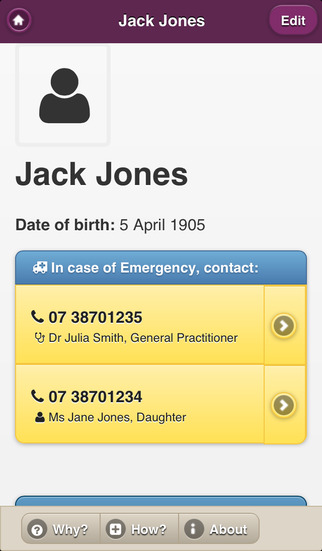
Why the Home Instead Senior Care ‘In Case Of Emergency’ [ICE] App is a real ‘must have’.

  • Permanently records crucial details such as blood type, medical conditions and history, allergies and medications, health funds (if any), where important documents are stored, and more.
  • Lists all important contacts, including GPs, specialists, next of kin, etc.
  • Features advanced automatic dialing capability to all contacts.
  • Multi-user: can record full details for ALL your loved ones
  • Complete with A3 Discussion Prompt sheet to encourage families to record their plans and desires in the event of hospitalisation or sudden illness.
  • Suitable for both iPhone or iPad
  • Totally private – all information is stored on your device

This innovative device is 100% Free… Download it NOW!

in-case-of-emergency-app

in-case-of-emergency-app

Fake Relationship Rorts Targeted by Centrelink

Minister for Human Services Marise PayneHundreds of couples are claiming false marital and relationship status to rort millions of dollars from Centrelink.

In one case a couple claiming to be separated but who were living under the same roof were found to be lying when they announced on Facebook they were expecting a baby.

“Welfare recipients who deliberately fail to declare a new or existing relationship to the Department of Human Services are breaking the law,” Minister for Human Services Marise Payne said.

Last year, 634 people were ordered to pay back $7 million after they were caught falsely declaring their relationship status to get additional payments from Centrelink.

“The consequences of welfare fraud are serious. Sentences can include jail time and people will be forced to repay the benefits they were not entitled to,” Ms Payne said.

Investigators last year conducted 120 investigations into people suspected of being an undeclared member of a couple and 16 were referred to the Commonwealth Director of Public Prosecutions. Half have gone to court.

Rorters are also going online and coaching others on what forms to fill out and what to say in order to claim the extra benefits that go with being separated but living under the same roof.

Tania Sharp was living in the same house with Darren O’Brien, the father of her two youngest children, but was claiming a single parenting payment because she said they were not a de facto couple.

But in January last year she put a message on Facebook saying: “To all of our family and friends … We are expecting a little girl in August. Fingers crossed all goes well xxx — with Darren O’Brien.”

After friends posted their congratulations she wrote: “We had two miscarriages last year so this is the best news. Thanks. we are over the moon!!”

Four months later Centrelink cancelled Ms Sharp’s single parenting payment on the basis they were a couple.

Ms Sharp made several appeals against the decision, arguing the pregnancy was the result of a one-night stand with her ex-partner.

Administrative Appeals Tribunal member Regina Perton said the Facebook messages about the pregnancy “all seem to point to a desired baby that both her parents-to-be were excited about”.

Unlike with their first child, Mr O’Brien also attended the birth of the baby girl.

Ms Perton said Ms Sharp’s claims to be financially independent from Mr O’Brien were also not as clear cut as argued.

“Ms Sharp would not have been living in that property had Mr O’Brien not paid the deposit,” she said. “The tribunal finds Ms Sharp was a member of a couple (when Centrelink cancelled the payment).’’

Related Family Law Judgments

Four Italian girls’ Mother cries Wolf one more time

Four-Italian-girls-and-their-mother

Four Italian sisters with their mother, Laura Kate, in Italy

Oh what a tangled web we weave, when first we practise to deceive!

Perhaps the only one who can accept blame for no longer being believed by anyone is the Australian mother, Laura Kate, at the centre of this sordid affair.

The extent of her deception is by now well known to most, especially after it was revealed in sordid detail in a 60 Minutes special last year.

Well, to re-inforce this point, 60 Minutes did a follow up interview with the two eldest daughters, aired last Sunday.

To which it was clear that there was no sign of any abuse of the daughters, abuse which Laura Kate claimed permeated their whole family, do the degree where the father was alleged to have also sexually abused the girls.

All these allegations were nothing more than convenient lies.

In fact the girls claimed that they were happy, and they felt loved.

In any case Laura Kate, who initiated the resulting international media frenzy by making sordid allegations against the father via the media, and by encouraging the girls to repeat these allegations on video, all of a sudden believes that exposing her daughters to the shear light of the media is not good for them.

Hmm, some would argue of course that perhaps it has more to do with the girls current happy-ness, which only underlines the extent of the mother’s deception.

Laura Kate wrote to 60 MInutes and Channel 9, pleading with them not to air the interview with the girls on national television.

The letter reads:

“Tara,

My lawyers have advised me to contact you with regard to the entertainment piece you propose to air on 60 Minutes as they are unable to represent me in Australia…

I am currently in Italy spending the last few days of some very precious time with my daughters and it was brought to my attention only yesterday that you had interviewed my daughters without my knowledge or consent.

As a mother to a young child, I’m sure you can appreciate my concern over the disrespect to me as their parent and would certainly not allow anyone to approach your child to appear in a tv segment to be shown internationally without your knowledge or consent.

Not only that, the girls were bribed with money and when they said no, offered even more money, which is simply an unconscionable act. How dare anyone!

Perhaps you [believed] I had authorised or consented to the girls being interviewed prior to having my lawyers intervene.

As their parent with active custodial rights I did not consent to the girls being interviewed and I would never consent to them being interviewed, particularly when they’ve only recently spoken to a judge in a pending case about their future.

In addition, both parties have been court ordered to not speak with or make statements to the media as part of previous rulings.

As the commercials started to air yesterday and the hate campaigners came back out in force (many on the 60 Minutes Facebook page – how do you think the girls will feel to read those nasty, hurtful comments?), my daughters told me the truth about what had happened.

The girls were advised … not to tell me that they’d spoken to the media or participated in staged interviews ….

I have spent much of the last 24 hours consoling all four girls ……. They’re distraught and in an extreme state of stress ……….

Contrary to what [you may have been told] he did proceed with criminal charges against me and tried to have my parental rights removed entirely.

What [they] may not have also advised is that we’re still in the middle of custody and divorce proceedings that are still being decided.

Claire and Emily Vincenti, two of the four Italian sisters at the centre of a custody battle talk to 60 Minutes.

Claire and Emily Vincenti, two of the four Italian sisters at the centre of a custody battle talk to 60 Minutes.

Allowing your segment to go ahead is a violation of the court ruling regarding no media involvement and simply adds additional stress to the girls’ lives which is not necessary and extremely hurtful to them as children.

Tara Brown, you and 60 Minutes have already put our family and my children through hell with your previous one-sided, inaccurate story which aired solely for ratings and for the entertainment of people who do not give a damn about my children and their physical or emotional welfare.

I ask that you do not do this again. Perhaps your intent is to fully destroy and discredit me and my family, but I doubt you’ve taken one second to consider how that affects the girls now that they realise they were manipulated and used simply because they’re a good ‘story’.

On behalf of my four daughters, and as a mother who is deeply concerned for how they will cope when I am not there to support them and they are left to their own devices to cope with the fallout from the segment airing, I ask that you show some humanity and compassion, put your ego aside, and leave me, them and our family alone.

It is traumatic enough that the court system has been so slow to rule in each case. Don’t make it worse for the girls because you want to attempt to destroy my reputation once again, because it’s your ‘job’.

Being a good human is a far more important job; one I would hope you’re teaching your son.

Please consider this my formal request to not air the segment you’ve produced involving my daughters.”

Related Family Law Judgments

A Child’s Right to be Heard

children speak upThe welfare of a child is a “paramount consideration” when making any decision that may affect them. This fundamental principle is formalised by the Family Law Act 1957 (‘FLA’), echoing the requirements of the Convention of the Rights of the Child to give children a voice in court, either directly or through a representative.

When directly participating in litigation, children are vulnerable to becoming a weapon of their parents’ disputes, used to achieve one party’s desired outcome.

Even when children act on their own interests, their insight may be limited by their age or maturity.

As a result, Australian courts prohibit children from being present at their parents’ court proceedings unless called upon by a court order.

Instead, their long-term needs are determined and expressed through a medium or representative – commonly a family consultant’s report, expert witness or independent children’s lawyer.

This considers the ‘best interests’ of the child while minimising distress.

Following a court order or individual application, children’s views are captured by ‘family reports’ in 60% of cases.

They are often required where the children are mature enough to express their own wishes or are victims of abuse.

Written by family consultants who must “ascertain” and “include the views of the child”, family reports are the second most referenced documents in judgements.

Therefore, both the child’s current wishes and future needs are articulated, strongly influencing the outcome.

If a family report is insufficient and specialist knowledge is required, experts may be employed to represent the child’s stance.

Either by application or court order, the expert will be selected through mutual agreement of the parties or the court. Restrictions on expert examinations are in place to ensure children are not traumatised by excessive interviewing.

Additionally, assessors may aid the judge’s understanding of expert evidence but are rarely appointed. Other mediums that may complement expert or family reports include “affidavit, video conference, closed circuit television or other electronic communication” as suggested by Family Law Rules 2004.

Although the reports are prepared for trial, they can encourage settlement in the 95% of family disputes that do not go to court.

If early settlement occurs, one can only hope that the warring parents have agreed on an arrangement that respects their child’s needs.

Parenting plans are written agreements about each parents’ responsibilities. This may include the child’s residence, time with each parent, maintenance and contact with others.

The FLAencourages but does not require parents to regard “the best interests of the child as the paramount consideration”. Fortunately a dysfunctional parenting plan can be altered by subsequent agreement.

Further, it has minimal legal value apart from overriding earlier court orders and becoming evidence for later court cases. Only a judge’s parenting orders are legally enforceable.

Overall, family courts have shifted towards a less adversarial approach. The whole procedure is simplified and negotiation-based with discussion guided by judges rather than parties.

At his own motion, the judge can question witnesses and call for evidence. If the judge excessively intervenes with the conduct of counsel and subsequent outcome, the decision can later be overturned.

Contrary to the win-lose mentality generated by an adversarial system, this co-operative model focuses on the child’s welfare.

Amid a complex adult conflict, it is easy for a child’s small voice to be warped or lost. The Family Court of Australia provides a representative network and procedural safeguards that both protect and involve the innocent third party.

Related Family Law Judgments